
 •
Rating:
•
Rating:
THE REVIEW
"The Stones would never have the audacity to release such a horror in Great Britain".
With this ironic comment, Keith Richard welcomes the release of "December's Children", in the last months of 1965. Yet the guitarist's laconic comment still seems exaggerated today. Released only for the US market on the heels of the enormous success of "Out Of Our Heads", at first glance, "December's Children" may appear as a disjointed and contradictory compilation made up of tracks that could seem like a collection of unreleased songs from the aforementioned album. Fortunately, the reality is quite different.
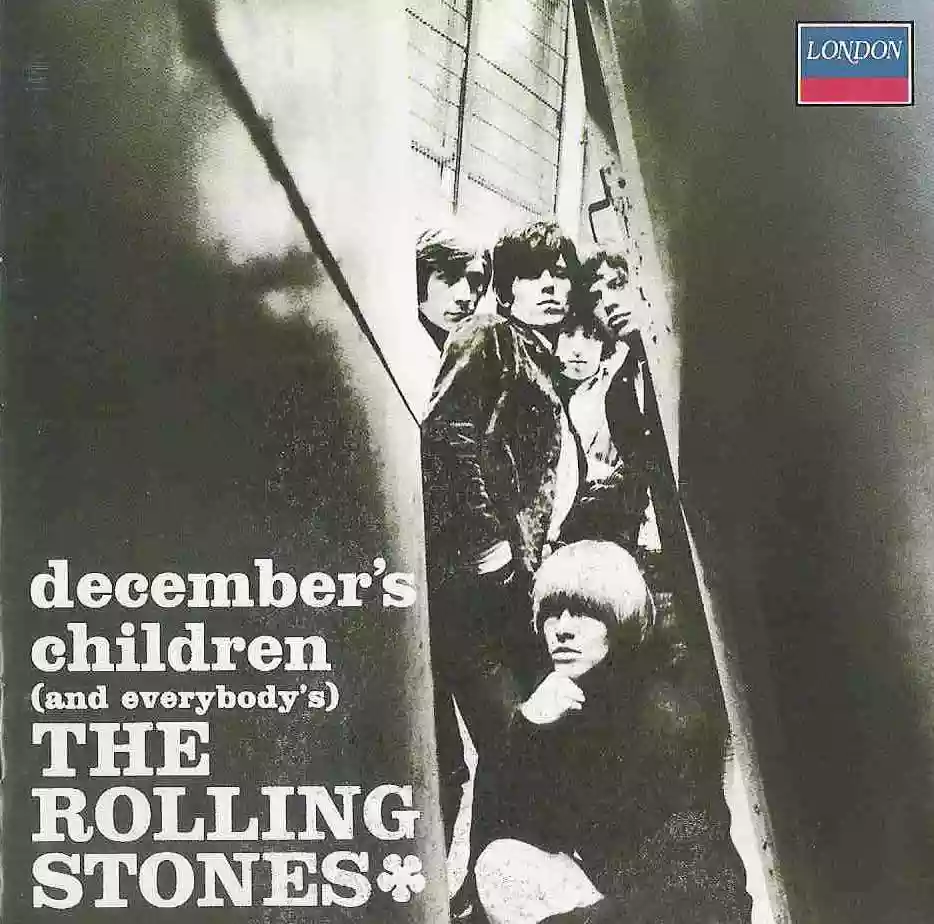
From the wonderful cover photo, which uses the same image as the British edition of "Out Of Our Heads" and features the Rolling Stones in the depths of some seedy street in the States, the album exudes aromas made of chiaroscuro that do not conceal the personalities and musical and cultural intentions of the group. The Stones, on the covers of their early albums, have always placed great importance on iconography, always relying on dark and somber colors. It is also for this reason that "December's Children" proves to be a complete, fascinating, and extremely attractive work.
The Stones know well that rock'n'roll was born and belongs to the street. Its spirit lives there and pulses right from the initial "She Said Yeah", a proto-punk incendiary bomb capable of capturing the total pandemonium of a Stones concert of the era, thanks to a totally unleashed Keith Richard. It is swiftly followed by the very famous "Get Off Of My Cloud", a gracefully vulgar extension of the youthful disorientation already expressed in "Satisfaction" and the live versions of "I'm Moving On", a rather ordinary slide guitar exercise with a touch of harmonica and the explosion of "Route 66" in which the group hits the throttle, making Keith Richard explode into a surprising solo.
The most sexist side of the band comes to the fore through Mick Jagger with the cover of Chuck Berry's "Talkin' About You" to which the Stones change the rhythmic structure, emphasizing the lyrics and making it sensual and explicit. The more accessible side of the group, however, emerges in the pleading simplicity of Arthur Alexander's "You Better Move On", in the moving, sweet, famous "As Tears Go By", originally written for Marianne Faithfull, and in the almost Beatles-like beat ballads "The Singer Not The Song", "Gotta Get Away", and "Blue Turns To Grey".
Of course, the blues roots are evident in the delightful "Look What You Done" and the social cry of the beautiful "I'm Free". "December's Children" is this and much more. The album, in fact, has the great merit of giving the listener a perfect image of the Stones' musical world, made not only of a series of brilliant reinterpretations, riffs, and blues rhythms but also of a new way of perceiving reality by a generation that, at the time, was already struggling to find satisfaction.
Unfortunately, they don't release records like this anymore.
Loading comments slowly
Summary by Bot
December's Children, released in 1965 for the US market, showcases The Rolling Stones' diverse musical talents and deep blues roots. Despite initial impressions of being a compilation, it is an attractive and complete work capturing rock's raw energy. The album features iconic tracks, from the proto-punk 'She Said Yeah' to the sweet ballad 'As Tears Go By.' It perfectly reflects the band's youthful spirit and social commentary of its time.Tracklist Lyrics
01 She Said Yeah (01:33)
03 You Better Move On (02:39)
04 Look What You've Done (02:15)
05 The Singer Not the Song (02:21)
09 As Tears Go By (02:44)
10 Gotta Get Away (02:06)
11 Blue Turns to Grey (02:28)
12 I'm Moving On (02:15)
13 I Just Wanna Make Love to You (Dean Martin intro, Hollywood Palace 64 live) (01:51)
14 Around and Around (Ed Sullivan Show 64 live) (02:35)
15 Time Is on My Side (Ed Sullivan Show 64 live) (02:50)
16 Oh Baby (We Got a Good Thing Goin') (Shindig 65 live) (01:48)
17 Down the Road Apiece (Shindig 65 live) (02:27)
18 Introduction (Big Beat' 65 live) (01:41)
19 Everybody Needs Somebody to Love ¦ Pain in My Heart (Big Beat' 65 live) (02:52)
20 Around and Around (Big Beat' 65 live) (02:23)
21 The Last Time (Big Beat' 65 live) (02:57)
22 Little Red Rooster (Ed Sullivan Show 65 live) (02:36)
23 Everybody Needs Somebody to Love (Ed Sullivan Show 65 live) (02:08)
24 (I Can't Get No) Satisfaction (Ed Sullivan Show 66 live) (02:47)
25 Lady Jane (Ed Sullivan Show 66 live) (02:29)
26 19th Nervous Breakdown (Ed Sullivan Show 66 live) (04:14)
The Rolling Stones
English rock band formed in London in 1962. Key long-term members include Mick Jagger and Keith Richards. Known for blues-influenced rock, enduring live performances and a prolific discography.81 Reviews
