
 •
Rating:
•
Rating:
THE REVIEW
Remember "Outshined", the roaring track by Soundgarden from the "Badmotorfinger" era? Chris Cornell smartly tuned in to the rising wave of Nirvana, finding a metaphor fit for a social communicator like Barack Obama: "I'm looking California and feeling Minnesota". That's the perception people have of the state of Minneapolis in the USA. How can one be surprised, after all? A cold, anodyne city, isolated from the rest of America except for the Mississippi, and sprawling into a vast, ghostly suburbia characterized by anonymous serial houses. Like "American Beauty", just to give an idea.
It tugs at the heartstrings to imagine the teenage Paul Westerberg by the gate of one of these houses, from whose porches hateful, hopeless sunsets are contemplated. Sneaking away quickly to avoid taking out the trash and to meet up with those three outcasts with whom he'll make Minneapolis vibrate with scorching punk and roll: the Stinson brothers and Chris Mars. They're called Impediments, but after being thrown out of a venue for taking the stage completely drunk before a concert, they changed their name to Replacements. Thus begins what has all the hallmarks of a fairy tale.
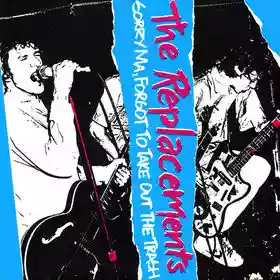
"Sorry Ma, forgot to take out the trash" is the long-awaited debut of the Mats: one of the peaks of American hardcore. We're in 1981, at the dawn of the Reagan era, a decade many kids will navigate clinging to Paul's songs. Despite displaying some understandable naivety typical of debuts, it hosts eighteen generational anthems of unrestrained vitality, compressed by a full-speed delivery and Westerberg's vibrant voice. His writing is already adept at detailing the myriad subterfuges and moods of "teenage angst," rendered with freshness and a happy abundance of imagery and circumstances in genuine slivers like "I'm in trouble", "Raised in the city", "More cigarettes", "Hangin' downtown" or "Don't ask why".
But it is a more nuanced work than it appears on first listen, and it's clear why the group will not remain long trapped in the flourishing city hardcore scene. A misunderstanding always surrounded the early Mats: that they were a hardcore band, or worse, mere followers of fellow Minneapolis band Hüsker Dü. Sure, the "Land Speed Record" band is a declared influence: the acid, supersonic punk of "Something to du" among these grooves is a clear tribute to Mould and Hart. But Ramones and New York Dolls were equally pivotal, as was the hard seventies of Kiss and Black Sabbath that grips Bob Stinson's robust solos. And above all else, Westerberg's ability to blend electric-saturated edges with nascent melodic inclinations in the vein of reclaiming the American singer-songwriter tradition, as in "Love you till Friday", "Shiftless when Idle", and "Johnny's gonna die", is already emerging.
It is precisely these last two tracks that reveal the immense potential of the four vagabonds, whose leader was then 20 years old, with the youngest even just 15. "Shiftless when Idle" erupts with a vehement Byrds-like innocence that renders it a classic power pop, with that tasty na-na-na bridge and a sharp Stinson solo that impresses the searing disdain of the Eighties. And what about the lyrics, which capture the plain philosophy of a youth abandoned to itself: "I ain't got no idols/ I ain't got much taste/ I'm shiftless when I'm idle/ And I got time to waste".
"Johnny's gonna die" is instead a poignant and fierce chronicle of a death foretold for Johnny Thunders, rendered with a soulful blues touch. Westerberg captures with shocking clarity the most tragic of the vicissitudes of show business, alternating vitriolic judgments ("He's got friends without no guts, friends that never ache") with sublime images matured beneath the leaden sky of Minneapolis ("And New York City, I guess it's cool when it's dark/ There's only one way Johnny you can leave your mark, and Johnny's gonna die").
A track that, in hindsight, will sound like a curse for its author. The needle will swallow not only the old Johnny but also Bob Stinson. He, the soul of the band, the good hooligan who had taught his stepbrother Tommy the basics of bass to get him off the streets. Unable to say goodbye to his wild lifestyle with the group now on the doorstep of the glory always dreamed of by Westerberg, and therefore removed. Until in 1995, he will be found lifeless, with a syringe by his side, in a shabby Minneapolis apartment, Minnesota. Rock fables rarely have a happy ending. And if there is one, beware folks: it's almost always fake.
Loading comments slowly
Summary by Bot
The review highlights The Replacements' debut album as a seminal work of American hardcore punk from 1981, capturing the raw energy and teenage angst of its young members. It details influences from the Minneapolis scene and key punk bands while praising Paul Westerberg's budding songwriting skills. The album is portrayed as a heartfelt and nuanced document of youth rebellion. The tragic fate of band members adds a somber layer to their story.Tracklist Lyrics
The Replacements
The Replacements are an American rock band formed in Minneapolis in 1979 by Paul Westerberg, Bob Stinson, Tommy Stinson, and Chris Mars. Evolving from punk roots into melodic alternative rock, they released influential albums including Let It Be (1984), Tim (1985), and Pleased to Meet Me (1987). They disbanded in 1991 and reunited from 2012 to 2015.09 Reviews
