
 •
Rating:
•
Rating:
THE REVIEW
Those who followed cycling feats in the early 90s will certainly remember the melancholic and defiant frown of Gianni Bugno. One of the most dazzling, complete, and inconsistent stars in the recent history of cycling. Someone who, when the road ascended beneath his wheels, "pedaled on velvet", as the late De Zan put it: a two-time winner on Coppi's mountain, Alpe d'Huez (as only Pantani and Armstrong did after him), but who in other long stages managed to reach the finish line with Cipollini and the other sprinters. Someone who won world championships and major classics in sprints with ease, allowing himself the luxury (and the risk) of celebrating 5 meters from the finish line despite his opponents being serpents like Indurain, Jalabert, or Museeuw, but who lost other races to underdogs like Jaermann or Gianetti. A fundamentally romantic hero, a Hector who had the misfortune to cross swords with the unbeatable Achilles of stage races, Miguel Indurain. The inscrutable Navarro, an enigmatic mask hidden under the white Banesto cap and dark Hidalgo sunglasses, who in the climbs would attach an invisible string to Gianni's wheel, only to inevitably thrash him in the time trial and finally allow himself a smile, draped in yellow, on the Champs-Élysées.
For those who love drawing parallels between music and sports, one cannot help but compare Bugno to Paul Westerberg. They share the same cheeky face, the brilliant talent (the ease of Gianni's pedaling and posture in the saddle find a counterpart in the melodic virtuosity of the Replacements' leader), the recklessness with which they managed their talent (Gianni often reckless in reading the race, Paul author of a solo career not up to his achievements), and above all, an unfavorable temporal circumstance for both. For Bugno, it was the Navarre nemesis, for Westerberg it was being overshadowed by Stipe and Mould, coming, moreover, too early to the explosion of indie rock, unable to hop on the "Nevermind" bus as his talent had already been exhausted.
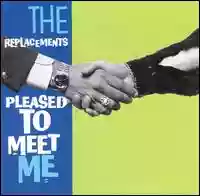
"Pleased to meet me" is among the most precious trophies in Paul Westerberg's showcase. The album created by the factotum after the ousting of Bob Stinson, the final piece in which the path traced by "Hootenanny", "Let it Be", and "Tim" culminates in the mosaic of a mature post-punk, classic and more confident with a fluid and personal writing, much like the contemporary major albums of cousins Hüsker Dü. Thus, we face an eclectic wall of sound of power-pop, eleven shifting shards of adolescent spleen, an authentic gold mine for a generation of alternative rockers in the following decade. The loss of Stinsonian burns on the six-string is mitigated by the production of Jim Dickinson, already behind the console with Big Star: the Memphis native expands the Mats' sound fabric, enriching it with solutions like keyboards or sax (even touching jazz in "Nightime Jilters") that enrich a Westerberg songbook in a state of grace, without losing tension and credibility.
And that the band of "Third/Sister Lovers" is the grey eminence of the Mats in 1987 is evident from the irresistible harmonies of "Alex Chilton": homage to His Majesty of power pop, whose shadow also extends in the r&b pastiche "I Don't Know" and in "Can't Hardly Wait" (watch for the horns!) where the author of "Thirteen" is a guest. Not to mention "Valentine", brightened by the white heat of a delightful organ and a Westerberg never so sensual (Evan Dando must have listened quite a bit). The more traditional Replacements emerge in the stones-like riffs, curare-laden, of the opener "I.O.U.", in the brash clarity of "Never Mind" and in the usual hooligan assaults: "Red Red Wine" and the harsh "Shooting Dirty Pool", the only ones where Bob's absence truly feels noticeable.
And then two shining diamonds in the songbook of the now-former kid from Minnesota. "The Ledge", suffocating anticipation of the existential surges of the 90s. Guitars as dry as whiplashes, the rhythm section pounding and hypnotic, and a Westerberg at the throat's edge painting a slice of teenage angst as sharp as a Gus Van Sant film. And the soft and fatalistic jingle-jangle ballad "Skyway", an ideal conclusion to the "Byrds vs Velvet Underground" triad opened by "Sixteen Blue" and "Unsatisfied" in the masterpiece "Let it be". But back then Stinson was still there to shape its forms with dark and desperate fate. Here Paul is alone - just a thread of mellotron added by Dickinson floats like a celestial vibration - beyond the dark skyline of Minneapolis, where "It don't move at all like a subway/ It's got bums when its cold like any other place/It's warm up inside".
In flight towards the summit, like Gianni Bugno.
Loading comments slowly
Summary by Bot
The review praises 'Pleased To Meet Me' as a mature and confident album by The Replacements after the departure of Bob Stinson. It highlights Paul Westerberg's melodic talent and the enriched sound achieved with producer Jim Dickinson. The album's blend of post-punk, power-pop, and experimental textures is seen as influential for alternative rock. Key tracks like 'Alex Chilton,' 'The Ledge,' and 'Skyway' are singled out for their artistry. The reviewer draws a compelling parallel between Westerberg and cyclist Gianni Bugno, underlining their shared brilliance and challenges.Tracklist Lyrics Videos
The Replacements
The Replacements are an American rock band formed in Minneapolis in 1979 by Paul Westerberg, Bob Stinson, Tommy Stinson, and Chris Mars. Evolving from punk roots into melodic alternative rock, they released influential albums including Let It Be (1984), Tim (1985), and Pleased to Meet Me (1987). They disbanded in 1991 and reunited from 2012 to 2015.09 Reviews
