
 •
Rating:
•
Rating:
THE REVIEW
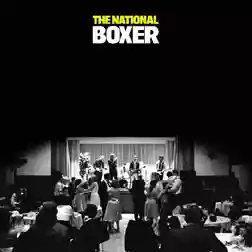
Experiment. Imagine New York on a late summer night, slightly breezy. You can't sleep, you go out for a walk, staring at your shadow cast on the sidewalks by the bank lights. The city is semi-deserted. You're vaguely anxious, yet overall you remain calm. You aspire to a chimerical serenity. Well, you are the alter ego of Matt Berninger, the baritone-voiced singer of Brooklyn's The National, on their fourth album.
"Boxer" is what you experience while wandering through the city: the loves you dream about inside apartments you barely glimpse, the illusions that lead you to stroll towards the manicured metropolitan park, the anxieties projected onto the buildings looming over you. The air tastes like an out-of-fashion cocktail. The sound is dark and elegant, a very soft new wave, with few shades besides black. Berninger's voice is halfway between Paul Banks and Nick Cave: it's deep, warm, yet controlled. The guitars are not intrusive. The bass rarely takes the forefront. Everything is entrusted to the piano, airy keyboards, and a mechanical drum (at times, seemingly semi-electronic), which keeps a precise rhythm to your steps, dry. It's the Joy Division's drum in "Passover", raw.
You pass through the NYC of Interpol. But the subway is not a porno, and the sidewalks are not chaos. It's all more velvety, almost romantic, muffled. Yet a track like "Mistaken For Strangers" the Interpol would gladly steal from their fellow countrymen: for those voids, those breaks that leave the voice bare, then picked up with a lazy and dirty spleen. Only here and in "Apartment Story" can you find a truly Interpol-esque style, with blurred guitars and post-rock echoes, playing on the walls but also in the inlays, more towards I Love You But I've Chosen Darkness. Always remaining in the dark.
The best tracks are marked by the piano (played by Sufjan Stevens in "Ada"). "Fake Empire", piano, drums, and voice crescendo, is simply a great song. At a very high level "Brainy", dreamy and airy, "Squalor Victoria", which feels like elegant empty clubs. The intensity touches drama without falling into it: you can smoke a cigarette with style, disguising the neurosis, keeping the despair under control. You disguise the paranoias. It's hard to fall into Curtis & co's depths: you stay on the brink. The pounding and hard drum fights with a romantically demodé voice.
Berninger's lyrics are detached, disconnected, like the asphalt you're treading. They amass surreal images and prosaic scenes. Here too is Banks' visionary style, made more cynical, Houellebecqian. So in "Slow Show", closer to American rock, with strings reinforced by an accordion and horns: "Can I get a minute of not being nervous and not thinking of my dick?". Then a sentimental note: "You know I dreamed about you for twenty-nine years before I saw you". Drunk swings. You see her in the faces of the few passersby.
"Green Gloves" and "Guest Room" are the other gems, built on dizzying interweaves of keyboards and guitars. But none of the twelve tracks falters. At times, it feels like hearing Nick Cave in "The Boatman's Call", that of "(Are You) The One That I've Been Waiting For?", on tiptoes, torn but present to himself. So in the final "Gospel".
Stop walking. The city is indie and romantic. Its chaos is muted. You look around better: you haven't moved a meter. But your heart is pounding in your ears.
Loading comments slowly
Summary by Bot
The National's Boxer immerses listeners in a dark, elegant indie soundscape reminiscent of a late summer night in New York City. Matt Berninger's deep baritone guides atmospheric, piano-driven tracks full of subtle new wave influences. The album balances emotional intensity with controlled restraint, drawing comparisons to bands like Interpol and Nick Cave. Standout songs like 'Fake Empire' and 'Mistaken For Strangers' showcase rich instrumentation and poetic lyrics. Overall, Boxer offers a cinematic and introspective musical journey.Tracklist Lyrics Videos
The National
The National are an American rock band known for Matt Berninger’s baritone vocals, literary lyrics, and dark, elegant indie-rock arrangements that often draw comparisons to post-punk/new wave aesthetics.11 Reviews
Other reviews
By cangaceiro
Each composition is a painting that, despite a certain homogeneity of approach, succeeds in leading us to different shores.
The sweet and delicate 'Gospel' is impossible to forget, offering emotions and sensations beyond any possible critical analysis.
