
 •
Rating:
•
Rating:
THE REVIEW
December 1968, the third and final album for that year, sees the release of "Cruising With Ruben And The Jets", a sort of return to the roots for Frank Zappa and The Mothers Of Invention. The group tackles doo-wop music, a genre that was very popular in the '50s, which Frank Zappa and his friend Captain Beefheart often listened to during that time. Doo-wop is a genre born in Italian-American neighborhoods, often sweet and romantic with a characteristic singing style spiced with verses that mimic music.
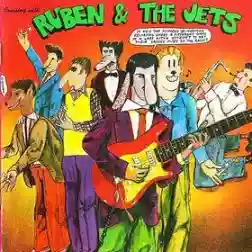
Our group therefore immerses themselves in this imaginary musical ensemble with a typically '50s name, Ruben & the Jets as noted on the whimsical cover designed by Cal Schenkel and on the back cover, where Zappa is portrayed in a period photo, under the guise of his Italian-American alter ego Ruben Sano, with a parodic biography titled "The Story Of Ruben & The Jets".
More than an actual doo-wop album, in reality, it's a parody (Zappa and parodies? how strange!) but at the same time a tribute to the genre, making it a semi-serious album, more so than the previous ones anyway. The difference between this work and the other masterpieces published by Zappa with the first ensemble of The Mothers of Invention is substantial to say the least: the usual depth of parody is missing, the irreverence in the lyrics and humor is missing, less sharp and politically incorrect than usual. There are no "forbidden" or taboo topics in the eyes of the American public. In short, grasping the humor of this parody may not be the easiest thing on this record.
The songs are all original and written by Zappa (except Deseri, Anything, and Jelly Roll Gum Drop written by the great vocalist Ray Collins), and some are taken from "Freak Out!" (I recall You Didn't Try To Call Me, Anyway The Wind Blows rather than I'm Not Satisfied) and rearranged in a doo-wop key, which makes them nothing short of whiny. Obviously, there's a splash of genius here too: Fountain of Love, where he even mixes in Stravinsky with chord changes and references in the finale to his "Rite of Spring". In 1984, the bass and drum parts were re-recorded, causing quite a bit of criticism, as Zappa was not satisfied with the sound on the original master tapes. Zappa also added many vocal parts and completely remixed the entire album.
The origin of the vocal matrix of the early Zappa and co.'s albums is well-documented in this record, making it a piece of certain interest, at least from this point of view. However, the public did not receive the album with the usual favor, except for a small group of '50s nostalgics (remember Sha Na Na?): a few years later, a band led by a certain Ruben Guevara asked Frank Zappa for permission to call themselves Ruben And The Jets, in honor of the album reviewed here.
Though it is a undoubtedly bold work, I must personally admit that this album didn't appeal to me much; I've always considered it the weak point of The Mothers Of Invention's discography: it is too average to belong to that grand cauldron of ideas typical of Frank Zappa. This album is suitable for those who perhaps adore '50s music, but certainly not for die-hard fans of Frank Zappa and his distinctive style.
Loading comments slowly
Summary by Bot
Cruising With Ruben & The Jets is Frank Zappa and The Mothers Of Invention's 1968 doo-wop homage, blending parody with tribute. While musically well-crafted, this album is less irreverent and politically sharp than Zappa's usual work. Despite its bold concept and clever nods to 1950s culture, it received mixed reviews and remains a lesser favorite among Zappa fans. The 1984 remix stirred further debate, but the album's roots reveal key aspects of early Zappa vocal style.Tracklist Lyrics Videos
The Mothers of Invention
The Mothers of Invention were an American avant-rock group formed in Los Angeles in 1964 under the leadership of Frank Zappa. Renowned for satire, studio experimentation, and fearless genre splicing, they released landmark albums including Freak Out! (1966), Absolutely Free (1967), We’re Only in It for the Money (1968), and Uncle Meat (1969).05 Reviews
