
 •
Rating:
•
Rating:
THE REVIEW
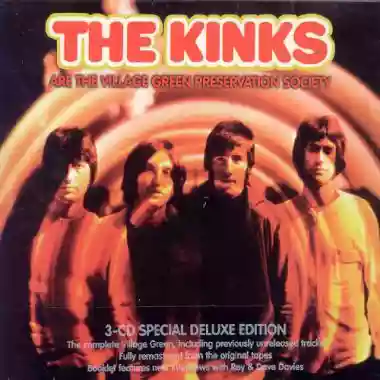
The laws that determine an artist's worldwide popularity (if laws they can be called, has anyone ever discovered them?) are quite strange, distributing everything to some and mere crumbs to many others who deserve more. For example, speaking of the period when this album was released (the 1960s, the record is from 1968), on one side we have the Beatles and the Rolling Stones who (rightly so, of course) are extremely famous, the Who are also very well-known, but on the other hand, the Kinks are just those of "You Really Got Me". But no, the Kinks are not just the ones who invented one of the first hard riffs in history. They are also the ones who took social/sociological commentary so seriously that they made more than one concept album about it, and they are also the ones who, in the pop/rock sphere, bring back the music hall tradition along with various other peripheral genres.
Thus, The Village Green Preservation Society speaks to us of the dream of Old England, the England of green fields, tidy houses, the England of Utopia. It speaks especially of people who still believe in that dream when it has been clearly swept away by the industrial revolution and modern lifestyle. People now ridiculous: "We are the Village Green Preservation Society, God save Donald Duck, Vaudeville and Variety, We are the Desperate Dan Appreciation Society God save strawberry jam and all the different varieties..." (from the song "Village Green Preservation Society"). People like Walter: "Walter, remember when the world was young And all the girls knew Walter's name Walter, isn't it a shame the way our little world has changed? Do you remember, Walter, playing cricket in the thunder and the rain?" (from "Do You Remember Walter"). Before them, no one had dedicated two songs to the noble art of memory photographs, which we all take, to confirm that we exist ("Picture Book", "People Take Pictures of Each Other").
Ray Davies's pen is often sharp and cynical in creating amusing portraits of anachronistic people. Yet he himself seems to melancholically confess the regret for this lost Arcadia, a regret that seems to be in the genes of every true Englishman. We see it in the excellent "Village Green" where the portrait of this village with the little church appears, almost a dream figure, a village now lost even though it still exists because the Americans come to take photographs: "And now all the houses Are rare antiquities. American tourists flock to see the village green. They snap their photographs and say 'Gawd darn it, Isn't it a pretty scene?'..." How penetrating, modern and accurate are these observations in a world devastated by mass tourism and inauthenticity? And in the chorus, the declaration of love: "I miss the village green, And all the simple people. I miss the village green, The church, the clock, the steeple. I miss the morning dew, fresh air and Sunday school".
And musically the album is remarkable. It would suffice to mention just "Starstruck", a masterful pop piece that works so delicately on the tones and is incisive at the same time. And it is a varied work, from the carefree pop blues of "Last of The Steam Powered Train" to the almost calypso of "Monica". The Kinks are a fundamental group in the history of music, particularly English music, of course. They have influenced many bands, they were among the inventors of Britpop understood in its broadest sense, that is, music composed with a specifically and typically English sensibility. Ray Davies is one of the most gifted lyricists and a great author of unforgettable songs and melodies.
It's time to rediscover them, isn't it?
Loading comments slowly
Summary by Bot
The Kinks' 1968 album 'The Village Green Preservation Society' beautifully captures a nostalgic vision of Old England through sharp, often cynical yet affectionate lyrical portraits. Musically rich and varied, it blends pop, blues, and music hall traditions. Despite not enjoying the widespread fame of contemporaries like The Beatles, The Kinks remain influential pioneers of English pop and rock, especially with Ray Davies' gifted songwriting. This album is a timeless classic deserving rediscovery.Tracklist Lyrics Videos
The Kinks
The Kinks were an English rock band formed in London in the early 1960s, closely associated with the British Invasion. Their songwriting is strongly identified with Ray Davies’ character-driven narratives and social observation, alongside Dave Davies’ guitar-driven early sound.15 Reviews
Other reviews
By luludia
For Ray, the project was imbued with a therapeutic intent — Dave Davies
I retreated into my small, simple world of little shops and black and white English films; perhaps it was my form of psychedelia — Ray Davies
