
 •
Rating:
•
Rating:
THE REVIEW
Warning: this review talks about Side A and Side B, as such it is clearly based on listening to a vinyl record.
The Kinks have given us many little pop gems and Ray Davies was a genius. Period.
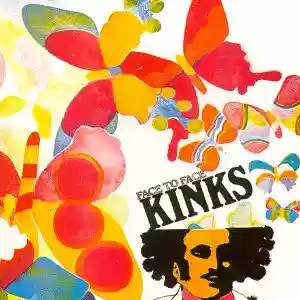
"Face to Face" is a fantastic record. Another period.
It came out in 1966, after precisely 30 beautiful years it still moves like a bullet. There must be a reason. And the reason is that this LP is the first exhibition of class, substance, and concreteness by the Kinks, an album that shows they can do many things and do them well. Listen to the opener "Party Line", a triumphant, irresistible, energetic track that has lost none of its original freshness. The whole first side is an alternating array of different genres returned rigorously to kinkssound, made organic by Davies' unifying genius. And almost every song is a triumph: from the cartoonish and ironic pop of "Dandy" to the beautiful melancholy of "Too Much on My Mind" passing through the self-referential rock of "Session Man", the soberly epic "Rainy Day in June" and once again the joyful pop of "House in the Country" (how much did Ray Davies teach his student Damon Albarn about houses in the countryside and beyond)? An irresistible sequence, a show of admirable skill.
After a first side so rich with beautiful songs, a slight drop in tension on Side B is natural, which nonetheless still starts with a bang with the rock of "Holiday in Waikiki" (which by the way has an irresistible riff). It's the stylistic hallmark of the album, which then consists of an alternation of contrasting emotions, from the overwhelming joy of "Holiday..." to the melancholic dreaminess of "Fancy". And yet, the second side contains another extraordinary masterpiece by the Kinks: "Sunny Afternoon" which like the best songs by the Kinks encapsulates so much in so little time!
"Face To Face" is the first masterpiece by the Kinks, the one where Ray Davies begins to reveal his ironic and melancholic vision of the world, a sort of mapping of British society and beyond. The early garage rock makes room for nuances, for delicate shades, although in "Face to Face" Davies' art excludes nothing of the recent past, preferring to proceed by addition, enriching the sound and compositional solutions. This makes "Face to Face" also one of the most enjoyable, entertaining, and immediate albums by the Kinks. Go get it.
Loading comments slowly
Summary by Bot
Face To Face by The Kinks, released in 1966, is praised as their first true masterpiece showcasing Ray Davies' genius songwriting. The album blends diverse genres with witty and melancholic themes, remaining fresh and relevant decades later. Highlights include energetic tracks like 'Party Line' and the classic 'Sunny Afternoon.' Overall, it is lauded for its musical richness, emotional depth, and enduring appeal.Tracklist Lyrics Videos
The Kinks
The Kinks were an English rock band formed in London in the early 1960s, closely associated with the British Invasion. Their songwriting is strongly identified with Ray Davies’ character-driven narratives and social observation, alongside Dave Davies’ guitar-driven early sound.15 Reviews
Other reviews
By jefko
"Face To Face is their 'Rubber Soul': a departure from early rock towards originality and experimentation."
"The Kinks appear stylistically clear, sober, and without the desire to overdo; every element serves the song, never the opposite."
