
 •
Rating:
•
Rating:
THE REVIEW
Marianne
Your lack of sympathy cannot disturb me.
Imagine leaving the weary city behind and heading off into a leaden Sheffield drenched in the 80’s, wearing only shorts and a t-shirt printed with that handsome Alan Vega face, those inseparable Koss HV/X headphones—glacial companions of cold alienation—on your head.
It’s cyberpunk before its time; its genesis is the Holiday ‘80 EP, that lucid dream directly transplanted into the marrow of the beautiful replicant Marianne, a real acid temporal portal with a view onto synthetic rituals of frozen shores that transport you to the throbbing heart of the synthpop revolution. The Human League, still in their original line-up—Philip Oakey, Martyn Ware, Ian Craig Marsh and Adrian Wright—are those techno-pop bonzes from a constellation of ideas and a sound laboratory where visual art, conceptual provocation, and analog technology are fused together.
Released in May 1980, it’s the last breath of the original line-up—Oakey, Ware, Marsh and Wright—before the great split that would create those two galaxies: Heaven 17 and the new chart-topping Human League.
“The Black Hit of Space” is as if Roy Batty is singing his farewell to the stars: the first contact, the alien signal picked up by an abandoned satellite, an imploding loop, a sonic virus corrupting a vacuum reality, primordial Atari sound trapped inside a hit that becomes too big for the terrestrial universe.
Then “Only After Dark”—the night becomes a black liquid flowing through circuits, it’s the moment of crazy, replicant love, the wild dance of love between software and reality, those synths cold caresses, the voice a whisper lost among antennas, that slow dance of two beings with no soul but who feel everything.
“Life Kills” is the awakening. The replicant discovers pain, routine, the prison of flesh; the words are blades, the sounds are cages. The factory where dreams are born and illusions die. It’s the moment you realize that even machines can suffer.
And then “Dreams of Leaving,” the masterpiece. A cyberpunk novel in the form of a song. A boy dreams of escaping from a school that’s a prison, from a city that’s a labyrinth. But escape is just another illusion; the synths create mental landscapes, electric deserts, highways leading to nowhere. He’s the Blade Runner dashing through the rain, chased by his own thoughts.
And “WXJL Tonight” is the end. A radio broadcasts from a world that no longer exists. The voice is that of a DJ who doesn’t know she’s dead, the sounds are echoes, ghosts, fragments. It’s the moment when the replicant powers down, but leaves behind a dream.
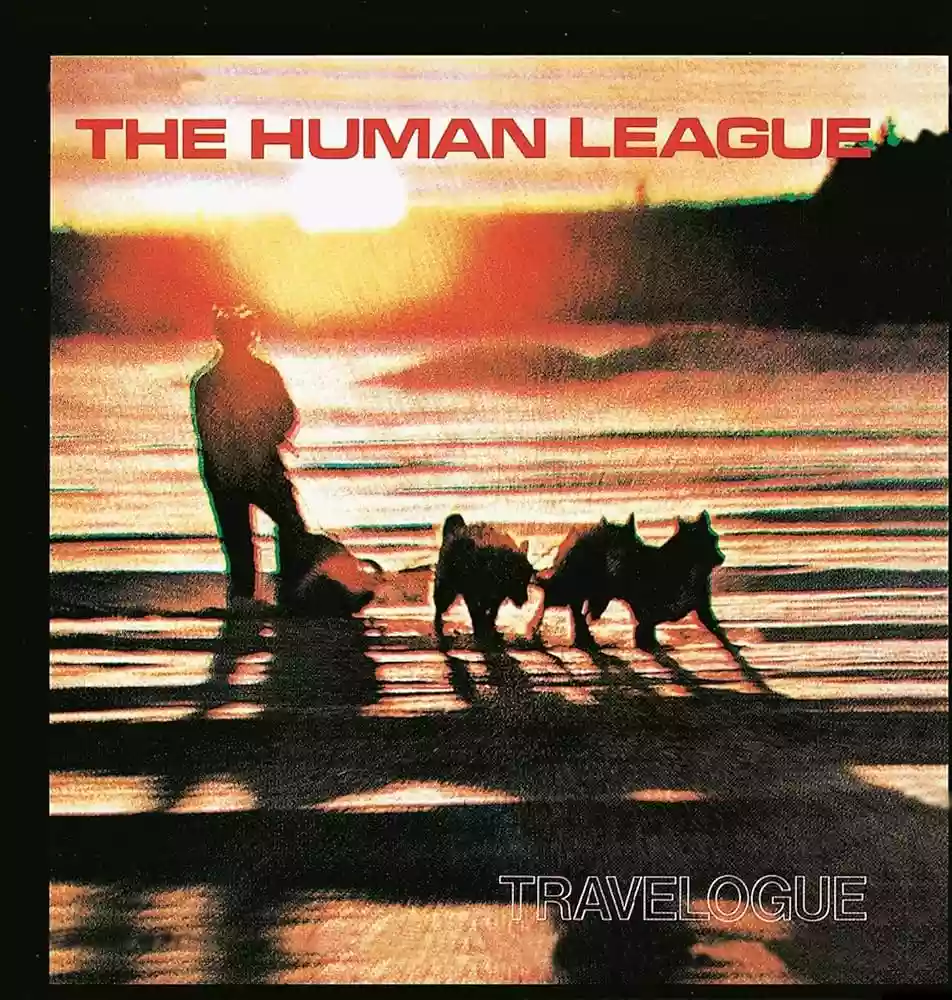
The cover is a deception. A natural landscape, dogs, a man. But it’s all fake. It’s the memory of a world that never existed. It’s nostalgia for something you never lived.
Travelogue is synthetic poetry. It’s the Blade Runner you’ve never seen, the diary of an artificial soul that has learned to dream, the sound of a tear falling on a circuit.
It is the future that has already forgotten us.
While there’s still time, grab those Koss HV/X and dive into listening.
And run, while there’s still time.
Loading comments slowly
Summary by Bot
This review praises The Human League's 'Travelogue,' highlighting its influence and innovation in the synthpop genre. The album receives top marks for its electronic soundscapes and forward-thinking production. Readers are encouraged to revisit this pivotal work in electronic music. The review emphasizes both nostalgia and musical excellence. It's a must-listen for anyone curious about the roots of synth-driven pop.Tracklist Lyrics Videos
The Human League
The Human League are a British synth-pop group formed in Sheffield in 1977. After early experimental records (Reproduction, Travelogue), they achieved worldwide success with Dare (1981) and the No.1 single “Don’t You Want Me”. Following a 1980 split that led Martyn Ware and Ian Craig Marsh to form Heaven 17, Philip Oakey steered the band into a pioneering pop era with vocalists Joanne Catherall and Susan Ann Sulley, continuing a long career with hits like “Human” and “Tell Me When.”05 Reviews
Other reviews
By Mike76
It is, in fact, a work that is neither fish nor fowl, neither experimental nor pop, but a confused middle ground.
A few valid episodes are not enough to save such an unconvincing album.
