
 •
Rating:
•
Rating:
THE REVIEW
Could it be a lack of self-esteem? No, Mark E. Smith is someone who plays his existential role well. And artistic. In all his impudent rants. Whether it's about social protest, politics, or recounting one of his obsessions.
The frequent changes in line-up, no less than those of wives, reinforce the image of a despot.
The sound of The Fall is dark, skewed, aggressive, syncopated, hallucinatory, schizophrenic.
The references are Captain Beefheart, Velvet Underground, and Can (Mark Edward will even sing “I Am Damo Suzuki”). And from Brit-Punk they make quintessential Post Punk. Yet everything is eccentrically Smithian. In a sense, they deal with intellectual violence. With the leader's uneducated and caustic voice, half singing and half speaking or ranting, always the same, always different. Relying on the expressionism of the verses, clearly hermetic. Expletives, statements, latent melancholy, over-the-top sing-songs, streams of consciousness where any logic is inconstant, unstable, and ultimately superfluous. A bit of irritation, a bit of decadence. That's the basic recipe.
Since the late '90s, Cog Sinister has flooded the market with concert releases and compilations. Sure, this “Live on Air in Melburne” from 1982, published in 1998, captures them in a state of grace, in a glorious season. Indeed, after the honorable debut, “Live at the Witch Trials,” a truly remarkable studio triptych followed: “Dragnet,” “Grotesque,” and “Hexen Enduction Hour.”
If the audio quality of the open-air concert in Melbourne isn't among the worst and at least holds its own against “Still” by Joy Division, and the lo-fi attitude suits it anyway, it should be remembered how The Fall's Live Acts were really disconcerting at the time due to the constant presence of unpublished material, the result of hysterical pregnancies and, to an unknown extent, spontaneous.
The bass is the most indelible mark of time. The drum is either driving or barely invasive. The guitar is bristly and cumbersome, overloaded with feedback. The keyboards are minimalistic. Smith's non-singing is enriched with onomatopoeic lines, sociopathic nuances, muffled thoughts (as if imprisoned in the mind, but screaming), with sneering and pathological irony.
The double CD highlights the fogs and whims of “I Feel Voxish,” “Marquis Cha Cha,” “Hip Priest,” and the manifesto “Totally Wired.”
But then there is this song: “Hard Life in the Country,” which will be officially recorded in “Room to Live: Undilutable Slang Truth,” released only in 1985.
If I say a post-punk band, I immediately think of Joy Division. It's mathematical logic. And if I think of just one post-punk song? It's “Hard life In The Country.”
Sound that is gloomy, dark, tending towards dormancy but remains pitch-black. Or rather, it shows an opening, but then hides it. Immediately. It rises, towards life... with a jolt. Yearning to grant itself an existence and, perhaps, happiness. Then it plummets. That incredible, pulsating bass retreats in a spiral, performs concentric circles; a back-and-forth of waves rippling on a stagnant water surface. They return to themselves. A cyclical journey that prolongs, intoxicating like the images lifted from the composition's words. For seven minutes... Nothing happens, you stagger, you fall, you stand still.
The bass riff of Marc Riley drags all this movement with it. Dictates, punctuates. The drum of Paul Hanley is sporadic, only hinted at. The guitar of Arthur Kadmon, co-author of the track, explores an impossible harmony, slicing through in the overflow of feedback.
Perfect, wonderful, stunning.
An emotional push that's quite evocative.
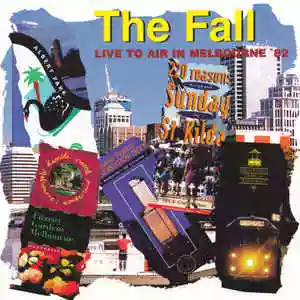
Having mentioned the horrible cover, obtained from snippets of Australian posters, and noting that “The Fall” connotes fall-ocracy (it fits within Mark E. Smith's poetic arsenal) and fall-acy (which it actually doesn't), let's remember how much the self-esteem of the Manchester band has grown thanks to John Peel. Thirty-two sessions! More than anyone else. He said: «They continue to be the standard by which all other bands must be judged!»
I tried to translate “Hard life In The Country”:
It’s hard living in the country
In the present state of things
Your body falls backward
You desperately need to drink
At three in the afternoon
People withdraw the stick
The local police lift your nose
And the leather soles remain glued to the stone paving
It’s hard living in the country
In a most delicate circle
With “new romantic” nymphets arriving from the hills
It’s somewhat depressing
The local newspaper screams scandal, drunk
It even publishes your address
Local people surround your house
Old ladies confiscate your gate and fence grille
To promote government campaigns
It’s tough in the homeland
Municipal boards dispute the boundary
D. Bowie’s lookalike enlarges the car parks
Grab the churches when you can
Toilets, yellow cabins from Methodist doors
New car parks in New Jersey
strewn about by the usual D. Bowie lookalike
It’s nice living in the country
You can reach true thought
Go around, look around and see the geometric design
The little cloak of porcupines pinned around the soles of your leather shoes
Fall drunken on the road
It’s nice living in the country
See yourself as a man
The valley’s road rings crossed by ice cream vans
It’s nice living in the country
Your leather soles stick to the prefabricated paving
Small American town centers look like the outskirts of your country
The villagers
Are surrounding your house
The local police have come to do their duty
It’s hard living in the country.
Loading comments slowly
Summary by Bot
The review highlights The Fall’s distinctive dark and aggressive post-punk sound, emphasizing Mark E. Smith’s unique vocal presence and artistic persona. The live 1982 Melbourne recording captures a pivotal moment showcasing both spontaneous and intense performance qualities. Special attention is given to key tracks such as 'Hard Life in the Country,' noted for its emotional depth and iconic bassline. The album, despite lo-fi audio, holds up well against other seminal post-punk live recordings.Tracklist Lyrics
The Fall
The Fall were an English post-punk band formed in 1976, strongly identified with vocalist and main lyricist Mark E. Smith, known for constant line-up changes and a repetitive, abrasive, minimalist sound.15 Reviews
