
 •
Rating:
•
Rating: THE REVIEW
"This is the end, beautiful friend. This is the end my only friend..."
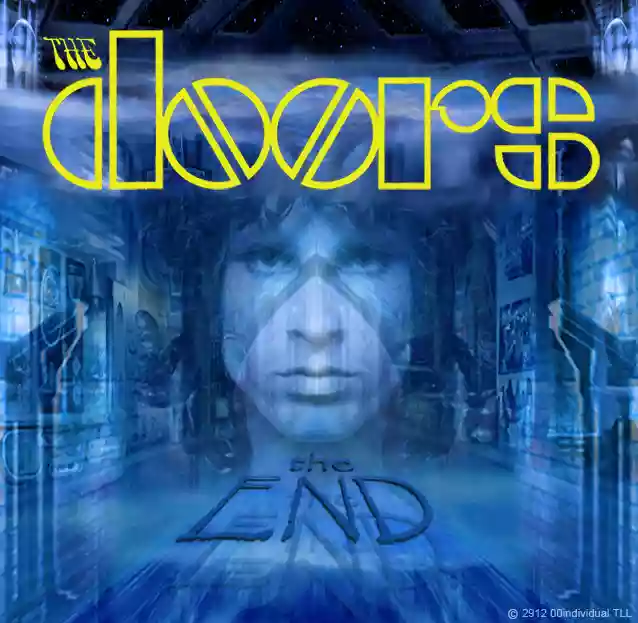
Born as a farewell song to a beloved girl, "The End," written by Jim Morrison, was one of the tracks that the Doors in 1966, still at the beginning of their career, played in clubs around Los Angeles. The Californian band started playing at the Whisky A Go Go in May 1966, a newly opened venue led by Elmer Valentine, a great businessman. During the summer of that year, the Doors grew musically thanks to their regular performances: they played twice a night, attracting young people in search of innovative music. The group's fame was initially due mainly to Ray Manzarek's skillful keyboard playing: Jim Morrison at first sang with his back to the audience, as he was shy and introverted, but over time he would learn to impose himself theatrically on stage. Morrison's vulgarity irritated the club owner, but as long as the cash register kept ringing, he could overlook it. The Doors drew more and more people, and the Whisky A Go Go gained fame. They played alongside more renowned and mature groups such as Van Morrison's Them and Love: this further helped build the reputation of Jim & company. Jim Morrison was the new sex symbol of the Sunset Strip, the neighborhood where the Whisky was located; everyone in the scene was saying that the Doors were the new great revelation. Everyone was talking about them, but they were without a contract. They continued to work at the Whisky, waiting for a decent offer to come. When Jim started being interviewed by newspapers a few months after the summer of 1966, he already expressed nostalgia for the period of regular performances at the Whisky, especially for the creative impulse that had come from it for the band. August 1966: Jac Holzman, president of Elektra Records, attended the Doors' performances. At first, he was dissatisfied and found nothing special in the Californian band, but when he heard "Alabama Song," he was so impressed that he offered the Doors a contract of $5,000 guaranteed for three albums, a 5% royalty, and 25% of Elektra's music publishing: many called Holzman crazy, but time would prove otherwise. After months of long reflection, the band would finally sign with Elektra in November 1966.
Jim Morrison looked up "Elektra" in a mythology book loaned to him by a friend and became aware of the "Electra complex" and, after further research, the "Oedipus complex." He was so fascinated by it that he began working on a hypothetical song inspired by it. "The End" is a masterpiece of extreme artistry, it has magnificent, orgasmic musicality, flawless psychedelia, no flaws, no imperfections, the best psychedelic track ever according to me, followed by "Interstellar Overdrive" by Syd Barrett's Pink Floyd. When Robby Krieger starts with that Spanish-accented guitar riff and mysterious atmosphere, my brain is entranced by the notes. But when Jim's voice comes in, my brain is completely tuned to the song. Eleven minutes of ecstasy, with the omnipresent keyboards of the virtuoso Ray Manzarek, a musical talent beyond imitation.
"The End" is an epic, a masterpiece of art in its purest form, a succession of orgasms, sensuality, and harshness. The Oedipal section is crazy, extremely out there, something that makes me swoon. When the track closes with Jim's whispered and weary "This is the end," and Densmore on drums moves to the cymbal, the ecstasy gradually fades away.
Loading comments slowly
Summary by Bot
This review delves into The Doors' iconic track 'The End,' highlighting its origins as a farewell song and its evolution into a psychedelic masterpiece. Describing the band’s early days at Whisky A Go Go, it emphasizes the musical brilliance of Ray Manzarek and Robby Krieger alongside Jim Morrison’s poetic and theatrical presence. The reviewer praises the song’s flawless psychedelic atmosphere and artistic intensity, especially the Oedipal section. Overall, 'The End' is celebrated as an epic, sensual, and groundbreaking work in rock history.Tracklist Lyrics
The Doors
American rock band formed in Los Angeles in 1965. Core members: Jim Morrison (vocals), Ray Manzarek (keyboards), Robby Krieger (guitar), John Densmore (drums). Known for a distinctive organ-led sound, theatrical live shows and landmark albums (The Doors, Strange Days, L.A. Woman).64 Reviews
