
 •
Rating:
•
Rating:
THE REVIEW
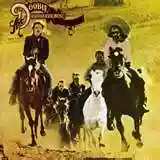
The fifth album by the Doobies, from 1975, sounds quite different from the previous four, despite the fact that the producer remains the same, that Ted Templeman who, after making a fortune with them, would make just as much and even more with Van Halen in the late seventies and eighties.
What's new? Two things mainly: the first is the addition of a third guitarist alongside the two leaders, singers, and composers Tom Johnston and Pat Simmons: Jeff Baxter, for some reason nicknamed Skunk (rascal), is a skilled and virtuosic musician who, having lost his job with Steely Dan who intended to continue as a duo without performing concerts, saw fit to join our guys, initially collaborating on the previous two records and then convincing them to take him on full-time. Jeff's style and musical ideas, technically at the highest level and with phrasing more intricate and unpredictable than his colleagues, more jazzy in fact, enrich the kaleidoscope of guitar moods available to the band.
The second novelty is the string and/or horn arrangements, present on seven of the eleven songs on the tracklist, an evident reflection of an attempt to enrich the irresistible rhythmic punch and the contagious commercial appeal of choruses and refrains, giving them a more refined, more generalist, even more cunning environment. One of the arrangements is even handled by Curtis Mayfield, a great in rhythm&blues, certainly among the favorites of these six Californians dedicated to a rock full of soul and sunny funk.
The result of this is indeed a richer, more thought-out, more mature and pretentious album, but also less spontaneous, less fresh, less radiant and charming. Not by much, of course, but it's noticeable, and I personally preferred them before, rawer and with fewer people around making music with them, even if they are all big names like Ry Cooder, Bill Payne...
The record opens and closes with two rock'n'roll tracks, titled "Sweet Maxine" and "Double Dealin' For Flusher," both written by Simmons who, in this release, swaps roles with Johnston: his sweeter vocal timbre and his superb acoustic guitar technique up to that point had cast him as the man for ballads, country rock, the acoustic side of the band. Instead, on "Stampede," it's Pat who steps on the gas and raises his voice more. Apart from the two aforementioned episodes, this is particularly pertinent to the torrential "Neal's Fandango," a matter of one-hundred-seventy beats per minute that first fires a frenetic and breathless lyric, really difficult to sing, and then introduces a whirlwind of instrumental solos crisscrossing or harmonized among the three guitarists.
The album's historically most successful track is, however, the only cover present: "Rock Me in Your Arms" is a piece of sixties rhythm&blues (created by the usual Motown songwriting and production trio, Holland/Dozier/Holland), energized by the phenomenal punch of Johnston's rhythm guitar and carried to glory by mighty gospel choruses full diaphragm; a true invitation to sing and shake your butt, something that promptly happens when the band performs it in concert. Any American knows it, precisely in this version by the Doobie Brothers, which surpasses its previous interpreters Kim Weston, Isley Brothers, and Jermaine Jackson.
My favorite, however, is "Rainy Day Crossroads Blues," driven in its first part by Tom Johnston's fantastic right hand, striking the acoustic instrument with rare power and compactness, transforming it into a rhythm forge even more effective than an electric. Jeff Baxter supports it with a dobro played with a slide thimble, and everything seems to resolve into an acoustic blues shuffle, but after two minutes the song comes to a stop, the rhythm unfolds, and an orchestral carpet comes to meet the instruments at play, expanding the atmosphere into a lazy, sly western soundtrack for a wavering and swollen instrumental coda, maximally antithetical to the initial dry, rootsy blues. Only boundless class can allow for such disparate visions in the same composition: lavish praise to the producer, but even more to the arranger Nick De Caro, brought into work for the occasion.
The same De Caro tries to repeat the trick in the album's most ambitious track "I Cheat The Hangman," but this time the outcome turns out a bit cloying. The premises change, in fact, they are reversed: the tempo is slow in the initial part, sung by the author Simmons, then starting to run in the long instrumental coda. Pat narrates a sad story inspired by reading a novel, about the ghost of a dead Civil War soldier returning to his homeland unaware that he is no longer alive... until a sea of strings envelops everything, begins to support the moans of brass, synthesizers, guitars and drags everything beyond six minutes, for a performance of suggestive but sugar-coated American progressive rock.
Simmons redeems himself greatly in his instrumental "Slack Key Soquel Rag," a high-class fingerpicking performance. It's just him, with two different acoustic guitars, one for each stereo channel, intersecting and completing each other in magnificent arabesques, full of resonances and perfect harmonies. Not even two minutes for this true show of strength by the pyrotechnic musician, all alone to amaze with a real gem particularly appreciable for guitar players. No problem anyway for its live performance: Pat is accompanied by the current third guitarist of the group John McFee (another panic-inducing player) and the performance is always perfect, identical to the original.
The last episode to mention is the radiant country rock ballad "Texas Lullaby," with Johnston celebrating the beauties of rustic life in the open air, accompanying himself with a calm electric guitar delightfully effected with the vibrato of a Fender amp that makes it float, just like a lullaby as the title suggests, even more accented by the sweet and knowledgeable long notes of Baxter's Steel Guitar.
Loading comments slowly
Summary by Bot
Stampede, the Doobie Brothers' fifth album from 1975, marks a shift towards a richer and more mature sound. The addition of guitarist Jeff Baxter brings jazzy complexity, while string and horn arrangements add sophistication. Though less raw than earlier work, the album delivers powerful rock, blues, and country influences. Highlights include the energetic cover 'Rock Me in Your Arms' and the acoustic blues gem 'Rainy Day Crossroads Blues.' The album balances commercial appeal with musical ambition.Tracklist Lyrics Videos
The Doobie Brothers
The Doobie Brothers are an American rock band formed in San Jose, California, in 1970. Anchored by Tom Johnston and Patrick Simmons, they bridged gritty California rock and harmony-rich country-funk before shifting toward sleek blue‑eyed soul with Michael McDonald in the late 1970s. Their hits include Listen to the Music, Long Train Runnin', China Grove, Black Water, Takin' It to the Streets, and the Grammy‑winning What a Fool Believes.07 Reviews
