
 •
Rating:
•
Rating:
THE REVIEW
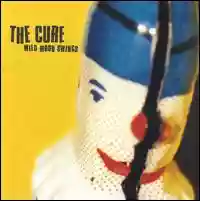
In retrospect, with the usual temporal distances that enhance the ability to focus on previously less relevant aspects, it is now clear that a controversial work cannot be discussed from the extreme empathic/enthusiastic or absolutely negative perspectives. Even the (more or less) controversial "Wild Mood Swings" does not escape this basic rule, now observable with greater transparency. Let me clarify two crucial points right away:
1. The Cure of '96 are not the Oasis of "Morning Glory," nor the Pumpkins of "Gish." I say this because, with this album, the English band reaches their 12th album of original work and almost 18 years of career (and as Easy Cure they easily surpass the twenty mark): the criteria of judgment for a work include specific criteria and universal parameters: the temporal and biographical context is indispensable, unlike the two cited (excellent) bands, they are not newcomers, the talent of Robert Smith and his musicians has long stood the test of time, and this should be the starting point for a more serene evaluation.
2. We are not talking about a cult band for a few enthusiasts, but a group with stellar success, and this album has already been judged by the public as "the worst" of their career. However, for once, public and critics are partly discordant, as the latter has expressed two different lines of judgment: outright rejection on one side or greater appreciation of innovative and at times original elements on the other.
It must also be clear that the hypnospheric writer certainly does not fit into the aforementioned category of Paper Magazines (NME, Spin, Melody Maker...) or Virtual Journals (OndaRock, Beat Concrete); he does not have the qualification (nor will he ever have it, for DeBaser's fortune). But I find it necessary, now that the collection of B-sides "Join The Dots" has been published (for those who did not purchase the singles), in addition to the obvious comment on the record, to create a sort of "critical meta-analysis," that is, to grasp the neuralgic points of these musics through a critical comparison between various positions.
First of all, regarding the first single "The 13th", quickly judged by many as "the worst single of their career," I want to quote the words of the excellent reviewer Alberto Campo (Rumore, Musica! - Repubblica, Stereodrome):
it is easy to shoot down The Cure, an activity many indulge in more for intellectual inertia or habitual habit, but it must be recognized that <The 13th>, the lead single of the new album is a clear little pop gem: Tijuana Brass trumpets, skewed piano, and Robert Smith's usual lovable/detestable falsetto, which evoke the remote memory of "Caterpillar".Opinions... but it is certain that in his analysis the journalist captures truly interesting aspects. This allows us to introduce a more general discussion on the album:
- it was released four years after "Wish," a "guitar-driven," spatial, and liquid album, stylistically homogeneous and developed along a fascinating atmospheric gradient, in a sense almost an alter-ego of the predecessor "Disintegration," instead based on the splendid and imaginative ethereal suggestions created by the keyboards.
- unlike the two mentioned works, this one seems almost "schizophrenically" heterogeneous in terms of style, and the production of individual tracks, each entrusted to a different author for mixing, including the notable Adrian Sherwood (working on "Strange Attraction") seems to negatively accentuate this impression; furthermore, although it is "officially" referred to as "most colourful album" followed by a new world tour, this is not enough to quell the perplexities aroused by an album that is both bizarrely eclectic and of oscillating quality.
- the "difficult circumstances that have surrounded its genesis" mentioned in the booklet are another negative element: a certainly troubled context, on one hand, the success achieved much later than colleagues Depeche Mode and U2 (who were already filling 80,000-seat arenas by the mid-'80s) has surely "unlocked" a new creative phase for Robert Smith, on the other, the shuttle between recording studios, mixing, mastering, and the court for the dissolution of Lawrence "Lol" Tolhurst and the legal case for song rights has certainly not benefited the general atmosphere.
The result is that this collection of new songs is, due to its discontinuity, difficult to encapsulate in a definition, hard to find parallels with previous works.
The beginning is good and bodes well for the entire album: "Want", echoing "To Wish Impossible Things" and "... The Deep Green Sea," cadenced, powerful, and absolutely convincing, seems (and perhaps is) a true outtake from "Wish," the song that most resembles the hypnotic cadences and more dilated and psychedelic atmospheres of the previous album. The subsequent "Club America", on the other hand, is in absolute the most resounding and distorted episode of the entire album: still psychedelia but of a different imprint, the model of inspiration seems to be the The Jesus And Mary Chain of "Psychocandy"; but it is with the third "This Is a Lie", literally paralyzing when listened to (as happened to me) first, as an example of "the new Cure album" for the emotional impact with something absolutely unusual for the Crawley band: chansonnerie almost reminiscent of Jacques Brel, constructed with a splendid harmonic intertwining of acoustic guitars and strings, which curiously rests on a barely perceptible electronic rhythmic carpet, it literally gives chills, excites with an intensity rarely achieved, also because it is without a doubt the most atypical Cure song in the entire repertoire: unthinkable that Smith & Co could have written a similar piece during the time of "The Head On The Door" or perhaps "Pornography," now it is possible, and the surprise aroused by such a jewel of rare neoclassical beauty should serve to understand the evolution that Cure's music has undergone in these years.
Parallelisms that are difficult but not impossible to talk about: "Numb", wrapped in soft and subtle psychedelic guitar spirals along with the mentioned "The 13th" harks back to the definitely more bewildering eclecticism of "The Top," while "Jupiter Crash", gently subtle and lingering, on one hand, similarly to "Want" continues in stylistic and poetic continuity with the previous work, on the other shifts the point of comparison to another eclectic album, the majestic, double "Kiss album" from 1987, an ambitious attempt to synthesize rock experimentalism, psychedelia, and "colourful" pop. In the same vein are "Return", "Trap", and "Strange Attraction", another flirt with certain "naive" electronic and exotic jazz-funk. Where, as noted, "Gone!" seems to be a hybrid between "The Lovecats" and "The Walk," the rest of the album flows as a wavering but ultimately pleasant "filler."
The creative fluidity that characterizes this period of Robert Smith, documented by the high number of B-sides composed, almost all of remarkable quality if not superior to the tracks chosen for the album, was mentioned. First of all, the stunning "It Used To Be Me," included in the version for Asia and the South Pacific, and the first B-side of "The 13th.": percussive, psychedelic, slippery, inlaid with a guitar.... provides an example of Robert Smith's vocal mastery and melodic talent. "Adonais," more elusive and rhythmic, moves within similar coordinates, "Ocean" (yet another B-side of the first single) is a tender and intense melancholic and autobiographical ballad, contemplative and suggestive. "Home," the B-side of "Mint Car" begins with a broad rhythmic and guitar partition then suddenly changes rhythm and seems like an updated version of "Inbetween Days."
In conclusion, it makes one wonder, if this album had been released in a "double disc" version or with a different selection of tracks, perhaps the overall cut would have been different, and the public and critical assessments possibly closer. But nonetheless, for the exquisite pieces included in the album, within a context at times less convincing, I can safely say that the Cure have not at all lost their talent, perhaps they should channel it into works structured in a more organized way and with less confused architecture, like the previous work, without falling into the probable temptation of a remake of a second, impossible "Kiss" album.
"As we grow older, we become a bit wiser and a bit more foolish, at the same time".
La Rochelle Faucault
Loading comments slowly
Summary by Bot
Wild Mood Swings, The Cure's 12th album, divides opinion due to its stylistic heterogeneity and uneven quality. While some tracks impress with originality and emotional depth, others feel like filler. The troubled production context and varied mixing add to its fragmented feel. Despite mixed reactions, the album reflects Robert Smith's ongoing creative evolution and contains standout moments, especially among its B-sides. Overall, it is a challenging but intriguing work within The Cure's discography.
The Cure
The Cure are an English rock band formed in Crawley and led by singer-songwriter Robert Smith. Since the late 1970s they have moved between post-punk, gothic atmospheres and pop-oriented experiments, producing widely admired albums such as Disintegration and Pornography.89 Reviews
Other reviews
By Mike76
"Wild Mood Swings is the most despised album by all Cure fans and the least regarded by critics."
"If you listen to the CD, program it to skip track number nine."
