
 •
Rating:
•
Rating:
THE REVIEW
The first live album by The Cure deserves a moment of reflection. I saw it just the other day prominently displayed among the offers (…) of a supermarket where I was shopping, and immediately the memory of the LP, now worn out like a frisbee from my teenage years, came back to me, resting in peace somewhere among my records. The album in question is dated 1984, which places us in the thick of a band’s productive era, where in the decade '80 - '89 they gifted us seven studio albums. "Concert / The Cure Live" was released after "The Top", in the same year.
Why delve deeper into the only existing review of this disc? The reviewer who took care of this live album in 2006 did a good job, creating a text that entices and communicates the importance of this work without too much fuss. You could thus integrate (if you wish) the two reviews and read one for some insight on the tracks and this one for, hopefully, an enjoyable analysis of the impact of this release.
I saw The Cure live in recent, and hence paradoxically late, times. But I realized that the intensity of their stage shows is indeed a strength of the English band. If they achieve great results today, just imagine what they must have been like back then. This is the primary reason for my perfect score of 5. At the time, they were staging the dehydrated and dried-out carcass of punk, painting a fiery and arid canvas with noisy shades. A simple and dark rock, unadorned, giving the sensation of being exposed to a deadly sirocco that allows no appeal. The conceptual classification of this Concert as a musical pamphlet that includes the tenets of death rock comes naturally to me. But that would be too little.
Another element that emerges vividly from these performances, recorded between London and Oxford still in 1984, is the presence of a pronounced psychotic factor with sounds that evoke psychedelic frames and therefore do not truly carry out a dreamlike function but embed themselves in the slow motion of a self-revisitation through dreams. This music is, in fact, the precursor to the sounds of bands like Portishead and Massive Attack. Finally, there’s the transversal soul of this thrilling and overflowing live work: the rock. Preceded, in whatever form you perceive it, always by the root "post-". The dark wave of that era is logically the most objective reference, but even this, in the proliferation of emotions and sensations of identification, would incredibly say too little. For a good critical listening, one must contextualize and imagine being there in those years, with all that entails. One needs to have the foundations of '80s gothic rock to provide a comprehensive evaluation of the Concert.
You will thus find yourself before a wholly personal dark interpretation, where My Bloody Valentine, Joy Division, Sisters Of Mercy, and even Lycia coexist in a synthesis, reduction, and personality operation that only the creative genius of Robert Smith & co. could orchestrate. A significant reductio ad unum, as it becomes the soil of sounds that push forward and become more contemporary and new. Although belonging to the first half of the '80s, this could very well be a '90s album given how fresh and new The Cure's live offering is. The hard rock is dissected to take only the useful parts like in a university anatomy lesson. Punk lies on the ground, and all that remains is the last gaze on the genre’s slain world, a view practically overturned and vertical, where the soul falls, leaving only the skeleton. Gothic rock travels between ethereal psychedelia and the scorching, living reality of a genre condemned to darkness.
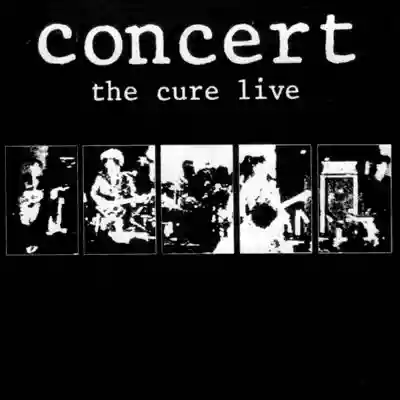
The fans present must have been thrilled with the performance, marking each track with evident appreciation and sometimes participating in the singing. The tracklist is really well thought out. It invites purchase already on its own: "Shake Dog Shake", "Primary", "Charlotte Sometimes", "The Hanging Garden", "Give Me It", "The Walk", "One Hundred Years", "A Forest", "10:15 Saturday Night" and "Killing an Arab" are smart choices among indispensable classics and unexpected pieces. Overall, the best daguerreotype that could be taken of the band at the time. The cover artwork is dominated by black, leaving little room for white. Burned photos reduced to these two colors stand out in the rectangles on the front. On the back, within the area of the same rectangles, the names of the musicians. A minimalism that well expresses the spirit of a band nonetheless overflowing with macabre creativity.
Drop by the supermarket to see if there are any copies left.
Loading comments slowly
Summary by Bot
This review reflects on The Cure's first live album, released in 1984, highlighting its intense stage presence and gothic rock roots. The album blends punk's remnants with psychedelic and post-punk elements, influencing later genres. The thoughtfully selected tracklist presents a strong representation of the band’s sound during their peak creative era. The reviewer praises its iconic status and timeless freshness, recommending it to fans of 80s gothic and dark wave music.Tracklist Lyrics
The Cure
The Cure are an English rock band formed in Crawley and led by singer-songwriter Robert Smith. Since the late 1970s they have moved between post-punk, gothic atmospheres and pop-oriented experiments, producing widely admired albums such as Disintegration and Pornography.89 Reviews
Other reviews
By domo
An eclectic, sparkling, colorful album, but at the same time melancholic, rarefied, mysterious...
The apotheosis of this live performance is reached with track number 8... 'A Forest,' the perfect example of Dark-Wave, inimitable, unattainable, exciting.
