
 •
Rating:
•
Rating:
THE REVIEW
The year is 1981, the album is "Faith": the dark opus of The Cure.
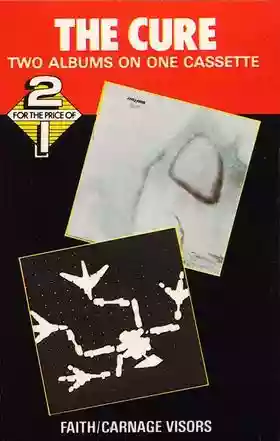
The cassette version, and only that one, contains a surprise on side B. The shout on the cover promises "2 albums for the price of 1": on one side the usual tracklist of Robert Smith and company's funereal masterpiece, on the other a terrifying instrumental nightmare of about 27 minutes: "Carnage visors", indeed. Placed in the most unlikely spot of all, extremely difficult to find for years when cassettes began their slow decline, the best-hidden diamond in the band's history remained so until 2005, the year of the reissue of "Faith" in deluxe CD version with all possible special contents, including this one.
It is the soundtrack of a black-and-white short film that opened the live concerts of the "Picture tour" of 1981: "Faith" had just been released and the atmosphere that permeated it would transform that tour into an emotional journey for The Cure themselves: Smith (as much as one can trust him...) declared that they almost always left the stage in tears.
"Carnage visors" is the perfect introduction to those leaden concerts, and a sort of minimal distillate of that sense of death that impregnated "Faith".
The difference is mainly chromatic: if the actual album is mostly black, with flashes of white light showing cadaveric shadows and non-Euclidean perspectives worthy of "The Cabinet of Dr. Caligari", the soundtrack that complements it is the apotheosis of gray.
Gray is the color of fog, of granite, of lead. In gray one gets lost, swirls, we abandon connections with the world. Gray is damp, cold, viscous but never arrogant.
Color of tombstones and sheet metal, without the blinding certainty of other colors.
More than a color, it is an essence, a state of mind... an uncertain place.
Gray is the color of doubt. A reassuring blanket of ancient dust under which to hide and be lulled by unresolved questions, to be devoured by nothingness with gratitude, to finally erase the noise... because gray soundproofs, it is the low fog of the Po Delta that transforms voices and laughter into spectral trails of faraway life.
Listening to "Carnage visors" is like slowly sliding down an inclined plane, into the fog. You know that reaching the bottom of the gray will probably devastate you, that something much worse awaits at the bottom, but you can't help but get closer and closer.
You repeat to yourself continuously, as in the most famous scene from "La Haine": "So far so good, so far so good"... until you turn the cassette and the death knells of the sacred hour begin.
Loading comments slowly
Summary by Bot
Carnage Visors is a rare and haunting 27-minute instrumental hidden on the cassette release of The Cure's 1981 album 'Faith'. Serving as a haunting soundtrack to their Picture tour, it complements the dark themes of the album with a foggy, gray atmosphere of uncertainty and doom. Reissued in 2005, this piece is a minimal, emotional distillate of the band's mood during that era. It represents an evocative, mesmerizing listening experience.Tracklist Lyrics Videos
The Cure
The Cure are an English rock band formed in Crawley and led by singer-songwriter Robert Smith. Since the late 1970s they have moved between post-punk, gothic atmospheres and pop-oriented experiments, producing widely admired albums such as Disintegration and Pornography.89 Reviews
