 •
Rating:
•
Rating:
THE REVIEW
"Boys Don't Cry" represents the American alter-ego of "Three Imaginary Boys", the first album by the group from Crawley, Sussex. Robert Smith and company (Michael Dempsey on bass, Lol Tolhurst on drums) were not at all satisfied with the tracklist of the latter, thus, taking advantage of the publication in America of the aforementioned debut, they took the opportunity to make some changes. First of all, obviously the name. New tracks are added, others omitted. Among others, the famous "Killing an Arab" appears here, which will lead to accusations against the group of being anti-Islamic (nothing more ridiculous, as the reference is to Camus' existentialism and his "The Stranger").
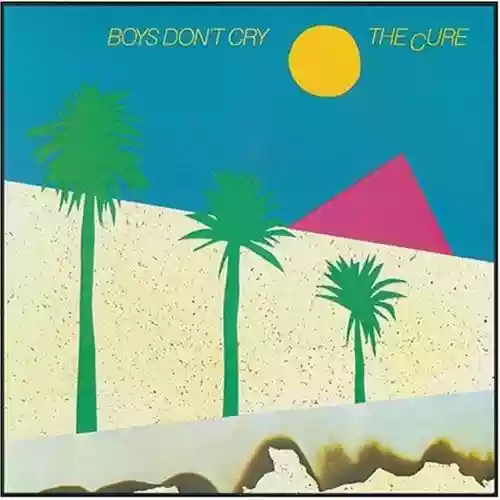
The cover reflects the mood of the album, a geometric and desert-like landscape, with a prominent sun, which with its "Camusian" power numbs the senses. It begins with "Boys Don't Cry", and the title track itself will remain the most well-known song by The Cure, with its catchy melody propelled by a danceable rhythm, an undisputed must in any pop-orientated nightclub. However, it is not the chorus, original but not so spectacular after all, that hits the mark, but rather the lyrics, permeated by an adolescent poetry as "romantic" as it is spontaneous. The classic text to dedicate to a loved one.
"Plastic Passion" is classic post-punk. The rhythm is syncopated and fast, with most of the attention reserved for Smith's guitar, which sounds fresh, new, to the ear. He is known for being attributed with great compositional qualities, lyrically speaking, but his approach to the instrument, decidedly personal and innovative, is often overlooked, destined over the years to evolve, especially in the psychedelic field (see Wish, The Top...).
"10. 15 Saturday Night" also leverages the pains of love, and suggests to us the sweet vision of the "Loser" waiting for his beloved’s call, sitting on the sink, in an endless wait marked by the hammering, continuous dripping. The small guitar touches at the beginning of the piece are precisely the transmigration of the small and annoying drops (another of Smith's inventions). "Accuracy" introduces the exotic component of the album, with repeated echoes of Arabic music, or rather "Arabesque," with its cadenced and transcendent gait.
"Jumping Someone Else's Train", as the title suggests, is a railway dance, with excellent work by Dempsey, this time as the protagonist. The subsequent "Subway Song" is difficult to analyze, seemingly a tasteless joke at first glance; the pace is velvety, imperceptible until absolute silence. The silence, however, is broken by a chilling scream, representing the epilogue of the "little story" narrated by Smith, concerning a night-time stalking. "Killing an Arab", with its desert melody (ingeniously rendered in the video, shot in a desolate, but frozen, rather than sunlit place as one might expect) is a candidate for the masterpiece of the album; Smith sings in a dry and detached tone, as a devout disciple of "Camus," on a fantastic, distant, dizzy, and dreamlike soundscape. Guitar and bass outdo themselves this time, especially the latter, with an absolutely memorable riff.
"Fire in Cairo" remains on the same level, whose misfortune is not being able to rely on the surprise effect of the aforementioned, as it was published some time earlier. The outline is always "Arabic," however, the content is about eros, unrestrained and indeed "fiery." Smith's future frustrations and melancholies emerge painfully with the gray, yet beautiful, "Another Day", the triumph of adolescent existentialism. Boredom, a sense of uselessness, stagnation:
"I stare at the window"Grinding Halt", with its exuberance, is almost annoying, and we can hypothesize that the reason for including it now is precisely this... after all, our guys are still youngsters, and despite an uncommon depth, the punky temptation to shock is great. The cutting edge of the album is a possible anticipation of the future "Seventeen Seconds".
Stare at the window
Waiting for the day to go
Winter in water colours
Shades of grey"
"Three Imaginary Boys" is a dark and rarefied lament. The singing and music are stretched out and remote, and it is precisely this rendering that definitively cuts off the, albeit very young, post-punk roots, which had already been questioned in "Another Day" . The track is a classic sad jewel, like many more that the tormented and moody mind of Smith will still offer us. Unlike a more manneristic torment, such as in "Pornography" but especially in "Disintegration" (two fantastic albums, but which respectively exceed in catastrophism and self-pity, in my opinion), here the discomfort is as spontaneous as it can be, as only that of a young person can be.
The heart of the album is therefore the handover from adolescence (aware, but carefree and not without vigor, as testified by the majority of the tracks, oriented towards post-punk), to a phase of life that is reflective, dedicated to introversion, disillusionment, and more adult concerns. The path that each of us has had to, or will have to undertake, interpreted with freshness, originality, awareness, and 20th-century existentialism. This is "Boys Don't Cry".
Loading comments slowly
Summary by Bot
The review highlights The Cure's Boys Don’t Cry as an American reworking of their debut album, enriched with additional tracks and refined themes. It praises the blend of post-punk energy with adolescent poetry and existential reflection inspired by Camus. Standout songs like "Boys Don’t Cry" and "Killing an Arab" are discussed, emphasizing innovative guitar work and emotional depth. The album is framed as a transitional piece capturing youthful vigor and maturing introspection.Tracklist Lyrics Videos
The Cure
The Cure are an English rock band formed in Crawley and led by singer-songwriter Robert Smith. Since the late 1970s they have moved between post-punk, gothic atmospheres and pop-oriented experiments, producing widely admired albums such as Disintegration and Pornography.89 Reviews
Other reviews
By Kurtd
Boys don’t cry, the opening of the album, who hasn’t played this track for a girl, all the girls when they hear it nod their heads from left to right.
After a night of troubles, the real fun is found on your own.
