
 •
Rating:
•
Rating:
THE REVIEW
On May 4, 1979, in London, Margaret Thatcher crossed the threshold at number 10 Downing Street.
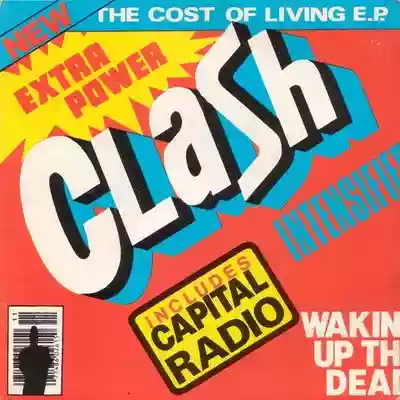
On May 11, 1979, the Clash released the ep «The Cost Of Living», whose cover originally was supposed to feature the face of the Prime Minister topped with a swastika...
More than in «Give'em Enough Rope», the evolution from the aware and uncompromising punk of the beginnings to the all-encompassing rock'n'roll of «London Calling» finds its full meaning in this kaleidoscope of notes that goes by the name «The Cost Of Living».
History tells of how the early punksters, in a fury worthy of much greater causes, made public boasts of destroying the copy of the ep and «London Calling», giving rise to the nascent anarcho-punk movement to pour fuel on the fire with the dull rhythm of the slogan «They say we're trash: well, the name is Crass, not Clash».
Frustrated and frustrating reaction from those who see Joe Strummer, Mick Jones, Paul Simonon, and Nick Headon as the last lifeline to cling to in order to keep the illusion alive that punk isn't dead: and even if there have been hints with «Julie's Been Working For The Drug Squad» and «Stay Free», the Clash still firmly hold their position on the barricade with «Safe European Home», «English Civil War», and «Tommy Gun».
But sterile invectives like «I'm So Bored With The U.S.A.», torn clothes, grimaces, grins, and disheveled hair are clichés now disdained by the foursome.
Four like the tracks of the ep, for a total duration just under a quarter of an hour, but that quarter of an hour carries the weight of eternity: because if «London Calling» is now unanimously recognized as one of the fundamental albums of the rock'n'roll saga, the artistic and historical value of «The Cost Of Living» is equal.
This is unmistakably evidenced by the initial cover of «I Fought The Law», a song written by Sonny Curtis in 1960 and brought to success by the Bobby Fuller Four in 1966; yet, from May 11, 1979, there is no one on the face of the earth who attributes its authorship to anyone other than the Clash. It's true that, in the Rolling Stone magazine's list of the 500 greatest rock songs, the version by the Bobby Fuller Four appears; but I'd bet if it weren't for the Clash's version, Rolling Stone wouldn't even have been aware of the song's existence.
The only precedent for such an event can be found in Jimi Hendrix's rendition of «Hey Joe». That's enough to understand that we are facing an epochal record, without a hint of rhetoric.
However, it becomes certain that times have changed only in the final «Capital Radio», a song already released in an ep of April 1977 reserved for New Musical Express readers, and here re-proposed to put an end to the speculations linked to the dizzying prices reached by the elusive artifact. It's all in the intro: a few seconds, enough to suggest to the rebels without a cause to look elsewhere for a pretext to set fire. Afterwards, the Clash unleash hell, but those first 20 seconds have a symbolic value incomparable to the following 3 minutes.
Also because, if Nero set fire to Rome for nine days, the Clash cannot burn London for two years.
Punk is dead, or perhaps it never existed, as an image/imaginary, but the Clash already know this. Many haven't noticed, busy as they are tarnishing them for having sold out to CBS or destroying copies of «The Cost Of Living» or «London Calling»; just as they don't notice the premonitions in «White Man In Hammersmith Palais»: «Punk rockers in the UK / They won't notice anyway / They're all too busy fighting / For a good place under the lighting / The new groups are not concerned / With what there is to be learned / They got Burton suits, ah you think it's funny / Turning rebellion into money».
Punk is dead, but the Clash are the North Star for anyone who understands punk not as a stereotype but as social consciousness: with «I Fought The Law» they remind us what it means to be punk, with «Capital Radio» they show us what it means to play punk.
And then, between «I Fought The Law» and «Capital Radio Two», «London Calling» takes form in embryo.
«Groovy Times» and «Gates Of The West» do the job, the microphones of Joe and Mick serve as a megaphone for any Eastside Jimmy and Southside Sue looking for new dreams, on board a subway car along the line from the London suburb of Camden Town reaching, with no intermediate stops, somewhere between 44th and 8th Avenue in New York.
Punk is dead, times have changed, and the Clash, to avoid drowning, have kept swimming, and have come a long way, to become the greatest rock'n'roll band on the face of the planet, just like the Rolling Stones did ten years earlier as they looked out on the world from the doorstep of «Let It Bleed».
All of this is «The Cost Of Living», for those who still believe that a record can change a life.
Loading comments slowly
Summary by Bot
The Clash's EP 'The Cost Of Living' captures the band's transition from raw punk to a broader rock sound, reflecting social consciousness and political tension in 1979. The EP features emblematic tracks like 'I Fought The Law' and 'Capital Radio' that helped cement the Clash's status as punk icons. Despite punk's decline, the band remained influential, embodying true punk spirit beyond clichés. This EP is seen as a key stepping stone leading to the legendary 'London Calling' album.
The Clash
English punk rock band formed in London in 1976. Core lineup included Joe Strummer, Mick Jones, Paul Simonon and Topper Headon. Influential for blending punk with reggae, rockabilly, funk and early rap; disbanded mid-1980s.35 Reviews
