
 •
Rating:
•
Rating:
THE REVIEW
On the return of the magnificent Saturday, the car's tape prepared for the occasion days before plays the Clash: "London Calling," "The Magnificent Seven," "Straight to Hell," "I’m Not DowN," "Janie Jones," "Know Your Rights," "Tommy Gun" - Delirium! How can a band make its way through numerous musical styles without any problems?
The word goes to the Clash, the supergroup of Joe Strummer, voice and guitar, Mick Jones, voice and guitar, Paul Simonon, voice and bass destructor, and Topper Headon, drums. One of the best bands the goddess Music has created: capacity, creativity, inventiveness, energy, ideas, avant-garde. After their successful self-titled debut, released in two versions, raw and unripe as a result of Punk fury with the fight anthems "White Riot," "London's Burning," and the first hint of reggae influences ("Police and Thieves"), the Clash ended 1978 with "Give ‘Em Enough Rope," considered by many a transitional album, but in my opinion a great leap forward, as indeed the subsequent albums will be until "Sandinista!," because "Combat Rock" will be slightly a small step back. A homogeneous album in its 36 minutes, which adds some classics to the English band's success tracklist.
It opens with "Safe European Home," and continues relentlessly without a moment of peace with "English Civil War," the story of Johnny's return home in an apocalyptic civil war backdrop, and then the famous "Tommy Gun," that is, what drives a man to shoot, opened and interspersed by Headon's continuous drum rolls. Next comes the fun rock and roll of "Julie’s In the Drug Squad," the sad discovery of a spy within the highs of a group of young friends. The first side closes with the description of the chaos among the gangs of London and its surroundings, brawls, fights, beatings that the "Last Gang of Town" people so love. If punk characterized the first tracks of the album, now a style close to more classic rock, simple, with small, rare, and truly inspired solos by Jones, emerges, which has in its lyrics the overwhelming force of life lived amid gang fights, shootings, notorious suburbs, violence. But what is punk in the end? An attitude of living one's vital condition, not exactly a musical genre... The Clash borrow the riff from the Who (the only 60s band respected in the punk world) of "I can’t explain" for "Guns on the Roof" (great Jones in the final solo!), this time weapons in the foreground, made to shoot, instill terror, and take away freedom. You have to turn up the volume to savor the charge of "Drug-Stabbing Time" (complete with sax!), with Headon's drums starring in the last 2 minutes. "Stay Free" (sung by Mick) and "Cheapskate" are stories of misery, precarious conditions, fear of bosses who follow you, tough years in prison, pastimes among friends. The album closes with the jewel "All Young Punks," the birth of a band, friendship, and the optimism of living punk (All you young punks laugh it up ‘cause there ain't much to cry for, all you sissies live it up now ‘cause there ain't much to die for), without the underlying nihilism of the Sex Pistols ("no future"), but with the awareness that even in a not-so-happy condition, by fighting, you can achieve everything. Perhaps the masterpiece of the entire album, remarkable in the music and intertwining of Joe and Mick.
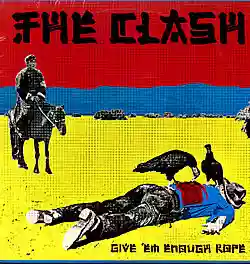
Give ‘em Enough Rope with its colorful and militant cover on the back, an altogether fun, easy and young album, harnesses the use of rock, the classic one, is perfected and refined to reach a technique that will lead the band the following year to compose the double and evergreen "London Calling" and in '80 the mammoth and diverse triple "Sandinista!," mixing various genres, which perhaps have nothing to do with each other but only with the Clash will manage to have an underlying logic together. Great, perhaps the greatest!
Loading comments slowly
Summary by Bot
The review praises 'Give 'Em Enough Rope' as a major evolution from The Clash’s first album, blending punk energy with classic rock elements. It highlights the band's creativity, musical experimentation, and socially charged lyrics. Key tracks such as 'Tommy Gun' and 'All Young Punks' exemplify the album's power and optimism. The album is seen as paving the way toward future classics like 'London Calling' and 'Sandinista!'. Overall, it’s regarded as a fun, youthful, and important record in punk history.Tracklist Lyrics Videos
The Clash
English punk rock band formed in London in 1976. Core lineup included Joe Strummer, Mick Jones, Paul Simonon and Topper Headon. Influential for blending punk with reggae, rockabilly, funk and early rap; disbanded mid-1980s.35 Reviews
Other reviews
By Beat_Ramone
'Give 'Em Enough Rope' is more than a mere collection of songs; it's a distillation of social and political critique in music.
This 'Give 'Em Enough Rope', underrated by many, especially for its position as a 'transition', is a splendid album full of emotions.
By Taxirider
This was punk ’77. The kind of rebellion that never really happened.
Thank you, dear Clash. Thank you for this cornerstone with which I built my sonic home.
