
 •
Rating:
•
Rating:
THE REVIEW
The year 1968 will be a year of introspection for the Beatles, in contrast to the signs of youthful rebellion predominantly perceived by the Western world. It was a historical period for the band's main lineup, characterized by self-restraint, moderation, and a lack of excesses. The event that left the Fab Four feeling ungrounded was the death of their manager, Brian Epstein (August 1967), which was ruled as a suicide. In February 1968, Paul, John, George, and Ringo, along with their families, embarked on a journey to India that would inspire a phase in their artistic lives, allowing the band to reflect on the decisions that would shape their collective professional life.
A cohabitation that seemed to be waning, considering that the conception of new songs occurred separately, with a more direct approach to instrumentation due to the distance of all members from the recording studios, leading to the creation of material primarily using just an acoustic guitar. The compositional process of Lennon and McCartney proved to be unconventional yet original, resulting in material that was dissimilar and refined only when the group returned to London. There, once again at the Abbey Road Studios, they developed the foundation for a substantial list of songs that would be featured on the new album.
Considering that the diversification of the tracks did not compromise the stylistic identity the band had matured up to that point, it is always a pleasure to be drawn in and involved by examples of spontaneous and immediate rock ("Back In The U.S.S.R." and "Why Don't We Do It In The Road") as well as Western indulgences ("Rocky Raccoon" and "Honey Pie") and, why not, a certain jazz freshness ("Martha My Dear") matched by a delightful medieval inclination ("Piggies"). An album clearly developing without compositional continuity in which the proposed genres might seem in contrast with each other yet manages to be a colorful and varied musical offer devoid of boundaries that would have limited the inevitable creative freedom of the now fab four. Indeed, the acclaimed Lennon-McCartney partnership exhibits an unrelenting ability to create a significant number of tracks capable of marking music history, like the alluring "Blackbird" or the tender atmosphere of "I Will" or even the audacity of "Helter Skelter" (which reportedly spellbound Charles Manson, prompting him to commit the infamous massacre of August 1969, which included the loss of Sharon Tate, wife of director Roman Polanski ...) along with what is arguably considered the first example of white reggae, titled "Ob-La-Di Ob-La-Da".
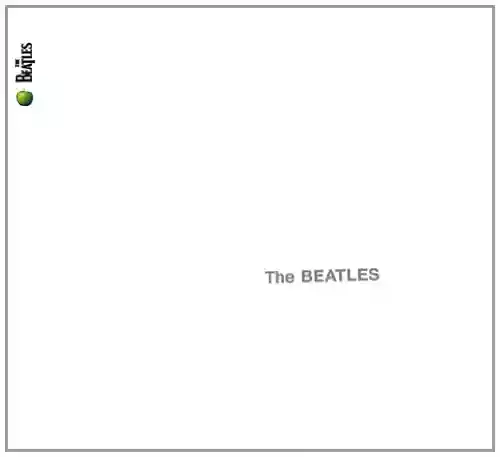
For the long-playing with the achromatic cover, George Harrison's pen conjures the surprising "While My Guitar Gently Weeps" (initially not highly appreciated by his bandmates), featuring a solo played by Eric Clapton, and the surreal delicacy of "Long, Long, Long" (explicitly inspired by "Sad Eyed Lady Of The Lowlands" by the inevitable Dylan), while the blues-country of "Don't Pass Me By" will be the first absolute test, a product of Ringo Starr's creativity. Closing the first eponymous double LP by the Beatles is the childlike melody of "Good Night" (also sung by Ringo), which Lennon wrote for his son Julian (who was five at the time) without telling him that it was a spontaneous dedication to his firstborn.
The tranquility and serenity the band sought during their 'eastern escape' were soon forgotten. Misunderstandings and contrasting moods began to emerge, partly due to the now customary presence in the recording studios (where there were hardly ever strangers attending the sessions) of Yoko Ono, Lennon's girlfriend, in the role of an unusual observer. The evident disagreements among the four musicians led to a situation where some of the recordings took place with only one Beatle at a time. The white double album (the first under the Apple label) marks the further development of a vibrant sound that floated in the magical atmospheres of "Revolver", evolving to shine in that unparalleled psychedelic-rock manifesto known as "Sgt. Pepper's Lonely Hearts Club Band" from almost a year and a half earlier, becoming over time a perfect fresco capable of showcasing an extraordinary lyricism and an experimentally versatile nature always magnificently original.
Loading comments slowly
Summary by Bot
The review highlights The Beatles' 1968 White Album as a product of introspection following their manager's death and a transformative trip to India. The album showcases a wide range of musical styles, reflecting the band's evolving creativity and internal tensions. Each member contributed distinctive songs, resulting in a diverse and experimental double LP. Despite internal conflicts, the album remains a milestone in music history with iconic tracks and innovative soundscapes.Tracklist Lyrics
01 Video (00:00)
02 Back In The U.S.S.R. (02:42)
06 Wild Honey Pie (00:52)
10 Martha My Dear (02:28)
16 Why Don't We Do It In The Road? (01:41)
17 I Will (01:45)
20 Yer Blues (04:00)
22 Everybody's Got Something To Hide Except Me And My Monkey (02:24)
25 Long, Long, Long (03:06)
26 Revolution1 (04:15)
27 Honey Pie (02:41)
29 Cry Baby Cry (03:02)
30 Revolution 9 (08:22)
31 Good Night (03:11)
32 The Beatles (Documentary) (05:30)
The Beatles
The Beatles were a British band formed in Liverpool in 1960 by John Lennon, Paul McCartney, George Harrison and, from 1962, Ringo Starr. They revolutionized popular music through songwriting, studio innovation and cultural impact, releasing landmark albums from Rubber Soul and Revolver to Sgt. Pepper’s, the White Album and Abbey Road before disbanding in 1970.173 Reviews
