
 •
Rating:
•
Rating:
THE REVIEW
Almost every day—or at least very often—one stumbles upon the latest voice of musical truth announcing the incredible revolution brought about by this or that group, in such and such genre. And even though many times the punctuality of these fierce judgments is—light of the facts—debunked, it’s certainly not a crime to have tried: in a world that—even in the musical sphere—sinks more and more into the indiscriminate and sadly flat non-sense of commercialization, it’s better not to pose as apologists for lost purism and to give recognition to those who proclaim themselves as manifest opposers of such flatness.
No, there’s really nothing wrong with indulging in a bit of healthy relativism in our judgments, letting oneself be carried away by the senses even when they lead you to musical shores unknown and unexpected by yourself. In the end, "revolution" is an overused and distorted word, moldy: records that haven’t changed a damn thing spin continuously in my player, warm my evenings, nourish my dreams; acclaimed and epoch-making works, Nobel of light music of all times walk miles away from my soul.
Quite a claim to see the two poles of personal taste and objective judgment of historical relevance, of the heart and the "mind," reunited syncretically in a single gift package.
Quite a claim to want many of them as well, to look each year under the tree for a new "Revolver," a handful of "Astral Weeks," of "Hejira," of "Steve McQueen"…Should I perhaps step out on the street, take the first available means and reach that nice old man named Brian Wilson—revived, vigilant, sharp observer of the multiple facets of the human soul—to ask him not to settle, not to stop, to pretend nothing happened and get back to work?
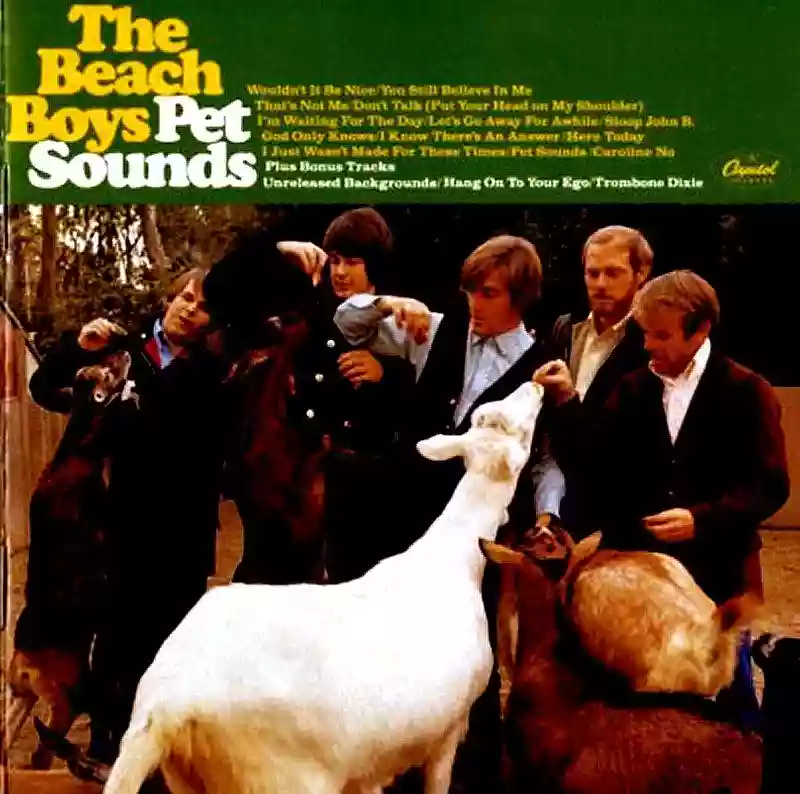
Pretend not to know what a nasty trick that man with the intensely wrinkled face played on the world by publishing—forty years ago (?!)—the sacred text of pop of all time, "Pet Sounds"? Pretend not to have realized that everything or almost everything started and ended there, among the pages of that indisputable and shocking Bible? From pop tout-court ("Sloop John B.": one of the most ingenious and joyfully sticky lullabies ever) to pop with prog nuances (the central slow-down and tempo changes in "Wouldn't It Be Nice"—which has little to envy to the subsequent earworm "Good Vibrations"; the brief, superb, endless "Caroline, No"), from the moving chamber arrangements of "Don't Talk (Put Your Hand On My Shoulder)" and "You Still Believe In Me" to the inspired (and only apparently brilliant) reconsideration of doo-wop harmonies ("That's Not Me": the apogee and decline of surf-rock), from the extraordinary and unheard-of experiments of symphonic jazz-pop of the instrumentals (the title-track, "Let's Go Away For Awhile") to the philosopher's stone of any upcoming torch-song or power-ballad (the immense "I Just Wasn't Made For These Times"), to the masterpiece of the Beatles without the Beatles ("God Only Knows": what else to ask for?)—everything that light song has always wanted, sought, experimented, desired, is born and dies in these grooves, in this work that stuns those who grasp its subtle and humble greatness, in this record, which since the day of its birth heats the senses and regenerates the mind.
There really is little to say about albums like this. "Pet Sounds" shines with a very special light: that, dazzling and everlasting, of an inspiration that is the cradle of three-quarters of modern music.
Loading comments slowly
Summary by Bot
This review celebrates The Beach Boys' Pet Sounds as a timeless, groundbreaking album that redefined pop music. It highlights Brian Wilson's brilliant songwriting and innovative production, emphasizing the album's rich textures and emotional depth. The reviewer argues that Pet Sounds remains a central inspiration in modern music and praises its variety, from doo-wop harmonies to symphonic jazz-pop elements. Overall, the review positions the album as an essential masterpiece and a cradle of musical creativity.
The Beach Boys
The Beach Boys are an American rock/pop group formed in Hawthorne, California, best known for their vocal harmonies and for Brian Wilson’s studio-driven ambition that reshaped 1960s pop, with landmark releases such as Pet Sounds and the long-mythologized Smile-era material.25 Reviews
Other reviews
By f.factor
Here, there’s pop that wants to grow up, and indeed it succeeds, while retaining its characteristics of readily engaging music.
Two spins in the CD player and you’re already humming the various Wouldn’t It Be Nice, Sloop John B, God Only Knows, or Caroline No.
By JohnWinston
If God had recorded an album, it would have been Pet Sounds.
'God Only Knows'... Such a refined melody led Sir McCartney to pronounce it the greatest song ever.
