
 •
Rating:
•
Rating:
THE REVIEW
If Talk Talk had ended their career with "The Colour Of Spring," the 1986 album, we would inevitably associate them with "Such A Shame" and "It's My Life." The aforementioned album, despite its maturation in compositions, a more refined sound, and pseudo-jazz influences, is not the end of the story. From here on, there are two years of hiatus and a miraculous, unexpected return.
It's worth noting that it was immediately apparent that Mark Hollis was not a flashy, charming, and egocentric leader. Quite the opposite. A shy, reserved personality, the classic alienated artist, visionary and deliberately enclosed in his own world. In the general musical sphere, we are observing the decline of the prolific new wave/post-punk, replaced by noise/psychedelic revival (Flaming Lips, Mercury Rev, Sonic Youth, Mudhoney, Butthole Surfer, Big Black).
In 1988, we encounter a crucial period: either another “intelligent trend” is generated, like post-punk was, or we are swallowed by “disposable” music. The new interesting landscape is suggested by Talk Talk themselves. Are you familiar with various Mogwai, Tortoise, Slint, Low, Codeine, and Bark Psychosis? These talented young folks follow with a completely personal portrayal the trail of the six tracks contained in "Spirit Of Eden."
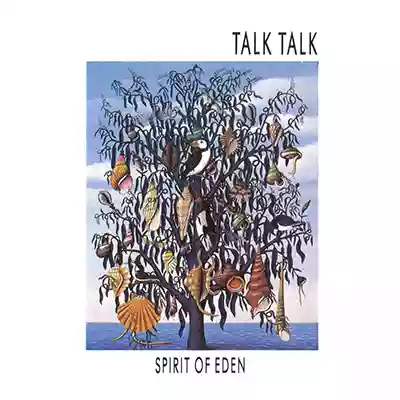
The album presents itself as a naive painting with soft colors but with a few more vivid brushstrokes that decisively outline the contour. The trance scheme is enriched with drones, background noises, effects that emulate natural sounds, and vocal lines almost whispered. It's all fascinating and so unique. A true miracle.
"I observe nature from a panorama. I observe the distance, the nuances, the play of symmetries. At the end of this game, I conceive what I see by layering the vision. It is all overlapped."
"The Rainbow" is the archetype of the new conception: echoes of King Crimson from the "Islands" period, Miles Davis, and the first two albums of Weather Report resurface. The trumpet and electronics are the elements that carry the flux for three minutes, before giving way to the somnambulant guitar groove, the piano phrases, and Mark Hollis's soft voice.
"Rubbery circle, beam of light, tasteless"
A glimpse of light arrives fleetingly with "Eden," a rhythm that is in no hurry to take off in the myriad of jazz, gospel, and soul nuances. The refrain, if we can call it that, given the annulment of standard structures, sees a colossal Hollis transform into a prophetic shaman, transcendental, belonging to another dimension. The pathos reached in the phrase "Everybody needs someone to live by, rage on omnipotent" announces the minimal mood of "Desire," another undisputed pinnacle. Despite the initial ghosts, we encounter a performance bordering on noise, complete with harmonica and savannah percussion.
"I touch the color. Yellow, green, blue. I section the view. I shift my gaze pretending that every small part of the panoramic view of my sight is a watercolor."
"Inheritance" is a prayer at times desolate, hopeful, visionary. Solemn and sacred intro softened by the evocative impact decorated by the instrumental/vocal mixture, a sublime alchemy that releases scents and images. I can't overlook the last phrase, placed as a signature to the spectacle: "Heaven bless you" arrives as a blessing, a caress, a kiss. Stratospheric elegance.
"Man is nothing compared to nature. Man destroys himself."
Now immersed in this earthly paradise, we arrive at the immense "I Believe In You," a sort of answer to the previous album's "I Don't Believe In You," but endowed with another charm and value. The formula is classic: nuanced sonorities struck to the heart by Hollis's verve, who once again perfectly connects with the mind and the ear. Here, unlike the other tracks, in the refrain we persist in the name of minimalism with a subdued Hammond and that moving "Spirit" whispered by Mark.
"Every person delivers a particular scent to their life. What I experience is part of another present, of another today. Then it folds into itself. And reappears."
The misty organ of the meditative "Wealth" concludes the masterpiece without making noise, without having to shout, in perfect Talk Talk style. From here on, everything will be different, and if we want, even easier. "Spirit Of Eden" is the Bible for the future, aware of symbolizing eternally the future itself.
"The future is connected to the receptor. Slowly it takes shape, the design. As it must go. Must. Go."
Unfortunately, the scene of the Nineties is colored by some appreciable peaks, like "Spiderland" by Slint or "Hex" by Bark Psychosis, but overly stuffed with copy and paste or not too exciting combinations with trip hop. The effort was there, but by 2017 I believe the echo of post-rock has ended and the sacred monsters have not been surpassed. There may be a reason.
Loading comments slowly
Summary by Bot
The review celebrates Talk Talk's 'Spirit of Eden' as a groundbreaking album that transcends its era, introducing post-rock's essence through jazz, ambient, and natural soundscapes. Mark Hollis's visionary, reserved leadership and the album's experimental nature solidify it as a timeless classic. Each track is highlighted for its emotional depth, minimalism, and evocative atmosphere. The album is seen as a pivotal moment in music history that influenced a generation of artists.Tracklist Lyrics Videos
Talk Talk
Talk Talk were an English band formed in London in 1981 by Mark Hollis, Paul Webb and Lee Harris, with early keyboardist Simon Brenner and long‑time producer/co-writer Tim Friese‑Greene. They evolved from acclaimed 80s synth-pop to the influential, spacious soundscapes of Spirit of Eden (1988) and Laughing Stock (1991), before disbanding in the early 1990s.10 Reviews
Other reviews
By egebamyasi
Talk Talk’s music sounds like a Salvador Dalí painting, with instruments weaving slow-moving textures that dissolve into the air.
'I Believe In You' is a lullaby of paradisiacal beauty.
By Mariaelena
"Spirit Of Eden is a rarefied poetry of the soul."
"For Mark and not only, the desire for paradise is where the music speaks of spirit, where the spirit speaks of the soul."
