
 •
Rating:
•
Rating: THE REVIEW
The Eighties: a symbol of big hair, happiness, economic development, the fall of bad and bearded communism, and the onset of consumerism. Are you really sure everyone was so alienated in happiness? I don't think so. Many were alienated in unhappiness, or rather, simply alienated. What was swirling in Michael Gira's mind before falling asleep in 1984, we don't know. We can imagine it, which is even more interesting and gratifying. One way or another, Sonic Youth had already hinted at the concept of "noise" and the charming Pere Ubu had spawned a herd of crazy geniuses like Albini with Big Black and the anarchy of Minutemen. All these are valid and highly original projects that didn't make one regret the Seventies, at least from a production standpoint.
We find industrial music on the brink of reaching a point of no return. The initial fertility was diminishing, the quality was dropping, and mediocre techno-synth pop products were beginning to be churned out. Just think of Cabaret Voltaire who, apart from the seminal "The Mix Up," had lowered their guard, generating rhythms for their own sake. Or the post-"Metal Box" PIL, becoming increasingly conventional. Bands like Flaming Lips, Swans, Sonic Youth, and Jesus Lizard slightly uplift the quality of the noise-punk hardcore scene records. They manage to delineate different nuances in each group, bringing new vigor to the latter half of the Eighties.
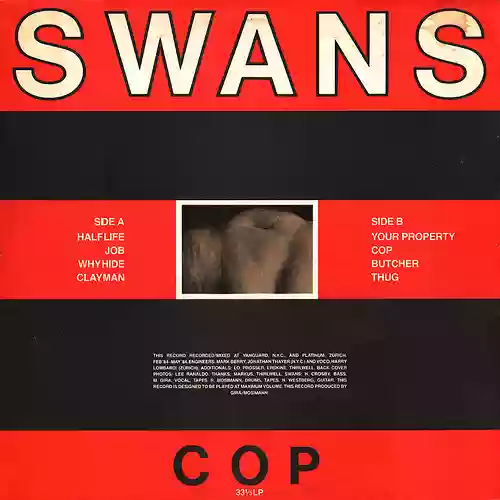
The "dark" concept is nurtured by Virgin Prunes, Bauhaus, and Killing Joke. In this environment, Swans come forth, devoted to a masochistic relationship with instrumentation and melody. Their disarming first work, with an inviting cover, paves the way for this second album, "Cop." It's 1984, and Gira & Co.'s intention is to delve into a "black hole," a wall of sound in darkness, generating oppression and vulnerability for the listener. Pain, physical harm, and reflections on all aspects of death are themes dear to poets from centuries past. At the end of the 20th century, besides writing verses on a sheet of paper, one has the opportunity to give voice to those words with the soul of a singer and the strings of an instrument. It's all very theatrical and focuses on the sonic slaughter to drop the curtain and make those who venture into such noise close their eyes. A true concert of dissonance, hammering, whipping, and submission.
Gira's declamatory approach owes to "The End" and "We Will Fall." A real judge who decrees the ailments alongside his dark minstrels. The rhythm of the opening "Half Life" crashes heavily onto the melody, the 2/2 time becomes the cornerstone of the sound and symbolizes modern social oppression. The drums are an evil machine spewing lashes on snare and cymbals. One must approach such a genre by managing to focus on the individual instrument's work and getting hypnotized by the pure sound's aesthetics. The litanies of the subsequent "Why Hide" and the noise of "Job" reveal the dark side each of us possesses. One only needs to be lulled by Gira to discover the existence of even a tiny inner discomfort that torments our personality. There's a play and an attempt to find the shock effect. The snare in "Clay Man" and "Your Property" increasingly resembles the ferocity of a vice. You no longer hear the drum's skin, but it's as if it's a hammer driving a nail. Subhuman, misfits, improbable people?! Simply another way to create art, which does not allow reflection or silence for the listener. One must submit or happily let oneself be invaded.
The torment and ferocity of every single piece, especially the title track, even surpasses the onslaught of Black Flag, Bitch Magnet, and Minor Threat. There's a sound torture, singing that ranges from the emphatic tones of a mystical vision to the blackest desolation ever reproduced on a record. Forget about Beefheart's alcoholic delirium... but please do not idolize Manson. Also because the band's career is not just marked by sonic impact. If it's true, as Morgan says, that in life there are three phases to understand things, Swans went through three periods. The first, sacrilegious, also includes the two subsequent works to "Cop," namely the thundering "Greed" and "Holy Money" with even the initial piano lied. Then the maturation in the masterpiece "Children Of God" and the more reflective third phase of "White Light From The Mouth Of Infinity."
Those who compose these pieces are fully aware of life's atrocities and do not resign to stopping negative thoughts or ignoring what torments. Gira and the Swans devastate the rock concept of four chords, a riff, and a shouted chorus. It's not so simple, it's not all obsessively tied to commercial purposes, fashion, studs, and a black t-shirt. Here, there is the representation of the artist's mind and their ghosts, without filters and constraints. One is free to live (!?)
Loading comments slowly
Summary by Bot
Swans' 1984 album Cop is a dark and intense exploration of industrial noise and emotional torment. Michael Gira and the band created oppressive, layered soundscapes that challenge listeners. This album helped redefine the noise-punk hardcore scene in the mid-80s and stands as a crucial work in Swans' early career. Its raw power and theatricality make it essential for fans of experimental and industrial music.Tracklist Lyrics
Swans
Swans are an American experimental rock band formed in the early 1980s in New York City and led by Michael Gira, known for evolving from punishing No Wave/industrial repetition to expansive, long-form avant-rock, with an especially intense reputation as a live act.23 Reviews
Other reviews
By mementomori
Violence, nihilism, and desolation are not goals to be reached but the starting point.
It’s Gira’s world vision that drives everything, a vision material and poor in images, confused, representing a bare and squalid world, a reflection of the artist’s soul.
