
 •
Rating:
•
Rating:
THE REVIEW
Grab my hand while it's open
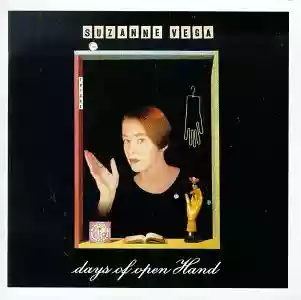
"Days Of Open Hand". Since the first time I read this title, I have always wondered how it could be translated: 'days of open hand' or, paraphrasing, 'days when the hand is open'? Each interpretation gives me a sense of urgency, of fragility, of fragile balance. The album cover, with Su zanne appearing from the darkness in a surreal frame decorated with hands, has something mysterious, almost esoteric. The title and cover successfully convey the spiritual tone and the profound refinement of Suzanne Vega's third album. It's not an immediately accessible album; it grew on me after many listens, and most importantly, the lyrics are a hidden treasure.
Reacting and growing from the two previous masterpieces, here begins the break from the folk repertoire of the first two albums, which in the '80s astonished critics for bringing back something that seemed outdated: the figure of the singer-songwriter with a guitar, a rarity in a very artificial decade of electronics and plastic. It is with this album that Suzanne introduces new sounds (a bit late: the album is from '90) and makes them her own through a dark and entirely new use of keyboards and synthesizers in her production, creating dreamlike and dark atmospheres where time stands still, with words suspended between visions, wakefulness, and endless waits.
The opening "Tired Of Sleeping" is a mandolin waltz with a bright chorus, full of extremely vulnerable images, the voice of a child in a hurry to be born. "Men In A War" is a rhythmic rock metaphor about war amputees, which, together with the joyful and carefree fantasies of "Book Of Dreams", supports the collection's tone, while overall being much more subdued.
Thus opens the solemn "Rusted Pipe" on an emphatic organ, an abreaction to a trauma often addressed by the author: the inability to communicate, the search for meaning in words, here guided by an intense electric background and a growing two-voice choir. It's one of the pieces most influenced by '80s sounds, along with "Big Space", with its imposing synthetic sound. The long, ethereal "Institution Green" is a suite of many instruments, but each is barely hinted, the melody is a slow procession advancing one step at a time, and the theme of the lyrics is one of the most original: the dehumanizing power of public institutions, narrated through an everyday life that unfortunately seems to lack a spiritual side.
The hypnotic and obsessive "Those Whole Girls" instead stands only on reiterated arpeggios, with a disturbing otherworldly atmosphere where monosyllables appear from the darkness and fall regularly like droplets into nothingness. It almost seems like an introduction to that masterpiece which is "Room Off The Street", a gypsy ballad of a woman drunk on love, dancing alone to the sound of Latin guitars and gypsy flutes and percussion. Predictions is a mystical and smoky chant, enriched by ethnic percussion and an oriental-sounding e-bow, incense smoke taking shape in the final "Pilgrimage", a solemn praise to the infinite circle of Life.
But the focal point, of maximum fragility, is "Fifty-Fifty Chance", the story of a suicide attempt. It balances between life and death on a dramatic cello and a poignant violin. The analytical nature of the verses is disconcerting, the promises in the chorus moving, the ending, chilling: "Will she try it again?"
Loading comments slowly
Summary by Bot
Suzanne Vega's third album marks a departure from her earlier folk style toward darker, dreamlike atmospheres enriched by keyboards and synthesizers. The album's themes explore fragility, spiritual depth, and profound emotional stories, highlighted by tracks like "Fifty-Fifty Chance" and "Room Off The Street." Though initially challenging, the album reveals its treasures through repeated listens, showcasing Vega’s growth and experimentation.Tracklist Lyrics Videos
Suzanne Vega
Suzanne Vega is an American singer-songwriter associated with literate, narrative songwriting and a restrained, intimate vocal style. She rose to prominence in the 1980s with albums such as her self-titled debut and Solitude Standing, later experimenting with electronic and eclectic arrangements in the 1990s, and continuing with acclaimed later releases.12 Reviews
