
 •
Rating:
•
Rating:
THE REVIEW
When talking about the best/most influential jazz artists, enthusiasts often mention many names: primarily Miles Davis and John Coltrane with a great lead, but also Ornette Coleman, Charles Mingus, Thelonious Monk... However, a name that is often (and unjustly) forgotten and snubbed is that of Sun Ra, a fundamental figure for free (considered by some second only to Coleman) and one of the most peculiar and interesting personalities in jazz, as well as in the already vividly varied musical world as a whole.
Of course, it must be said that the person in question, whose real name was Herman Poole Blount (who later changed his name to Le Sony’r Ra since 1952), did his part to not be taken too seriously, quickly becoming one of the most controversial figures (some consider him a genius, others an exalted individual) on the scene. Indeed, at a certain point in his career (which began with more traditional sounds like swing and bebop), he adopted a lifestyle that can be described as “eccentric.” He began to dress ostentatiously, in the manner of the ancient Egyptians, and to proclaim that he was not human but rather an angel from Saturn; he also developed his own personal philosophy, mixing personal thoughts and mystical traditions of various kinds with the cosmos (as evidenced by the chosen name: Sun = sun; Ra = Egyptian deity representing the aforementioned).
Well, this is exactly how the music proposed by him (who coined, I seem to recall, or was it the critics? Anyway, the fact is that someone dubbed his style cosmic free-jazz) sounds, a kaleidoscope of free-jazz, immersed in mystical-cosmic atmospheres and open to the most varied ethnic influences (a variety that is also reflected in the use of instruments). Therefore, although it is difficult to ignore the folkloric aspect of his persona, it would be unfair (especially to ourselves, as it would deprive our ears of the joy of listening to a great musician) to reduce his career to mere aesthetics; he is actually an enormously underrated musician by many, who was also among the first to introduce and heavily use synthesizers in jazz (he played piano, organ, and synthesizers), with one of the most free, interesting, and personal musical offerings I have ever heard.
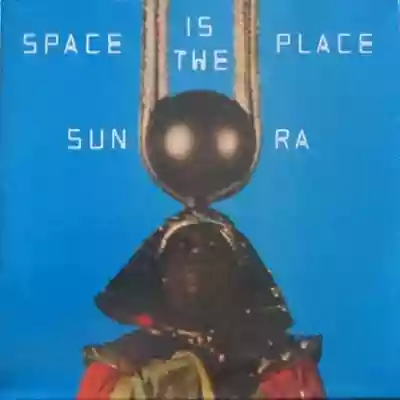
Although belonging to the later phase of his career, "Space is the Place" represents an excellent album to start getting to know this artist, as it offers a good summary of his career, highlighting his various facets and presenting both more canonical and linear pieces and purely stellar moments, thus presenting an excellent compromise between experimentation and accessibility. Moreover, what is even more remarkable, it’s a really great CD!
Ps: I checked, and the term cosmic free-jazz must have been assigned by some critic because he himself did not like to define his music as free (since, in fact, every single note had to be carefully considered), but as phre music (=music of the sun).
Loading comments slowly
Summary by Bot
This review highlights Sun Ra as an often overlooked but fundamental figure in jazz, known for his cosmic free-jazz style and eccentric persona. Space Is the Place is regarded as an excellent introduction to his diverse musical career, balancing experimentation with approachability. The album showcases his pioneering use of synthesizers and unique blend of mystical, ethnic, and free-jazz elements. Despite his eccentricities, Sun Ra remains an underrated genius whose music offers a joyful and profound listening experience.
Sun Ra
Sun Ra (born Herman Poole Blount; later Le Sony'r Ra) was an American jazz composer, bandleader, pianist, and synthesizer pioneer, best known for leading the Sun Ra Arkestra and for his cosmic, avant‑garde approach. Active from the 1930s until his death in 1993, he fused big-band traditions with experimental electronics and Afrofuturist imagery.05 Reviews
