
 •
Rating:
•
Rating:
THE REVIEW
“I wonder how people will react to seeing a band made up entirely of people of color and a white leader.” (Sting, January 1985)
The concert on March 4, 1984, held at the Showgrounds in Melbourne (Australia), will go down in history as the last live performance of The Police, closing the “Synchronicity” tour. In fact, the next day, Sting would return to Great Britain, Stewart (Copeland) would take a flight to Tahiti, while Andy (Summers) would head to Sri Lanka.
The potential of the three musicians confirmed over the years their career possibilities outside the group, involving themselves in collaborations, soundtracks, and albums of other artists, without ever treading the path of fleeing from a musical project where maximum commitment had always been given by all. Already in the spring of 1984, Andy was fully engaged in promoting “Bewitched” (A&M, 1984), designed and created with the tireless Robert Fripp. The indomitable Stewart prepares to realize his desire to discover Africa which would lead to the publication of “The Rhythmatist.” This work underlines the drummer’s pursuit for continuous stylistic enrichment, which finds full sharing and appreciation among fans and insiders. Sting’s preference leans towards acting, which engages him for “The Bride” alongside the barely over twenty-year-old Jennifer Beals, fresh from the success of “Flashdance.”
Musically, and as the history of The Police has taught us, the bassist never liked resting on his laurels due to a personal tendency towards an unstoppable artistic pursuit that has always led him to investigate new things, consistently confirming the validity of his musical intuition. A profound self-esteem that led him to act by trying to further evolve his writing, which in the safety represented by the band with Summers and Copeland, could never have found full expression.
Sting seeks the help of his journalist friend Vic Gabbarrini for choosing the musicians to involve in a new project distant from the world of rock and familiarizing with jazz. Branford Marsalis (saxophone and percussion) together with bassist Darryl Jones (already with Miles Davis) were the first to join, while the versatile Omar Hakim (since 1983 with Weather Report) was chosen on drums, known during a dinner with Mark Knopfler of Dire Straits in Montserrat during the sessions of “Brothers In Arms.” Kenny Kirkland (simultaneously serving the Polish violinist Michal Urbaniak and the bassist Miroslav Vitous) completes the lineup, capable of sliding his hands on the keyboard with elegance and mannerism, much to the leader’s liking.
The introduction to this new artistic journey is presented by “If You Love Somebody Set Them Free”, where the initially predominantly soul choir blissfully merges with those jazz elements that characterized Sting’s beginnings with Last Exit. A collection of sounds whose roots are visibly distant from The Police’s records but move nimbly following a pop timbre, channeling a text where the analysis of a two-person relationship is seen from a different perspective from the romanticized one in “Every Breath You Take” (“If it’s a mirror you want, just look into my eyes – Or a whipping boy, someone to despise – Or a prisoner in the dark – Tied up in chains you just can’t see – Or a beast in a gilded – That’s all some people ever want to be: If it’s a mirror you want, look into my eyes – But if it’s a scapegoat, someone to despise – Or a prisoner in the dark – Bound by invisible chains – Or a beast in a gilded cage – This is what no one would ever want to be”).
The Caribbean brightness of “Love Is The Seventh Wave”, represents much more than successful entertainment, conveying a message of love dedicated to the whole world through a catchy chorus.
For the drama of “Russians” - Sergey Prokofiev’s “Romanza” is borrowed – as noted in the liner notes – leaving to the classic tones that distinguish the vocal melody for a goose-bump-inducing interpretation. The depth of the lyrics tied to the actuality of the cold war highlights once more the virtuosity and the desire for maturity of The Police bassist (There’s no historical precedent – To put words in the mouth of the president – There’s no such thing as a winnable war – It’s a lie we don’t believe anymore – Mr. Reagan says “We will protect you.” – I don’t subscribe to this point of view – Believe me when I say to you – I hope the Russians love their children too -: In history, there is no precedent – Putting words in the president’s mouth – There’s no such thing as a winnable war – It’s no longer a lie that convinces us – Reagan says “We will protect all of you” – I don’t listen to these concepts – Believe me when I say – I hope the Russians love their children too -).
The notes of “Children’s Crusade” show how an artist characterized by great compositional talent can unleash his creativity, engaging in refined pop that blends with the rise of the waltz that characterizes both verse and chorus. The retrieval of “Shadows In The Rain” (from the equivocal “Zenyatta Mondatta”) is perhaps a message to remind old fans how important it is not to break with one’s past, while clearly showing new ones how alive the roots still are.
The second half of the listen opens with “We Work The Black Seam” and a hypnotic riff in which Kirkland creates the right atmosphere that, combined with a fading tribal rhythm, sets the stage for one of the album’s most beautiful choruses, where the swirling vocalizations soak it in elegance. Equally refined is the jazz-pop of “Consider Me Gone” (whose making was adorned by an unexpected visit in the control room by a very elegant Eddy Grant – owner of the Blue Wave Studios where the recordings of “TDOTBT” were taking place – together with the President of Guyana, causing some embarrassment within the band), where the musical interplay finds definitive release in the title track, a true manifesto of instrumental skill and mastery.
“Moon Over Bourbon Street” (Moon Over Bourbon Street) is an essential swing where the scene is dominated by a vocal pliability reminiscent of Billie Holiday, for which the noble inspiration borrowed from Ann Rice’s “Interview with the Vampire” leads the blonde musician, for this piece only, to set aside the guitar for a soft double bass accompaniment. The familiarity of the rhythm and melodic pace of “Fortress Around Your Heart” ushers the end of the listen, delighting those who want to savor, under a new guise, already known emotions that should never fade away.
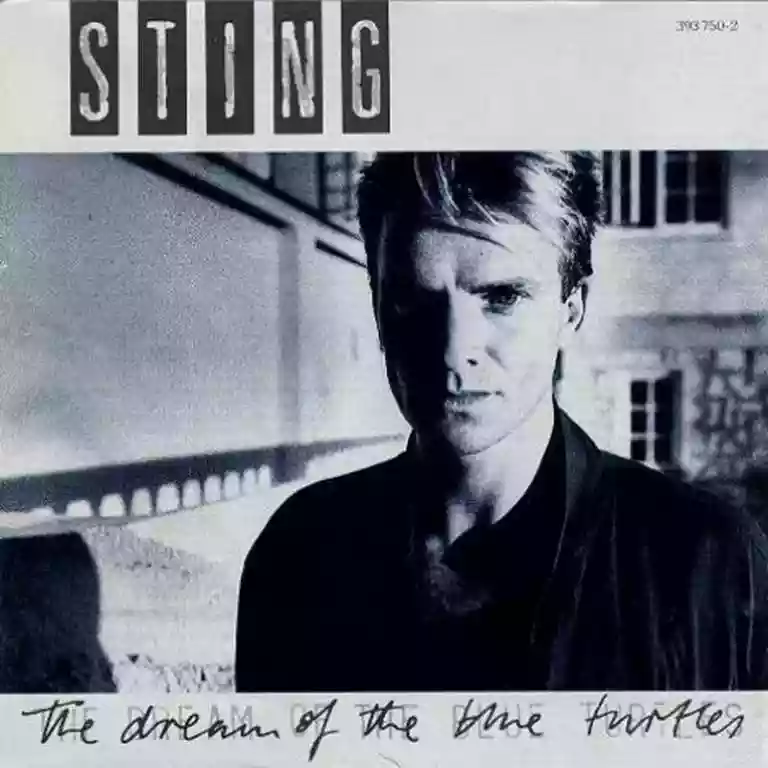
From the cover photo, the resemblance in expressive resolve with the great Lawrence Olivier, who excellently portrayed the wise King Lear, embodying the Shakespearean tragedy without equal, cannot go unnoticed. Likewise, the juxtaposition of the musician from Wallsend to Sir Lawrence does not seem at all out of place, considering the boldness in playing the role of a modern and straightforward poet, to which the heterogeneous combination of atmospheres, style, and sounds seals the preciousness of the whole.
The album can be seen as a successful combination of styles that draws from the past but is oriented towards the future in an attempt to merge the two musical cultures at its core: white and black. The result is given by the sum of those musical components ranging from jazz to funk, also passing through classical music and rock as needed, to be elegantly and wisely fused.
Regarding the title, Sting traces the inspiration back to a sort of nightmare (also easily interpretable!), where the devastation of his yard was caused precisely by blue turtles; very different from the pleasant imagery that, after listening, this album can generate among The Police fans, but also inevitably among an audience capable of appreciating its artistic depth. That same depth is capable of ensuring the start of a new and risky solo experience, acting in defiance of the solid past that would have guaranteed safety and survival without further challenging oneself.
Loading comments slowly
Summary by Bot
The review highlights Sting’s successful departure from The Police with his solo debut, The Dream Of The Blue Turtles. It emphasizes the blend of jazz, funk, pop, and classical influences, supported by renowned jazz musicians. The album is recognized for its artistic depth, lyrical maturity, and bold musical experimentation. Sting's evolution as a composer and performer is praised, marking a confident and innovative start to his solo career.Tracklist Lyrics Videos
Sting
Sting (Gordon Matthew Thomas Sumner) is a British singer-songwriter and bassist, best known as the frontman of The Police and for a long solo career blending pop/rock songwriting with jazz and other influences.23 Reviews
Other reviews
By Grasshopper
Sting has continuously sought a compromise between his noble passions and the taste of the broadest possible audience.
This sycophantic record, made to please everyone, is still very enjoyable to listen to after 20 years.
By primiballi
Sting understood that things are born, develop, and end.
Creating an album both light and intellectual. Easy and difficult. Of immediate enjoyment as well as long chewed.
