
 •
Rating:
•
Rating:
LA RECENSIONE
Steven Spielberg's works always spark discussion, for better or worse. It is no coincidence that he is considered one of the most influential directors of the last two decades, a filmmaker who has contributed with his creations to developing almost a "new" strand of the Hollywood machine: his are auteur blockbusters, cinema characterized by recurring elements often tending toward excessive spectacle. Grandiose feature films, expressions of a way of making cinema that is both "classic" and innovative. Like it or not, works such as "Jaws," "E.T. the Extra-Terrestrial," and "Jurassic Park" among others, have contributed to fostering a cinema with a global character but have always tried to maintain foundations closely tied to its author. Perhaps precisely because of this tendency to be considered a "mainstream" filmmaker, Spielberg's more "intimate" and complex works have often been overlooked: I'm thinking of "Schindler's List," "Amistad," and "Munich" (those that have struck me most and are often almost considered "minor" films in his career). "War Horse" represents the marriage between these two different aspects of Spielberg's filmography: entertainment and "good-heartedness" on one side, human conflicts and suffering on the other.
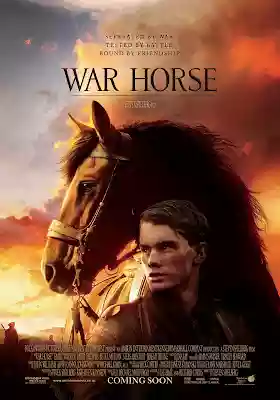
Right around the release of the new and highly acclaimed "Lincoln," it is interesting to take a slight step back to analyze "War Horse," a film that hasn't managed to carve out the space that other Spielberg releases have been able to. We are in the period shortly before the outbreak of the First World War: Albert (Jeremy Irvine) is a farmer from the deep south of England. Little money, little food, poverty. The only reason for living is Joey, a horse that Albert has seen grow and is the only means they have to plow the land, a mirror of his peasant family's existence. But as in the "great story," the horse and its master must part ways: the equine is "recruited" by the British army, as a mount for an officer. It's just the beginning of a "road movie" on four legs...
These are premises for an "happy" or "family" movie that move "War Horse," over two hours of hyper-buzz about the unpredictability of life and the goodness of the human soul. Spielberg, perhaps excessively tied to a not very incisive screenplay, does nothing but showcase all his technical mastery behind the camera, never going beyond the superficiality that "War Horse" carries like a shadow. A trivialization of events and situations expressed blatantly in the scene of Joey's release by two soldiers, one German, the other English, enemies but "friends."
A film that relies entirely on a syrupy dramatic tone, redundant and often out of place, thus undermining the usual perfect images, the usual impeccable photography. It's as if Spielberg looked in the mirror and decided to show everyone how talented he is, yet unable to go beyond his image, failing to truly investigate the characters and the historical phase that serves as the background to the story.
Not much there.
Loading comments slowly
Summary by Bot
War Horse blends Spielberg's blockbuster spectacle with human drama but ultimately suffers from a superficial and syrupy narrative. Despite technical mastery and beautiful visuals, the film fails to explore its characters and historical context deeply. The drama often feels redundant and detracts from the film's potential emotional power.
Steven Spielberg
Steven Spielberg (born December 18, 1946) is an American film director and producer known for landmark blockbusters and critically acclaimed films across multiple genres.37 Reviews
