
 •
Rating:
•
Rating:
THE REVIEW
The symmetry of form is one of the constitutive principles of this music by Steve Reich: divided into five sections, the first is linked to the last, the second to the fourth, and the third section, the middle one, is in turn divided into three subsections where the first refers to the third, and the second remains alone acting as the pivot of the entire composition.
Thus, the structure of the piece is: I - II - IIIa - IIIb - IIIc - IV - V. What was mentioned above applies to the tempos (I= fast, II= moderate, IIIa= slow, IIIb= moderate, IIIc= slow, IV= moderate, V=fast) and to the arrangement of the sung texts, drawn from works by the American poet William Carlos Williams: the fourth section has the same text as the second, and section IIIc has the same text as section IIIa.
Sure, the listener does not immediately notice all this because "The Desert Music," composed in 1984, flows without interruptions between one section and another in its 48-minute duration. In this work, as already in "Tehillim" from 1981, there is a significant presence of voices, in this case, a choir of 27 members. The rest of the instrumentation is that of the large orchestra: 28 wind instruments, 2 pianos (played four hands), 48 string performers, and the usual, very large array of percussion instruments (including 2 marimbas, 2 vibraphones, 2 xylophones, and 2 glockenspiels).
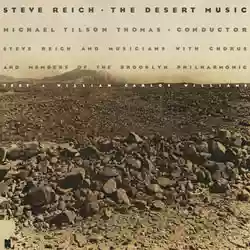
The music is that pulsating and labyrinthine type, based on repetition, characteristic of Reich's original perspective on minimalism, but "The Desert Music" is no longer, as was previously the case with the American composer, the slow evolution of an idea or a musical form. Here, the sections are more differentiated from each other, each with its own personality, even if more hidden than displayed; and some forebodings about the fate of man, suggested in Carlos Williams's texts, return to us the image of the desert as an inhospitable place where the perception of things changes, where our certainties become misleading like a mirage. Like this music, both placid and inexorable at the same time.
Loading comments slowly
Summary by Bot
Steve Reich's The Desert Music is a 48-minute minimalist composition marked by a symmetrical five-part form. The work integrates complex tempos and choir texts drawn from William Carlos Williams' poetry. Reich expands his minimalism with differentiated sections, creating a pulsating yet meditative soundscape. The piece evokes imagery of the desert as a place of shifting perception and foreboding. Overall, it is a profound orchestral exploration of texture, repetition, and meaning.Tracklist
01 The Desert Music: I. Fast (07:54)
02 The Desert Music: II. Moderate (06:59)
03 The Desert Music: III. Part One: Slow (07:00)
04 The Desert Music: III. Part Two: Moderate (05:53)
05 The Desert Music: III. Part Three: Slow (05:54)
06 The Desert Music: IV. Moderate (03:35)
07 The Desert Music: V. Fast (10:47)
Steve Reich
Steve Reich (born 1936) is an American composer and pioneering figure of minimalism known for phasing, pulse-driven structures and the use of tape and speech fragments. His catalogue includes Music for 18 Musicians, Drumming, Different Trains and Electric Counterpoint; he received the Pulitzer Prize for Music in 2009 for Double Sextet.07 Reviews
