
 •
Rating:
•
Rating:
THE REVIEW
The album "Kimono My House" is a clear example of how, very often, some artists in their careers are capable of producing many decent works, but only one great masterpiece. Sparks, in 1974, had this flash of genius and produced this record which, despite its gradual obscurity, was (and remains) a milestone in its genre, now called glam-rock.
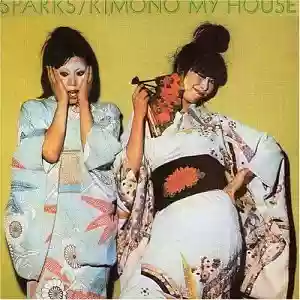
First of all, let's say that when you say Sparks, you are mainly referring to the brothers Ron and Russel Mael, Californians transplanted to London, respectively the keyboardist (and leading songwriter) and singer of the group. The two, to their fortune, were accompanied by three excellent performers, among whom guitarist Adrian Fisher stood out. The brothers were not only great musicians but also two stage performers. Just take a look at the album cover to glimpse their characteristics, among which Ron's unsettling resemblance to Adolf Hitler stands out. A resemblance not coincidental, as it is precisely to the era of the decadent German cabaret that Sparks' music refers. With the multi-award-winning musical film Cabaret, produced just a few years earlier, an artistic trend began intending to reevaluate the culture, ultimately alternative and underground, present in the smoky venues of Berlin and Munich during the rise to power of Nazism. Music also did not escape the trend, and "Kimono My House" is the most enlightening example of it because it knew how to fuse rock canons, even hard ones, with the murky and decadent atmospheres typical of German cabaret shows.
The album starts with three tracks that, at the time, left even the most demanding listeners breathless and that are the three pearls of the production: "This Town Ain't Big Enough for Both of Us," an energetic and slightly hard western duel, which hides the metaphor of the Aryan with the Jew, "Amateur Hours," a seductive rock'n'roll, and the great "Falling in Love With Myself Again," whose rhythm is directly taken from the typical Bavarian beer hall songs. Standing out is Russel Mael's falsetto voice, which did not hide his admiration for Marlene Dietrich and her "Blue Angel," which he mimicked, and Adrian Fisher's guitar, clean and light. In full normality, the rhythm section and Ron Mael's keyboards, whose great merit was composing all the tracks of the then LP. Other notable pieces are "Talent Is an Asset," almost a xylophone rhythm dance, "Hasta Manana Monsieur," another pure cabaret piece, and "Thank God It's Not Christmas," an ironic rock paced by the text, then anti-conformist. Less successful are the others and the two bonus tracks, now inevitable on all reissued CDs.
Ultimately, a successful mix of atmospheres, of simple and decisive rock with marked colors and a decidedly Central European background, which made it an absolute and, unfortunately, unique masterpiece of the glam-rock scene. Many musicians who later became more famous (such as, for example, Queen, which I hear in every note, even if many of you will say no) have been inspired by this album.
Loading comments slowly
Summary by Bot
Kimono My House is Sparks' defining 1974 album that blends glam-rock with German cabaret influences. The Mael brothers, backed by skilled musicians, crafted energetic and theatrical tracks. Highlights include 'This Town Ain't Big Enough for Both of Us' and 'Falling in Love With Myself Again.' Though some tracks are less impactful, the album remains a unique masterpiece and a major influence on later glam-rock and rock artists.Tracklist Lyrics Videos
Sparks
Sparks are the Los Angeles–born duo of Ron and Russell Mael, renowned for theatrical vocals, witty lyrics and stylistic swerves from 1970s glam to synth‑pop and orchestral pop. They first recorded as Halfnelson, broke the UK charts in 1974, and have remained restlessly inventive ever since.06 Reviews
Other reviews
By Dune Buggy
Russel Mael's voice, demonstrating control and power beyond imagination in his falsettos and the most challenging sound passages.
Thanks to these ten delirious, joyous, and light-hearted anthems to life, the Sparks rewrite the history of glam.
