
 •
Rating:
•
Rating:
THE REVIEW
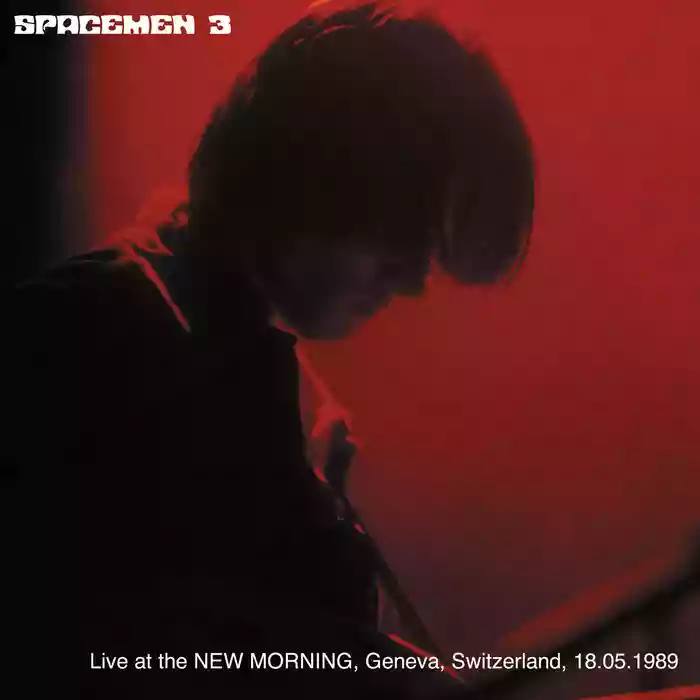
Published many years later by Space Age Recordings and remastered in 2015, Live at the New Morning, Geneva, Switzerland, 18-05-1989 doesn’t feel like a record meant to be listened to with clarity. It’s more like something that resurfaces from a night that went on too long, like waking up with the smell of smoke still clinging to you and not quite remembering what actually happened. In May 1989, Spacemen 3 were already neck-deep in their own chemical and minimalist myth, and this concert documents it with no filters, no embellishments, no intention of being likeable.
This isn’t the colorful psychedelia of the Sixties posters: it’s a gray, nocturnal psychedelia, born in a half-empty club with amps way too loud for the room. During the Playing with Fire tour, the band had found a formula based on repetition, slowness, and saturation, and here they apply it with a kind of stubborn determination. Jason Pierce and Sonic Boom’s guitars don’t try to move you: they just keep something burning, like two burners left on low for hours.
“Rollercoaster” starts and never really takes off, turning round and round itself like a carousel seen from afar, too slow to be frightening but insistent enough to hypnotize. “Revolution” loses all sense of slogan and becomes an emptied-out march, almost indifferent, as if the title was just stuck to a song that no longer believes in anything. Everything is stripped down to the essentials: pulse, distortion, repetition. No virtuosity, no climax, no consolation.
Then comes “Suicide” and the concert stops behaving like a concert, for good. The song stretches out, drags on, spirals in on itself until it becomes a dense sonic mass, a kind of toxic cloud that doesn’t break apart. At a certain point — and it’s one of the most quintessential Spacemen 3 details — the band walks off stage leaving their instruments to scream on their own: guitars leaning against the amps, keyboards locked down, feedback pulsing on as the room fills with smoke. This isn’t theater, it’s not clever provocation: it’s almost indifference elevated to an aesthetic. The sound continues without them, as if the music no longer needs the musicians.
When they return, it’s not to close the track but to reactivate it, pushing it even further. It’s the kind of gesture that today would be read as conceptual performance, but probably then was born out of a mix of stubbornness, exhaustion, and intoxication. Kember himself later said that the band used moments like these as a natural filter for the audience: those who could withstand it would stay, the others would leave.
The recording preserves all this latent hostility. There’s none of the reassuring polish of many official live albums, but neither the indistinct chaos of bootlegs: it’s clear enough for you to feel how physical that volume was, how little room it left for distraction. The audience can barely be perceived, as if trapped in the same suspended state as the band. If you listen expecting mystical revelations, it can be frustrating. But if you take it for what it is — a raw recording of a band playing slow, loud, and stubbornly always the same while everything else around them blurs out — it becomes almost hypnotic. Not because much happens, but because it stops mattering whether anything happens at all.
In the end, more than a concert, it feels like the sonic residue of a night when no one really planned on going home early. Imperfect, monotonous, sometimes unpleasant, but also strangely coherent with the idea that Spacemen 3 had of music: not to entertain, not to explain, not to improve the mood — just to alter perception until reality loses definition and all that remains is an unbroken, persistent drone, difficult to turn off.
Loading comments slowly
Summary by Bot
The review explores the raw energy of Spacemen 3's 1989 live set in Geneva. It highlights the hypnotic, psychedelic soundscapes and performance intensity. Audio quality and setlist authenticity are discussed. Fans of drone rock and shoegaze will find much to appreciate. The reviewer awards a strong rating, noting the album's lasting impact.
Spacemen 3
Spacemen 3 were an English psychedelic rock band from Rugby, noted for minimalist, repetitive songs, heavy feedback, and trance-like live performances. Central figures Jason Pierce and Pete “Sonic Boom” Kember later pursued separate projects, including Spiritualized and Spectrum.23 Reviews
