Spacemen 3
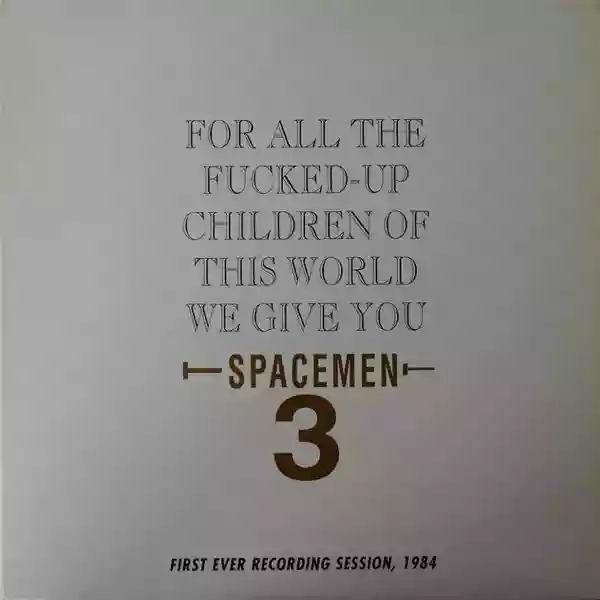
For All The Fucked-Up Children Of This World We Give You Spacemen 3 (First Ever Recording Session, 1984)

 •
Rating:
•
Rating:
THE REVIEW
For All The Fucked-Up Children Of This World We Give You Spacemen 3 is not simply an early recording, nor a relic for completists: it is the moment when Spacemen 3's music is born already inseparable from an altered state of perception, but still in a raw, instinctive, not yet fully focused form. Recorded in 1984, when the band had not yet developed a defined language, this tape documents a very clear vision that, however, has not yet learned to control its own means. It's music that already knows where it wants to go, but not how to get there.
Drugs, in this context, are neither a pose nor a biographical detail, but a perceptual condition that informs the entire project. The tracks move through repetition and subtraction, as if conceived to act on the nervous system even before reaching the ear. Walkin’ With Jesus, Things’ll Never Be the Same, 2:35 do not seek development or resolution: they work through accumulation, stasis, insistence. This is music aiming for trance, but it does so in an irregular, sometimes uncertain way, as if hypnosis were sought more by trial than by mastery.
This is where it must be said clearly what is often avoided: Spacemen 3's music presupposes an altered state in order to be truly understood. Not because it demands this as a provocation, but because it was conceived, constructed, and calibrated for unsober listening. Heard in ordinary clear-headedness, this music might seem monotonous, poor, unfinished; but listened to from within the same perceptive horizon that generated it, it reveals its real function, which is not to narrate or entertain, but to modify the perception of time, of the body, of sonic space. Without alteration, it remains a partial object.
That this is not some critical fantasy is demonstrated by the musicians’ own words in later years. Peter Kember, aka Sonic Boom, openly spoke about the centrality of drugs in his life, even describing himself as a heroin addict and calling his first heroin injection an existential breaking point, capable of radically transforming his relationship with time and perception.
On this primordial record that vision is present, but not yet disciplined. The drumming is obsessive but sometimes mechanical, the guitar vibrates more out of intuition than plan, the voice remains suspended, unsure of its own role. Even the blues that runs through these recordings is shapeless, slowed down, intoxicated, filtered through an English province without flair. The substances do not serve to make the music more colorful, but to strip it down, even at the risk of leaving it incomplete.
Heard today, For All The Fucked-Up Children… should not be mistaken for a finished work. It is a document that shows intention before form, tension before control. More than a debut, it is a starting point: a powerful vision still searching for its own grammar, and which, for this very reason, retains an urgency that later, more defined and aware records will partly lose.
Loading comments slowly
Summary by Bot
This review examines Spacemen 3's first recording session, highlighting its raw and unpolished sound. The album captures the band's early psychedelic edge and uncompromising spirit. The reviewer appreciates the authenticity and historical value of the material. The release is seen as essential for fans and collectors. Overall, the tone is enthusiastic and appreciative of its significance.Tracklist
Spacemen 3
Spacemen 3 were an English psychedelic rock band from Rugby, noted for minimalist, repetitive songs, heavy feedback, and trance-like live performances. Central figures Jason Pierce and Pete “Sonic Boom” Kember later pursued separate projects, including Spiritualized and Spectrum.23 Reviews
