
 •
Rating:
•
Rating:
THE REVIEW
Summer is coming, the heat, the sultriness. That unbearable feeling of warmth that will grip us for months is about to overwhelm us. There I see everyone sitting on the benches, "catching" the last drop of melting ice cream on the fly, ready in the morning to go to the beach and enjoy the sunbathing. I go against the trend, rowing against the tide, and perhaps it is because of the delicate period I'm going through that instead of enjoying the sun (which I don't even see much of anyway...) I "review" records that mean a lot to me. Those intense works you put on the stereo right after a summer evening spent with friends...
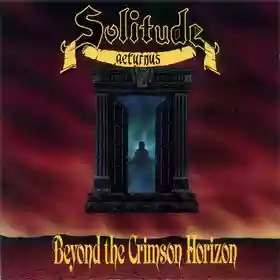
In these situations, I find myself reliving the past, re-listening to dusty CDs that had accompanied the past years. After finding it, in a corner (in the underworld or on the paths where fairies run), "Beyond The Crimson Horizon" opened up a new path for me, in a sense it gave me a positive energy, which paradoxically is one of the most unlikely things to feel from a doom album. Yet despite everything, this CD is one of the few of the genre that can lift me on typical bad days.
The positive energy that this record exudes is mainly due to the ability of the five Texans to create a totally personal doom, which although based on the typical concepts of the genre, has a decidedly more positive and less decadent attitude than other musical offerings. "Beyond the Crimson Horizon" is a typical doom album, not very depressive, that doesn't dwell on ultra-slow guitars and growls, but leaves the listener with a semblance of hope. The clean singing of Robert Lowe certainly helps a lot in this sense, delivering a vocal performance of great importance. This is a doom/heavy classic album so don't expect cross-genre contaminations: guitar, drums, bass, vocals. Nothing more, nothing less.
Solitude Aeturnus has given life to a work that is not very "existentialist", less cerebral and suffered than the previous "Into the Depths of Sorrow" and compared to other doom groups. We do not have the theatrical drama of My Dying Bride, the gothic influences of Paradise Lost are not heard, and, in a certain sense, the band from Texas also distances itself from the masters Candlemass. The tracks, in fact, are more direct and less epic than the compositions of the Swedish group. Listen to believe "Black Castle" with its powerful rhythm reminiscent of Metallica's "And Justice For All." Moreover, compared to the first album, the band, which has not undergone any lineup changes, proves to be more cohesive, and the work benefits from it. The sounds are also better, the sound richer, and everything helps to package a great example of doom metal. A record where the obscure "It Came Upon One Night" stands out, thanks to its foggy and trembling beginning, while with "Beneath The Fading Sun" the band shows us its more intimate side. "Beyond the Crimson Horizon" concludes with its manifesto: "Beyond" is the essence of doom. Finally, slow and oppressive guitars crush the listener with their heaviness, having come to the end of the journey.
To be continued...
1. "Seeds Of The Desolate" (6:30)
2. "Black Castle" (4:08)
3. "The Final Sin" (5:41)
4. "It Came Upon One Night" (6:58)
5. "The Hourglass" (5:16)
6. "Beneath The Fading Sun" (4:25)
7. "Plague Of Procreation" (6:27)
8. "Beyond" (4:01)
Loading comments slowly
Summary by Bot
This review praises Solitude Aeturnus' album Beyond The Crimson Horizon for its unique take on doom metal that conveys hope rather than despair. The band's cohesive sound and Robert Lowe's clean vocals bring a positive energy uncommon in the genre. Compared to other doom acts, their style is more straightforward and less theatrical, with clear influences yet a distinct identity. The reviewer highlights standout tracks and improved production quality, making the album a notable classic in doom metal.Tracklist Lyrics Videos
Solitude Aeturnus
Solitude Aeturnus are an American doom metal band from Arlington, Texas, formed in 1987. Led by guitarist John Perez with vocalist Robert Lowe, they helped define U.S. epic doom, releasing six studio albums between 1991 and 2006. Lowe later served as singer for Candlemass.06 Reviews
Other reviews
By Hellring
"Into the Depths of Sorrow is a classically doom album, both in the structure of the songs and in the lyrics."
"Transcending Sentinels is, in my humble opinion, the highlight of the entire work, thanks to a slow start that heralds the strong advent of the guitars and Lowe's always commendable vocalizations."
