 •
Rating:
•
Rating:
THE REVIEW
Sometimes, thankfully, they return. It doesn’t matter how long it takes, or how much (very much) they have to lose. What mattered, in the case of Mike Ness, was simply returning from that hell made of drugs, prison, violence, abandonment, which almost sucked him into the abyss where so many other bad boys from the old Orange County had already ended up.
For Mike, evidently, destiny had something different in store than a cemetery or a jail: continuing a fantastic story that began in 1983 with that small (barely 27 minutes long) yet great (listen to it to understand) gem titled "Mommy's Little Monster". A shining comet whose golden trail would have been a crime not to follow. So we arrive at 1988, the year when the celebrated Metallica released "...And Justice For All" (pay attention to this title, as we'll find it partially in the realm of Social D too), the first album post-Cliff Burton, while Social Distortion released the first LP signed by the Recovered Ness. Or, depending on the point of view, the first album of the new era.
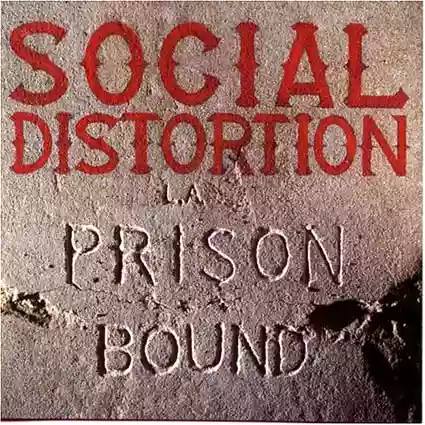
"Prison Bound", the album in question, is indeed the launching pad for what Social D would become up to the present day: an unrepeatable (and very personal) fusion of melodic California-made punk and the best of American music, the kind with a capital A. With a good dose of Rolling Stones added (here honored with the beautiful cover of "Backstreet Girl"). Some will call it Country Punk, others will simply be captured by this warm sound that mixes Johnny Cash and the Ramones (or Hank Williams and the Clash, if you prefer), all concentrated in the charisma and songwriting—somehow wonderful from the start—of the poetic and tormented Ness.
Compared to the sacred triad signed with Epic ("Social Distortion", "Somewhere Between Heaven And Hell", "White Light White Heat, White Trash"), "Prison Bound" enjoys an evidently more spartan production, closer to the group's beginnings in Fullerton rather than to the bright future. The ties to the past are highlighted by the first tracks: "It's The Law" is nothing but a re-proposition of the original "Justice For All" (see above to remember the nominal connection between Mike Ness's band and L.A.'s Thrashers) contained in the Mainliner collection, while "Indulgence", with its breaks and restarts and its essential lyrics, appears as the ideal link between "It Wasn't A Pretty Picture" and "Moral Threat" featured on their debut platter. "Like An Outlaw (For You)" should be remembered for several reasons: besides being the first openly western-punk song of the work (and perhaps of the entire production of the group), it is the result of a collaboration between Mike Ness and his comrade-in-arms Dennis Danell, who co-signs three tracks on the album. It is peculiar that the two guitarists had very few other occasions to demonstrate their compositional harmony, while in private life they were inseparable until Dennis's premature death. The title track, a wonderful country punk ballad that foreshadows the more renowned (and equally splendid) "Story Of My Life" and "Ball And Chain", talks about the frontman’s tough experience in prison, linking it to the discovery of new influences (Cash above all) and stylistic and attitudinal change. It’s hard to think of a better and more personal way to seal the first half of the album.
"No Pain No Gain" doesn't entirely convince, with its unusual flamenco progression, immediately followed by the much more impactful "On My Nerves" and "I Want What I Want" (opened by a menacing riff, precursor of dark-toned pieces like "Pleasure Seeker" and "Gotta Know The Rules"). The closure is entrusted to the dark and tormented blues-punk of "Lawless", whose mournful tone even harks back to the best Mississippi tradition, and the autobiographical "Lost Child", where themes of perdition and turmoil are narrated with the flair and punk poetry that only Mike Ness can evoke.
Regardless of discussions about individual tracks and the production still anchored to lo-fi standards, it would be unfair to reduce Prison Bound to the role of a mere transition album. Despite being without the groundbreaking impact of MLM, it maintains the fundamental energy while attempting to develop it in more personal directions and trace that path which would allow Social Distortion to survive the fate of many other punk bands born and buried in L.A. suburbs, eventually earning the well-deserved title of legend. A myth that has lasted for more than three decades, built on a few but brilliant albums; on enviable consistency and the ability to play punk rock by combining simplicity and personality. It might seem like little, just as few are the chords Ness uses to craft his jewels of suburban poetry and blues-country warmth. Very few, however, manage to offer the same, astonishing result.
An indispensable album, if one wants to understand and delve into the history of a unique group; nevertheless precious, for those who believe that punk rock can also (or mostly) be a winning mix of melody, lyricism, and feeling.
Loading comments slowly
Summary by Bot
Prison Bound marks Mike Ness's triumphant return after personal hardships, blending punk rock with American country influences. The album serves as a pivotal moment for Social Distortion, showcasing their raw yet melodic style. Despite lo-fi production, the songwriting and emotional depth solidify their legendary status. This work bridges their early punk roots with a more mature and personal sound.Tracklist Lyrics Videos
Social Distortion
Social Distortion are an American punk rock band from Orange County, California, formed in 1978 and led by singer and songwriter Mike Ness. Their sound is widely associated with melodic punk shaped by rock ’n’ roll, country, and blues influences.12 Reviews
