
 •
Rating:
•
Rating:
THE REVIEW
Sly & The Family Stone is the name of the project born from the sulfurous mind of Sylvester Stewart (1943), an African-American multi-instrumentalist who made a name for himself in the early '60s as a producer and session musician for the major Californian soul music record companies.
Midway through the decade, he decided to form a band with his siblings Rose and Freddie, comprising diverse musicians in both gender and skin color. They were to break the first taboo with their own “multiraciality”, the one about “whites” who should not or cannot play black music. Thus, “The Family” was born, with Sylvester at its head, adopting the name “Sly Stone“.
But the innovation occurs primarily on the musical side: a series of dizzying experiments by the whole group begin, increasingly pushing the boundaries of soul, a genre until then untouchable and the realm of heroes like Otis Redding or Sam Cooke (who, due to their premature deaths, had not even had the time to start a potential stylistic revolution of the genre).
Sly, in a parallel journey with the more experienced—and at the time equally creative—James Brown, would pioneer a new music, a soul taken to the extremes and crossed with white rock, especially the more wild and psychedelic kind. Funk would be born, an extraordinary and highly imitated genre that would experience a golden age throughout the '70s, with its riches reaped from the seeds planted by these innovators, until it symbolically faded with the arrival of disco music, a subspecies of funk without art or substance.
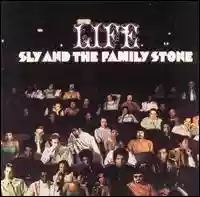
Returning to Sly, after a couple of mediocre albums where the desire to break out of the circle is omnipresent but without clear ideas on the “new path” to take, a third sparkling album is released, Life (1968). Ahead of its time, the tracks are short and catchy, yet vibrant and full of life: the sounds are—a science fiction-like feat at the time for a Ray Charles or for the Supremes—based on the lyrics, and not just vice versa. Indeed, the lyrics, although simple, head in a precise direction, sending out a message for all of peace, love, and celebration of life.
Everything is therefore very simple, but new, and it’s hard not to be captivated from the first listen. And not just because of the music, truly rich and amusing, with a band that has absorbed all the goodness of R&B (crossed singing with scales of tones worthy of the Temptations, wild grooves, almost circus-like or beach party tunes, a great sense of rhythm) and carried it forward, not for a hit single but for an entire album, and all at full power. And these 11 little songs are just a taste of what the first black rock band has in mind. Making a BLURian comparison, Life is the band's Modern Life Is Rubbish. Stand will be their Parklife.
Loading comments slowly
Summary by Bot
Sly and The Family Stone, led by Sylvester Stewart, broke new ground in the 1960s with a multiracial, gender-diverse band. Their 1968 album Life is a vibrant and innovative fusion of soul, funk, and psychedelic rock. Short, catchy tracks deliver a message of peace and celebration, setting the blueprint for a golden age of funk. Life is recognized as a pioneering record that pushed musical and social boundaries.
Sly & The Family Stone
American mixed-gender, interracial funk and psychedelic soul band formed in San Francisco by Sylvester “Sly” Stewart. They pioneered a fusion of soul, rock, and psychedelia; played a historic Woodstock set; and scored era-defining hits like Everyday People and Family Affair, with Larry Graham popularizing slap bass.05 Reviews
