
 •
Rating:
•
Rating:
THE REVIEW
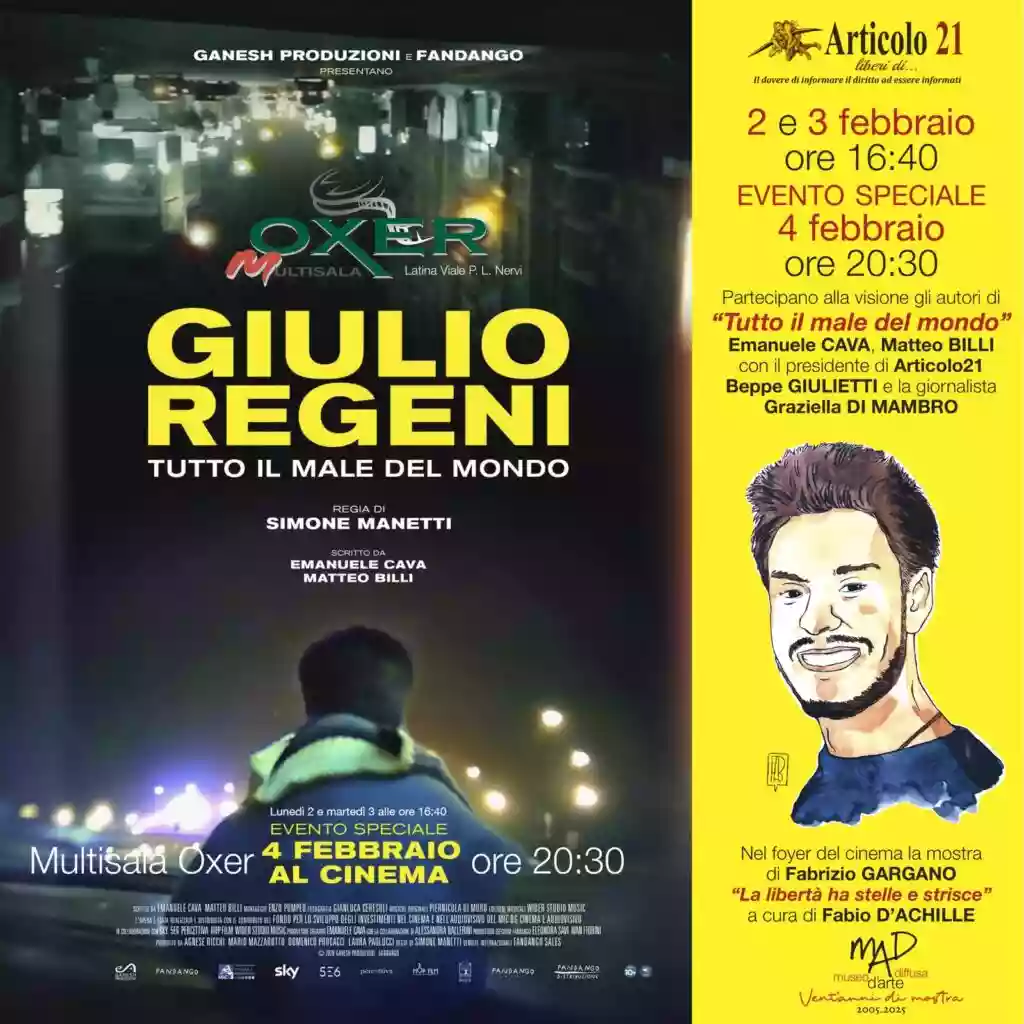
The documentary film "Giulio Regeni – Tutto il male del mondo," which I watched the other evening, led me to imagine how, in an indeterminate future in Italy, we might remember the aforementioned Italian researcher. My fear is that he will eventually be forgotten, if already 10 years after his violent death the ongoing trial in Rome—which began in 2024—has yet to be concluded, hindered by a thousand obstacles. Perhaps I am an incurable pessimist, but what I saw left me with a sense of dismay.
The director Simone Manetti, a renowned documentarian, unfolds the stages of a well-known affair over the course of 97 minutes through various footage. In short, Giulio Regeni was a doctoral student at the University of Cambridge who had been sent to Cairo to conduct research on independent Egyptian trade unions, specifically among street vendors. This was a research project fraught with risks, as Giulio had come into contact with unionists inclined to pass information to the watchful and suspicious members of law enforcement under the control of Al Sisi's authoritarian government. And in this web of treacherous characters, the Italian PhD student became entangled, disappearing without a trace from January 25, 2016. His body, subjected to unspeakable torture, would later be found in a seedy, outlying area of Cairo on February 3, 2016. And already here, what Giulio's mother stated might suffice: she said she recognized her son’s body only by the tip of his nose, the rest so battered as to suggest that all the evil in the world had been visited upon that poor soul. Who knows, perhaps the paranoid Egyptian torturers mistook Regeni for some kind of Italo-British spy, an even greater threat than James Bond himself...
Unfortunately, what followed was even more disheartening. The Egyptian authorities tried to mislead the investigation, insinuating that Regeni had been embroiled in criminal circles and male prostitution. Only when the Italian ambassador in Egypt was recalled to Rome did Al Sisi appear willing to cooperate in shedding light on the events and those responsible. But this was more appearance than reality, considering that the trial commenced in Rome in 2024 features four Egyptian counterintelligence agents as defendants, none of whom have been extradited, despite the serious evidence against them.
One might say it’s something, after years of public awareness about the tragic story thanks to the commendable commitment of Giulio's parents, lawyer Ballerini, and various public demonstrations in Italy. All this is recounted in the documentary, which also shows footage of Regeni meeting an Egyptian union activist just days before the tragic end. It reminds us that on the treacherous streets of Cairo, traitors and double agents were ever-present.
It is a harrowing episode, but in my view not the only one. Seeing images of certain Italian politicians, then in top positions, looking so contrite as they met the Regeni couple and expressed hopes for justice, was hardly reassuring (indeed, no definitive verdicts exist in the case). But even worse was watching a group of Italian businessmen in Cairo who, through Descalzi, president of Eni, confirmed the good economic and commercial relations between Italy and Egypt. Al Sisi, the boss of Egypt, beamed with satisfaction—and how could the Italian government, given that Italy is an importer of raw materials, consider breaking off diplomatic relations with Egypt? As someone once sang, "money makes the world go round," and the truth about the Regeni case can wait in an adjacent closet…
The final blow, however, was for me the recent news that the commission of the Ministry of Culture (minister Giuli, where are you?) has decided not to grant public funds to the documentary "Giulio Regeni – Tutto il male del mondo," simply because it demonstrates "scarso interesse culturale." In other words: the less said about the Regeni affair, the better (it might be too embarrassing for the current Italian Prime Minister’s good relations with Descalzi, president of Eni).
Since watching the reviewed film isn’t all that easy, I urge all of you who have read me so far to make an effort to do so. Giulio Regeni not only deserves the justice he is owed, but also not to be consigned to oblivion. Italian citizens of goodwill owe him that, and I sincerely hope that in ten years’ time we are not left asking ourselves who killed an innocent Italian.
Loading comments slowly
Summary by Bot
This review praises Simone Manetti's documentary on Giulio Regeni, highlighting its emotional resonance and critical storytelling. The reviewer awards a top rating, emphasizing the film's importance and impact. Themes of justice, truth, and human rights are explored. The documentary is portrayed as essential viewing for those interested in modern history. Overall, the critique is strongly favorable.
