
 •
Rating:
•
Rating:
THE REVIEW
“As we march down to Fanerio
our captain fell in love
with a lady like a dove,
and they called her name pretty Peggy-o”.
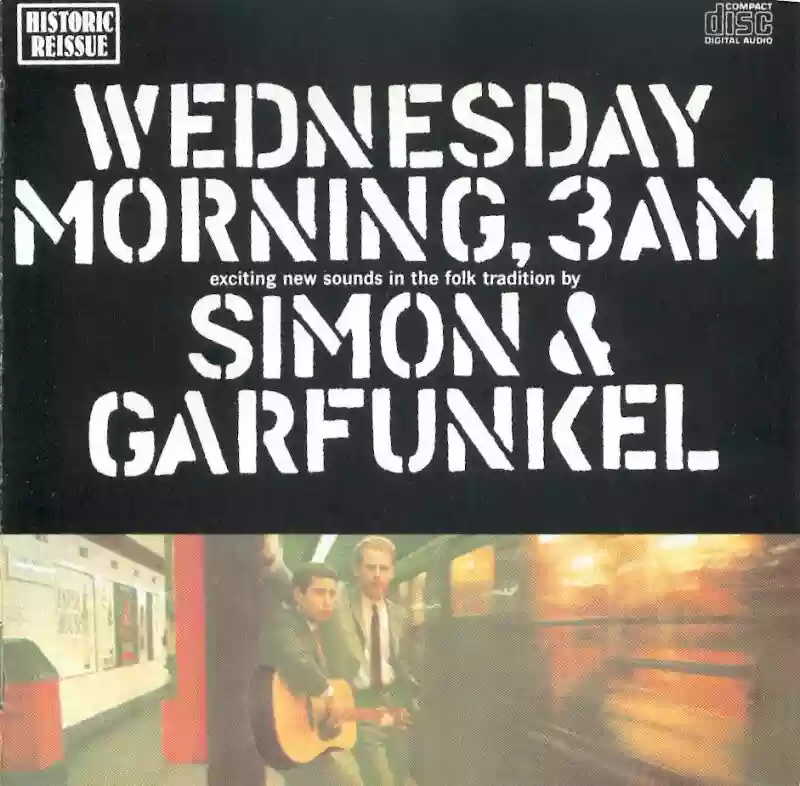
The LP debut (the first single, “Hey, Schoolgirl”, was in 1957) by Simon & Garfunkel is all here: immediate melodies, delicate guitars, and a touch of folk tradition. An oasis of serenity: we are in nineteensixty-four; for the United States, these are years of war (Vietnam) and mourning (among others, J.F. Kennedy, Martin Luther King, and Marilyn Monroe) that deeply affect society. If this background really relates to what I am saying, frankly I ignore it, but I like to believe it: in the funereal cover with epitaphic characters - a counterpoint to the colorful mosaic enclosed within - the two very young American musicians send to print this “Wednesday Morning, 3 A.M.”, an unripe hint of the good things to come, despite an initial sales failure.
The LP takes off in apnea with “You Can Tell The World”, indeed a cheerful verbal blow for the baby of Israel – who after all brought joy joy joy into my heart. Well done, cowbells and cans: here is “Last Night I Had The Strangest Dream”, a sort of shouted nursery rhyme while people dance around in the streets. The peculiarity of the two voices already stands out, pure in their whiteness, two voices that find and support each other along different paths. It touches deeply “Sparrow”, the fragile sparrow seeking a crumb of love – Not I, said the oak, the swan, and the corn. I will give it, said the Earth, dust you were and to dust you shall return.
Folk tradition, as was said: and on one side, we have the joyful “Go Tell It On The Mountain” announcing the birth – Hallelujah! - of the divine infant to seas and mountains, on the other, here is the sublime nursery rhyme of “Peggy-O” mentioned earlier, so tender, sweet, and loving it ends up being destructive and incendiary. Figuratively speaking, of course. War is truly destructive, to the extreme. And so here is the burning Vietnam current events: the Dylan-esque inspiration of “He Was My Brother”, an indictment against the war arts, strikes with the piercing memory of the hero for the homeland. One of the many, perhaps forgotten, heroes of the homeland. He was my brother, he was 23 years old the day he died. He was my brother, and he died so that his brothers could be free. Amen: prayer. “Benedictus”, a liturgical remake, highlights despite a hesitant Latin the beautiful voices of Art and Paul. An estranging yet very sweet piece (I think that’s the correct term).
The journey from track to track, as if following a thread of some unknown plot, brings me to a solid, well-built, and comfortable structure, which the two will often find themselves inhabiting. “The Sun Is Burning” is constructed on five stanzas of equal dignity and with a beautiful melodic line; the celestial parable of the star to which we owe everything becomes an allegory of human imperfection, from afternoon affection to the scent of ashes in the evening. “Bleecker Street” continues along the same lines, frankly beautiful: impressionism in music, brush strokes capturing a moment, unique in its appearance.
Voices leaving from a sad café, smiling faces try to understand; I saw a shadow touch a shadow’s hand on Bleecker Street.
Quite unusual for those musically arcane times, here comes a punctual cover of the same Bob Dylan gaining new luster and vigor: “The Times They Are A-Changin’”, in this case, made more fluid without the genius potato-in-mouth of the great songwriter.
A few excellent tracks, in short, a lot of sweetness and some nice fillers; but all this does not make history (whether this album does, I don’t know; I say that in its small way it stirs something). To make a fine jewel, you need the gems. “The Sound Of Silence” is one. Still unripe, minimal, yet dreamy; known to anyone, I believe, even without knowing they know it. The two melodies are perfect, overlapping in a beginning of immortality; it may not be the wonderful song of the vinyl namesake nephew, but this dialogue between the voices and the guitars moves with purity. “Wednesday Morning, 3 A.M.” perhaps is even more so: it is poetry, a chilling portrait, the weight of thoughtless actions (My life seems unreal, my crime an illusion: a scene badly written in which I must play), distressing in the full moon of winter nights, terrible pangs of stupidity. Yet it is also hope: it is the assurance of love’s warm body, the wait for morning, just a few hours away, to warm the coldness of the soul.
It is not yet the time of Kathy and Cecilia, it is not yet the moment to tell of America and parsley-sage-rosemary-and-thyme. Many stories will still come, many events will grow the two musicians, highs and lows will separate them several times, making evident the strength of their union. For once, however, it is nice to dwell on the moments when everything begins. Because Simon & Garfunkel understood one thing right away: every story deserves to be known, narrated in a sigh, resounding in the silence of man. It matters little if even prophets must write on subway walls. The important thing is that they write.
Loading comments slowly
Summary by Bot
Simon & Garfunkel’s debut album Wednesday Morning, 3 A.M. presents a delicate blend of folk tradition and poetic lyricism. Though initially overlooked, the album contains foundational tracks such as 'The Sound of Silence' and socially reflective songs inspired by the era’s turmoil. The duo’s vocal harmony and storytelling offer a serene musical experience marked by hope and emotional depth.Tracklist Lyrics Videos
Simon & Garfunkel
Simon & Garfunkel are an American folk-rock duo from Queens, New York. Active primarily in the 1960s, they released five studio albums and became known for close harmonies and songs like The Sound of Silence, Mrs. Robinson, The Boxer, and Bridge Over Troubled Water. They split in 1970 and reunited for notable live events, including the 1981 Concert in Central Park.08 Reviews
