
 •
Rating:
•
Rating:
THE REVIEW
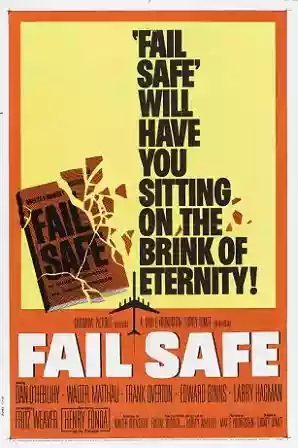
Sooner or later, we will have to rediscover and re-evaluate certain films from the past that, due to unfortunate coincidences, have ended up somewhat forgotten. As in this case, if today a work like Kubrick’s “Dr. Strangelove” is still remembered and quoted in cultural and cinematic circles, the same cannot be said of “Fail-Safe” by Sidney Lumet. The reason is that both films came out in the same year (1964), and Kubrick requested and obtained that “Dr. Strangelove” be released first. Both works tackled the burning issue of the threat of thermonuclear war: while Kubrick opted for a satirical approach, reinforced by Peter Sellers’ superb performance, Lumet displayed a more sober and distinctly dramatic style.
Based on the novel by Eugene Burdick and Harvey Wheeler, “Fail-Safe” tells the disturbing story of a squadron of US bombers which, due to an unexpected malfunction in their onboard command devices, receive the order to begin a mission to attack and wipe out the capital of the USSR. No less than Moscow—and as unbelievable as it seems, the pilots can do nothing but proceed with the mission to the very end. Needless to say, both the Pentagon and the air command center in Washington do everything possible to prevent the irreparable. But the death mechanism, once started, moves inexorably forward like a runaway bulldozer, and at that point there are no prayers to comfort us mortals, as the terse ending crashes over us like a cold shower.
If the story is, in short, the chronicle of a foretold apocalypse, there are certain technical and more general notes that demand attention. The director favors sequences set in confined spaces, generating a claustrophobic sensation that doesn’t let up until the tragic conclusion. And nothing eases the tension, also thanks to the performances by great American actors. One is Henry Fonda, in the role of a US president who is fully aware of the gravity of the situation and tries in every possible way to find a solution, speaking on the phone (assisted by an interpreter of the Russian language) with the Soviet premier. Witnessing these desperate dialogues between two politically powerful men who, unfortunately, are unable to save planet Earth, plunges the viewer into anguish. If destroying Moscow cannot be avoided, what could be the fate of a metropolis like New York?
Then, among the other actors, an effective Walter Matthau does not go unnoticed, here in the role of a grim political analyst or political science professor named Groeteschele (the reference to the then-famous Professor Henry Kissinger should not be missed). According to Groeteschele, sitting among the generals, scientists and various experts gathered in the Pentagon during those hours, the US bombers must strike first. Then it’s a matter of seeing whether the first strike will cause the immediate death of 60 million or 100 million people. Quite a difference, but the scholarly analyst fails to consider that, over time, living conditions on planet Earth would become increasingly unfavorable for any living being.
In the discussions preceding the inevitable tragedy, only one American general voices a reasonable observation: that the arms race has gotten out of hand for those who should have stopped in time. As if to say that the human race is now subordinate to machines, which are becoming ever more sophisticated and unpredictable.
And although a closing caption warns that the film is pure fiction and that the United States armed forces have the best systems to prevent the extreme events portrayed, I can assure you that I’m unable to feel any sense of relief. I have watched a film from 1964, but in these post–Cold War times, it doesn’t seem that things have improved. Too many powerful men speak casually of destructive weapons. There are those who are considering the use of tactical nuclear weapons in the war against Ukraine (well known who I mean), while another threatens to destroy an entire civilization in a single night (an uncouth current tenant of the White House). And to make matters worse, it’s not science fiction that there are now Artificial Intelligence solutions available to autonomously conduct military conflicts. Who should stop them? Are we really this blind?
Perhaps art—as a vehicle of beauty—will not save the world, but watching an old film like “Fail-Safe” can help awaken the consciences of people of good will. Before it’s too late.
Loading comments slowly
Summary by Bot
The review highly praises Sidney Lumet's 'Fail Safe' as a masterwork of Cold War cinema. It lauds the film’s unrelenting tension, realistic portrayal of nuclear threat, and strong performances. The analysis highlights Lumet’s direction and the movie's powerful anti-war stance. The reviewer rates it 5 out of 5, calling it essential viewing for classic film lovers.
Sidney Lumet
Sidney Lumet (1924–2011) was an American film director whose debut, 12 Angry Men (1957), set the tone for a career of morally incisive, New York–rooted dramas. He earned multiple Academy Award nominations and received the Academy Honorary Award in 2005.10 Reviews
