
 •
Rating:
•
Rating:
THE REVIEW
It was by chance that, browsing the web, I discovered that critics did appreciate this film, but in the end, it’s not like they were tearing their hair out about it. Now, I’m no cinema expert and you’d probably be right to tell me to go back to talking about metal and pancarcòr, but I felt it was only right to do my part to adjust the average rating that the internet might have of this work.
The genesis of the film was a bit troubled: the director wanted to close the western chapter, new territories were being explored, the historical actors like Eastwood are nowhere to be found, nor are the typical western dynamics, and, just to round things off, there’s a much more European approach throughout. The western had changed and the all-American stuff with the Indians belonged to another era: out of this transformation, Sergio Leone created a masterpiece.
I’ll go as far as to say that, for me, the fight for the top spot is between this movie and “The Good, the Bad and the Ugly” (which needs no introduction). However, while on a cinematic level “Duck, You Sucker!” admittedly comes in second, my personal taste might just prefer it. To start with, this film has real breadth in every sense of the word: it starts from a well-defined historical moment and spans through time, from Mexico to Ireland, covers the expanse of human experience, from war to the peones, delves into personalities, from guerrilla fighter to general, and so on. Here we immediately catch Leone’s spark of genius in writing this film: it’s a movie that masterfully portrays human nature.
The variety of the scenes is huge and creates an organic film, long yet generally flowing, majestic without ever going overboard. From the sarcastic banter of the two main characters to the epic bridge scene and the slaughter, from the assault on Mesa Verde to the explosion in the church. Each scene has its meaning, its weight. Mesa Verde, for example: the bandit dreamed of robbing the bank but instead finds a city different from his memory. The metaphor hidden behind scenes like this resonates with every viewer. So, the typical western codes are somewhat reinterpreted here for a film that can rightfully be considered innovative within its genre.
The music, then, is the icing on the cake. How could you not mention the ethereal mood of the Irish flashbacks?
Right, and how could you not mention the scene (spoiler alert) where Sean remembers killing his friend? According to standard interpretations, from that moment Sean makes it clear that he has stopped judging people; for me, though, there’s more to it: while the doctor betrays the revolution and accuses Sean of never having endured torture and not knowing what it means, Sean seems to answer: “That’s true, I wasn’t tortured, but you know why? Because when they came for me I was in a bar with a fucking rifle hidden under my coat and I shot those fuckers, that’s why.” And maybe this is exactly where it’s useful to start thinking about the “violent but sharp” nature of Sean, compared to Juan’s loud and unruly one. Similarly, perhaps from here, we should begin reflecting on two moments where another stroke of genius in this film becomes clear: this is a political movie.
Noteworthy is Juan’s reflection on the revolution, expressing his hatred. In light of the cultural process of the last decades, though, it feels a bit predictable. Much less so is Sean’s reflection: “When I started using dynamite I believed in a lot of things, freedom, the revolution… in the end you end up believing only in dynamite.” This is one of my favorite quotes: yes, because we all like protesting, the chaos, discontent spilling into the streets, occupying schools, and so on. But in fact… maybe the truth is that, at least a little, we like the protest itself as much as the reason we protest for? I don’t mean to make any superficial arguments, we’ve heard those a thousand times, I’m saying something much more human. After years of rants, of talk and everything else, maybe we should ask ourselves: what still matters to us? The protest or the dynamite? What do we enjoy, what do we believe in. I’ll leave this thought open for the reader.
To conclude, I’d note that this film is also a beautiful story of a tumultuous, adventurous friendship: badass revolutionaries raising hell in the prisons, tough-as-nails people blowing everything up, machine guns, revenge, trains crashing, uprisings, knives in the back, and so on.
This film, in short, is an anthology of human life, transposed into one of the most gripping stories you’ll ever find.
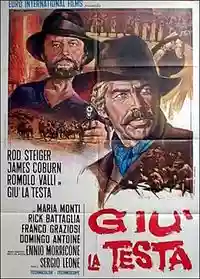
“Giù la testa, coglione” Score: 95/100.
Loading comments slowly
Summary by Bot
This review highly praises Sergio Leone's 'Giu La Testa', spotlighting its significance in western cinema. It recognizes the film's exceptional direction and storytelling. The reviewer conveys the timeless appeal and cultural impact of the movie. 'Giu La Testa' is presented as a must-see for western and film enthusiasts. The 5-star rating confirms its status as a cinematic masterpiece.
Sergio Leone
Sergio Leone (1929–1989) was an Italian film director who defined the Spaghetti Western with the Dollar Trilogy and expanded his scope with Once Upon a Time in the West and the crime epic Once Upon a Time in America.10 Reviews
Other reviews
By embryo
"'Duck, You Sucker' exudes the rebellious spirit of the era, portraying its pros and cons, noble causes, and contradictions."
"Sergio Leone creates an apt parallelism between the era in which the film was made and the one it is set in to demonstrate that, as the saying goes, the truth lies in the middle."
