
 •
Rating:
•
Rating:
THE REVIEW
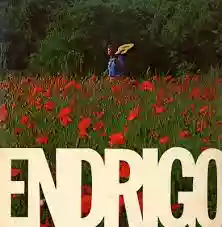
...And as I listen to a record from about fifty years ago, looking at its cover I understand the greatness and freedom of the artist and the era. Before analyzing the songs, let's talk about the cover, a cover that without speaking tells the personality of the artist and the record in question. The Cover represents a field of poppies, with Endrigo and his guitar in the distance, an image perfectly chosen for a songwriter like him, the great and unique Sergio Endrigo.
The record starts with the song "Girotondo Intorno Al Mondo" (the song with which Endrigo participated in Scala Reale 1966), a song that aims to unite the world, for a united world of peace, a text in Endrigo's style, very deep, a song that gets the record off to a good start. Then it moves on to a popular love song "Teresa", in which Endrigo wonders what his beloved will think of him now that he has kissed her. Another Chanson D'Amour "Dimmi La Verità" (B-side of the 45 rpm "Mani Bucate") is a very intense song, with Endrigo's voice very warm and intimate, almost like an Italian "Crooner", really very beautiful. Next up is "Adesso Sì", a Sanremo song by Endrigo from 1966 (brought to Sanremo in duet with Chad and Jeremy, reaching eighth position), a very Sanremo-style song, consisting of a pop ballad, with a valid text, but without a deep voice from Endrigo, a song that does not convince much. After side A, comes side B of "Adesso Sì", "Io E La Mia Chitarra", a song that almost takes you to the Far West, in fact, Endrigo writes an Italian country-songwriting song that breaks up the record a bit but is pleasant. Another initial guitar strum, but this time with a love text that tells a love story made of deception and mistakes. With this very melodic Italian song, Endrigo concludes side A of the 33 RPM.
Side B opens with "Chiedi Al Tuo Cuore", a slow Italian-style song, Dorelli style, very pleasant, but from Endrigo, we expect something more authorial. And here comes what I was asking for, "Mani Bucate", a song accompanied by a simple guitar loop, with a fabulous text, full of teachings and truth. Endrigo moves from "Mani Bucate" to a "Come Stasera Mai" (B-side of the 45 rpm "Teresa" from 1965), a romantic song, in which a lover declares to his woman that he has never loved her like that night... "La Donna Del Sud", a song written and sung by Bruno Lauzi, here well interpreted by Endrigo, who proves to be also a great performer and author. The record closes with a song signed Bardotti-Endrigo, with the famous song "La Ballata Dell'Ex", which tells the story of a partisan persecuted after the war. A song with a very beautiful text and rhythm, a fantastic song to close a very sentimental record with some bursts of pure songwriting.
The record is beautiful, but inconsistent, in fact, it starts very well only to get lost and find a true path at the end. With the record, Endrigo wants to make a breakthrough in his career, making him one of the greatest songwriters of the moment, and let's say he succeeded!
Loading comments slowly
Summary by Bot
The 1966 self-titled album by Sergio Endrigo showcases his unique songwriting and heartfelt lyrics wrapped in characteristic Italian pop and chanson styles. The record opens strong with songs promoting unity and love, though some tracks like 'Adesso Sì' feel less convincing. The album shines towards the end with deep, poetic songs like 'Mani Bucate' and 'La Ballata Dell'Ex,' cementing Endrigo's status as a great songwriter. Despite moments of inconsistency, the album remains a valuable work in Italian music history.
Sergio Endrigo
Italian singer-songwriter born in Pola in 1933. He emerged in the early 1960s with "Io che amo solo te", won Sanremo 1968 with "Canzone per te", placed second in 1969 with "Lontano dagli occhi" and third in 1970 with "L'arca di Noè". He collaborated with Sergio Bardotti, Luis Bacalov, Vinícius de Moraes, Toquinho and poets such as Giuseppe Ungaretti and Gianni Rodari, and is also beloved for children’s songs like "Ci vuole un fiore" and "La casa". Awarded the Luigi Tenco Prize in 2001; he died in 2005.08 Reviews
