
 •
Rating:
•
Rating:
THE REVIEW
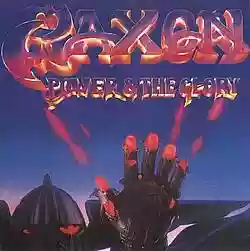
After the success of "Denim And Leather", in 1983 Biff Byford and company released their fifth studio album: this "Power & The Glory", less incisive in my opinion than its illustrious predecessors, but still an entry of great respect, always full of their unmistakable dirty and captivating sound.
Opening the dance is the fantastic title track; "The Power And The Glory", indeed: a story of rough and fierce mercenaries, a kind of gritty street epic, a compelling, aggressive, fast, fierce, compact song without any weak points: a real wall of fire in pure Saxon style; a special mention for the chiseling work of bassist Steve Dawson and another for the refrain, compelling and you never want it to end: ultimately this is, at least in my opinion, the most successful track of the album, along with the concluding one, "The Eagle Has Landed". Following is the more relaxed "Redline", a typical biker and motorcycle song, which some might find a bit predictable, with its classic rock'n'roll gait, but which I really like, especially the guitar solo, dreamy and aggressive at the same time. The next "Warrior" in its initial part recalls "Dissident Aggressor" by the never too praised Judas Priest, and for the rest it goes on fast, singing of Nordic warriors and coastal village devastations, but without any particular highlights, except for the solo, truly very engaging. Introduced by an acoustic arpeggio, which would suggest a sappy ballad, comes instead "Nightmare", indeed a gentler track but not at all sugary: in fact, it is a piece that alternates harder parts with more dreamy and almost melancholic ones, like the refrain, which however is characterized by the square guitars of Graham and Quinn, and the final part, where the acoustic guitar returns. The following "This Town Rocks" is a typical arena anthem, introduced by a drum burst from their new member, Nigel Glockler, who entered to replace Pete Gill, and who provides a very convincing show of strength precisely in this piece.
"Watching The Sky", dedicated to the movie "ET", deals, in fact, with aliens and spaceships and is, according to Saxon themselves, the most commercial piece of the lot: in fact, the melody is catchy and 'catchy', but sudden more metallic comebacks are not absent, while the ending surprises, taking on an almost rock'n'blues pace and fading a bit quickly, almost to emphasize even more the change of tempo. "Midas Touch" is another excellent piece, alternating acoustic parts with guitar outbursts in the refrain; Byford's interpretation is excellent, sometimes suffering and sometimes aggressive: even the guitar solo develops in this dualism: initially slow and suffering, with the support of the acoustic guitar, then fast and launched with full power. The piece is good, but nothing compared to what the last track reserves: slow, majestic, solemn, akin in rhythm and sound to the most psychedelic Led Zeppelin, almost sneakily comes "The Eagle Has Landed", bringing us back to the distant and magnificent 70s, alternating these more psychedelic parts with harder ones, but never fast or excessive, always measured, solemn, with a slight pinch of the very first NWOBHM (I refer to the very first Judas of "Sad Wings Of Destiny", in particular "Victim Of Changes", where nonetheless the latter were still heavily influenced by Led Zep and Black Sabbath); an absolutely must-listen piece, unmissable, which only at the end picks up more speed, without ever breaking the dream.
An album perhaps not excellent (I am not referring to the individual episodes but to its entirety) but still one to have, without a doubt; recommended to all lovers of NWOBHM and well-crafted rock of the past, a purchase that will disappoint no one: guaranteed!!
Loading comments slowly
Summary by Bot
Saxon's 1983 album Power & The Glory offers a strong follow-up to Denim And Leather, featuring aggressive, compact metal tracks. Highlights include the title track and The Eagle Has Landed, with solid performances and nostalgic nods to classic 70s rock. Though not considered their best overall album, it remains a must-have for NWOBHM fans.Tracklist Lyrics Videos
Saxon
Saxon are a British heavy metal band formed in 1977 in South Yorkshire and a leading force of the New Wave of British Heavy Metal. Fronted by Biff Byford, they broke through with Wheels of Steel (1980) and followed with era-defining releases like Strong Arm of the Law and Denim & Leather, continuing to record and tour for decades.19 Reviews
