
 •
Rating:
•
Rating:
THE REVIEW
There are bands that have made rock history without ever staying in the spotlight of success and a large audience. There are bands that have invented or contributed to the evolution of musical genres while always remaining true to themselves and their ideals (musical and otherwise). There are bands that have evolved and deliberately changed their way of making and thinking about music without ever being conditioned, in doing so, by thoughts or desires for commercialization and without ever being attracted, in their choices of change, by the "God of Money". There are bands that have endured and resisted musical trends (grunge, britpop etc...) and personal adversities (the premature death of Chris Oliva R.I.P.), which would have brought down even the bravest spirits, without being completely influenced by them and, indeed, finding in them a reason to continue, with even more conviction, their story of men and artists. There are bands (and I hope there always will be) that fully reflect all the aforementioned characteristics and that make me proud to listen to a certain type of music... I personally believe that the most fitting example of such bands are, without a shadow of a doubt, the legendary Savatage.
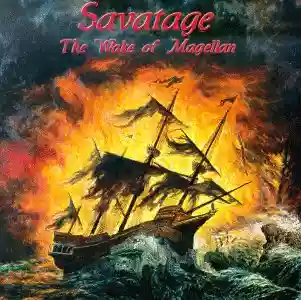
A band that, after overcoming endless contractual and personal difficulties, presents itself in 1997 with what is their eleventh studio album in 18 years of career: "The Wake Of Magellan."
Let's make one thing clear: it is the first time in a decade that Savatage remains with the same line-up as the previous album (the immense "Dead Winter Dead") and you can feel it... The album, in fact, musically continues what was experimented and expressed in the previous work, but beware... It is absolutely not a copy and does not even draw from it... Of course, there are many common points (this is also a concept album and also in this one the symphonic-orchestral parts are decisive), but our guys continue, with this work, their path of evolution and refinement, being always original and never static or resting on what they have done before. In fact, "The Wake Of Magellan" is certainly less introspective, emotional, and reflective than "Dead Winter Dead," but at the same time, by evolving the sound, it results in being more theatrical, more "pompous," more ambitiously imposing... In short, more linked to a (pre)concept of "Musical" so dear to the good old Jon Oliva (who, enthusiastically, since he saw "The Phantom of the Opera" in a theater in 1989, has always tried to enrich his music more and more with that baroque component typical of certain works).
The album sounds somewhat like a summary of everything Savatage is in 1997: connected to the past and their origins, never denied, through square-shaped and driven songs where, as usual, Jon's powerful, cutting, and rough voice (author, among other things, of all the lyrics and almost all the music along with the now omnipresent Paul O'Neil) prevails, as in the case of the heavy and 80s-style "Another Way" or the stupendous and aggressive "Blackjack Guillotine" (where actually Zak Stevens sings)... Attached (as usual) to that sweet and dreamy conception of Rock-Metal with a retro taste, so much liked by guitarist Chris Caffery and bassist Johnny Lee Middleton, as in the energetic "Turns To Me" or in the semi-ballad "Morning Sun"... Attracted by that crazy experimentalism that sometimes leads them to wander in the most disparate fields of music, like in the strange and energetic "Paragons Of Innocents," where at minute 2:40 we find an incredible Jon delighting us with a break at the borderline of the most pissed-off Rap (yes, you heard right: Rap), or in the rhythmic and "modern" "Complaint In The System"; a track where the stopped rhythm and the filtered voices chorus combine the heaviest component with an almost "industrial" attitude of "new metal" (Nu-Metal?).
But there is much more: as usual, they confirm themselves as excellent performers, capable of delivering emotions even with their incredible and dreamy instrumental pieces, dominated by the splendid solo guitar of Al Pitrelli... this is the case with "Underture" and "The Storm", unforgettable moments of enormous evocative power (especially stunning "The Storm" where the instruments, in a whirlwind of passionately crescendo notes, seem to really catapult us into the heart of the most infernal ocean storm) that masterfully connect the various final parts of the story being told.
Personally, however, I believe that the best from the recent Savatage repertoire is given to us by the most majestic, epic, and symphonic-choral parts, which the group has managed to perfect over the years... Indeed, the album gives us splendid examples of this in the first two tracks: "The Ocean" and "Welcome"; the first starts with a sound of waves crashing on a beach, immediately followed by Jon's sad piano and the entry of all the other instruments that welcome us into the melancholic and reflective story of the concept in question... The second connects immediately to the first, gifting us one of the most majestic and theatrical moments of the album in question: we are faced with the first example of what I define as "Hollywood Metal," where the pressing and epic progression gives the music an almost "cinematic" spectacularity... Nothing to do with the fantasy-epic-dragon-Hollywood metal of Rhapsody and their medieval-like company, which, however, this album anticipates by a few months.
But that's not all... At the end come what are the most elaborate, complete, and imposing tracks of "The Wake Of Magellan," those that best express the symphonic-musical component of late-millennium Savatage: the title track starts with a base of drums and bass, then progressing, building up, into increasingly engaging and "metallic" moments that, supported by piano and orchestral scores (present throughout the album), culminate in the powerful and magnificent 6-voice overlapping choirs, now characteristic of "Savatage" production. Immediately following is the sweet and passionate "Anymore" which, picking up on the melodies of some songs and using choirs that I would dare to call "angelic and dreaming", offers us one of the most heartfelt and engaging moments of the entire work.
Savatage has always accustomed us to stunning closing songs and this time too they don't disappoint us at all: "The Hourglass" is the most representative thing our guys could give us to conclude the story... We are indeed facing a track that synthesizes and re-proposes all the facets of the album: from Jon’s tormented piano to the metallic anger, from the sweet melodies that pervade the whole album to the imposing polyphonic choirs already mentioned... In one word: Perfect.
The instrumental and vocal performance of all the members is as usual excellent... There isn't a blemish or an uncertainty, everything sounds full and satisfying, showing a meticulous attention to all details. The production is perfect, never too crystalline or confused, and best renders the atmospheres evoked in the story of the concept...
Right... The concept (the third for the band) is, as usual, touching and poetic... Spines-chilling. The story told (entirely written by the usual "Paul O'Neil") magnificently combines the melancholic aspect of human reflection with news and current events which, in those years, had greatly disturbed the worldwide interest.
I will not go on too long (perhaps) in the narrative, but I would like to summarize something for you anyway.
It all revolves around the tender and sad figure of the elderly Hector Del-Fuego Magellan (a descendant of the great navigator Ferdinand) who, conversing with his only friend "The Ocean," reflects on desires, mistakes, and the values of his own life. He finds himself, with a childlike gaze, looking at the woman he could never express his feelings to ("Turns To Me"). He sadly reflects on the lost values in his life, realizing that what was important to him now no longer exists and that his choice of solitude at sea has been at the expense of his happiness ("Morning Sun"). Finding on the beach the body of a young man who died of an overdose, he asks the ocean how it is possible that people throw their own lives away for trivial reasons and with a gentle "innocence" full of lightness... The ocean then responds by telling him the story of Veronica Guerin, a journalist who sacrificed her own life fighting against the "system" and the world of drugs ("Blackjack Guillotine", "Paragons of Innocents", and "Complaint In The System"). Overwhelmed and horrified by a world he can no longer recognize, he makes the dramatic decision to go to sea in search of the storm that will end his days of pain ("Underture" and "The Wake Of Magellan"). The story of the old man intertwines, throughout the album, with the (true) story of the poor sailor Miguel embarked on a frigate under the Taiwanese flag, the Maersk Dubai, and who during his journey, witnesses helplessly the cruelty of his captain ("for a captain at sea is as close to a God on earth as you can get") towards some stowaways he doesn't hesitate to throw overboard, thus sealing their certain death... Miguel manages, in the end, to save the last of the 4 stowaways, hiding him from the eyes of his companions, and to report the incident without succeeding in condemning the captain ("Another Way" and "Anymore"). The two stories touch when the old Hector Magellan, during the storm that the friendly ocean has sent to fulfill his death wish, manages to save from the waters the third of the 4 stowaways (the last to be thrown overboard)... But Miguel will never know this ("The Storm"). Finally, the old man prays the ocean to let him return to shore and delay the moment of his death, to save the life of the shipwreck victim... His new wish is granted and Hector finds, in the end, in the innocent and kind eyes of a child he had previously encountered, the strength to continue hoping that the world can still save itself from a selfish end...
And he returns, lonely, in front of the bar on his beach to secretly watch the woman he has always loved... Maybe one day he will find the courage to talk to her...
"When the night gathers darkness
In a black and pitch cloud,
Only poets, dreams, and fools
Will sail into the storm."
Savatage offers us an incredibly convincing performance where, as usual, the combination of lyrics and musical atmospheres is exhilarating...
And you may ask: But why, after praising this album so much, does Ocram only give it 4 out of 5 stars in the album rating?
Well... Let's say it... I personally believe that this work by our most affectionate, is slightly inferior to the previous work or to their best albums, and I will explain why.
It almost seems to me that this time Savatage, in their continuous search for perfection and evolution, have slightly neglected a small detail: the purely emotional aspect and "romantic" involvement that characterized "Dead Winter Dead." Don't get me wrong... They have given us an exceptional and exciting work, with songs on the verge of absolute masterpiece, and which should be taken as an example by all those young bands who claim to play metal... But it seems (and I highlight "seems") to me that they offer us a not entirely heartfelt performance, a performance, in short, where their involvement does not totally shine through their notes and which reflects in me a semblance of "slight coldness" and "imperceptible detachment."
But this is just my opinion... The hard sentence is yours to make!
Loading comments slowly
Summary by Bot
Savatage's 1997 album The Wake of Magellan showcases their continued evolution with a blend of theatrical and symphonic metal. The concept album tells a poetic and emotional story supported by strong instrumental performances and powerful vocals. Although slightly less emotionally intimate than its predecessor, Dead Winter Dead, it remains a richly crafted and ambitious work. The album merges traditional metal with experimental elements, solidifying Savatage’s legacy in rock history.
Savatage
Savatage are an American heavy metal band formed in Florida, founded by brothers Jon and Criss Oliva. They became known for blending metal with piano, orchestration, and theatrical, concept-album storytelling, especially on releases like Gutter Ballet and Streets - A Rock Opera.17 Reviews
