
 •
Rating:
•
Rating: THE REVIEW
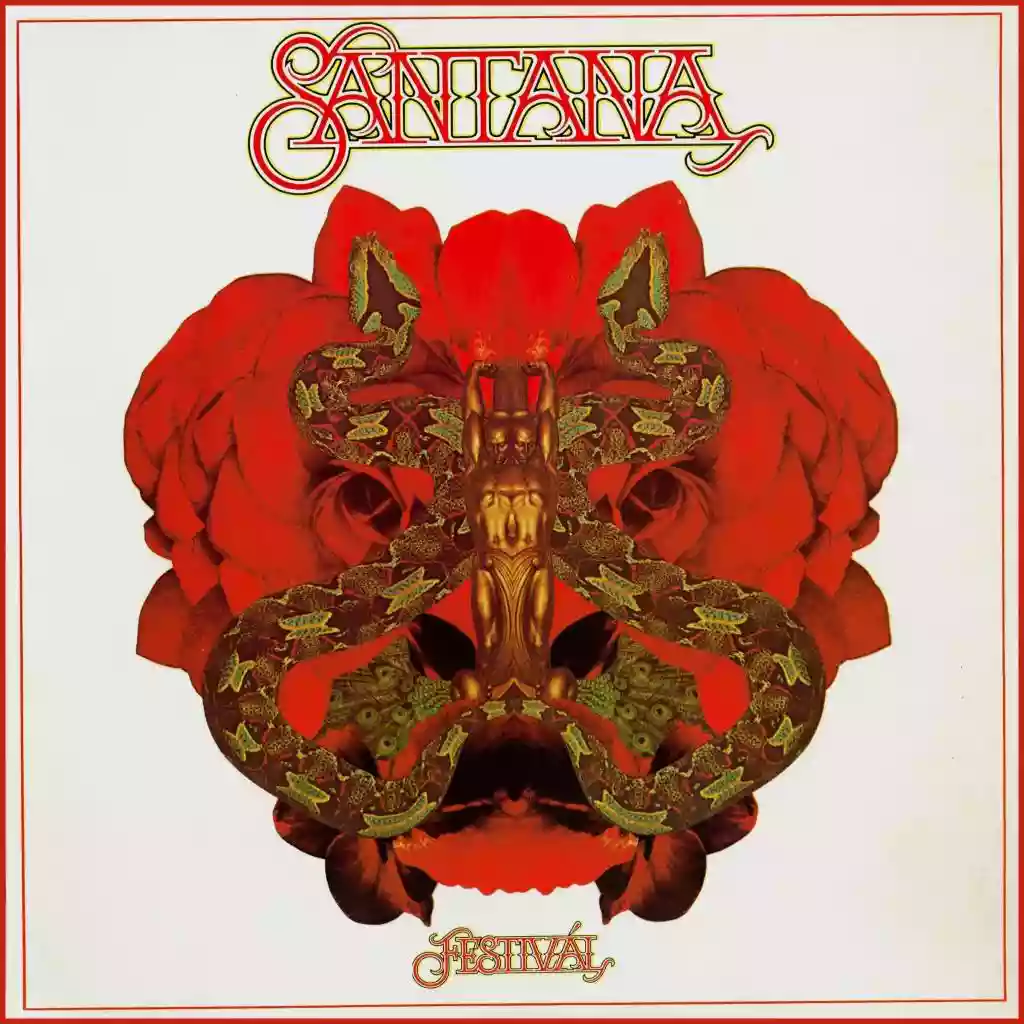
The album 'Festival' hits the stores following the planetary success of the singles 'Europa' and 'Let It Shine', which convinced Carlos Santana that he had found the definitive mood after the psycho-Latin rock origins and the jazz rock-fusion of the New Santana Band, which was promptly dismissed in search of a respectable crossover with American chart pop. 'Amigos' has just decisively rewarded the band's landing on a sophisticated and reassuring form of mainstream Latin-rock/R'n'B, marking the end of the excesses and instrumental diversions of 'Lotus' (and in some parts also of 'Borboletta') and essentially bringing everything back to the song format: no more 'atmospheric' interludes, ethnic-world percussion solos, and ambient effects, just a great freedom given to the leader's guitar in the solo parts – always full of wah-wah and sustain – and otherwise a 'soft' approach to composition, with soothing voices and funky bass.
For what will be the last album objectively worthy of the Santana name, the leader has, however, the last nostalgic (or modest, if you will) flare to resurrect and reserve the Latin-Carioca key to the album's opening and closing, and still maintain a very Latin feel in all compositions, unlike later productions, which will be clearly dedicated to a plasticized American rock that is as anonymous and annoying as it is profitable. Such a passionate and dramatic instrumental as 'Revelations' will no longer be found on a Santana record, an undisputed gem of this heterogeneous album, nor the perfect Latin-rock fusion of the early sequence 'Carnaval / Let The Children Play / Jugando', often replicated live in the years to come, nor indeed a track like 'Maria Caracoles', a minor production but indicative of the leader's tastes in this second half of the seventies.
The key to the new stylistic course (replicated only in the unpublished parts in the studio of the excellent 'Moonflower') is the keyboardist Tom Coster, a very technical romantic and quite master of the expressive possibilities of the instrument, whose defection coincides not by chance with the production of the dreadful 'Inner Secrets', the beginning of the abyss from which Santana will never recover (at least in the studio). The future 'Marathon', 'Zebop', 'Shango' and gradually up to the multimillionaire 'Supernatural', will indeed include some objectively interesting points but the bulk of the tracks will always be absolutely unworthy of such a glorious and historic band, and as far as I'm concerned, the discography can undoubtedly end with this satisfying 'Festival' and the subsequent studio/live montage of 'Moonflower', not the swan song one might have expected but two albums still honest and enjoyable.
Beyond the masterpiece 'Revelations', well-constructed on an atypical (for Santana) bolero crescendo with a highly dramatic effect, critics will note in this 'Festival' the soothing ballad 'The River' and a series of very well-played funky-Latin cues ('Reach Up', 'Let The Music Set You Free', 'Try A Little Harder') that still make the music's authorship recognizable for the last time, before collaborations with Russ Ballard and productions frankly too AOR completely zero out the typical characteristics of the Santana group (including the sumptuous percussion section). This is the last record where you can hear the legendary percussionists calling each other during solos and the whistles just before Carlos's Hendrixian starts, even if the drums begin to be buried under the slaps of the bass and the voices start to overpower the instruments.
The bootlegs of the 'Festival' tour tell of a very satisfying set, as the concert sections of 'Moonflower' testify, and especially of a long and passionate 'Revelations' that failed to re-emerge even in the subsequent compilation of unpublished works 'Viva Santana' (where there's the best version of 'Europa' ever recorded, Japan 1979). If Carlos wants to inaugurate his series of memory-lane concerts, as many have started to do after the Grateful Dead, I sincerely hope this tour will be duly considered, in addition to the exceptional snippets published on 'Moonflower'.
Loading comments slowly
Summary by Bot
Santana’s Festival album marks a pivotal moment in the band's career, embracing a sophisticated Latin-rock style with memorable solos and mainstream appeal. The review highlights the album’s fusion of Latin rhythms and melodic song structures, praising key tracks like 'Revelations' and 'Europa.' It acknowledges this record as the last truly worthy Santana album before a decline in artistic quality. The review also notes Tom Coster’s crucial contribution and the enjoyable live performances during this era.Tracklist Lyrics
Santana
Carlos Santana (born July 20, 1947) is a Mexican-born guitarist and bandleader known for blending rock and blues with Latin/Afro-Cuban rhythms. He rose to international attention around 1969 with Santana and performances associated with the Woodstock era, and later achieved massive mainstream success with the 1999 album Supernatural.23 Reviews
