
 •
Rating:
•
Rating: THE REVIEW
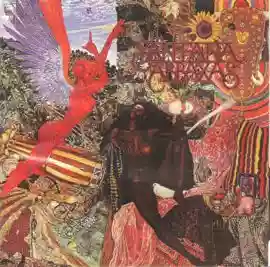
1970. While in England, prog and psychedelia are making waves, evoking sidereal atmospheres, the Mexican sprite named Santana has an intuition that is nothing short of brilliant. He combines a smoldering blues-rock, the smoky one of the sixties, with an entirely Latin and caliente sensibility, while also winking at the emerging jazz fusion: what results is a kaleidoscopic masterpiece, which after 37 years still seems fresh and evocative.
Oh yes, forget melodic abstractions, forget intellectualisms and various nonsense, Santana is a legend for his imaginative power. You can easily picture them on a bare stage, in the sweltering heat of a Central American summer, in an atmosphere as sticky as it is murky; solid, in a tank top, without any frills. Carlos's exoticism, however, is not overly exaggerated: he knows well that everything revolves around the United States, and so he does not overdo the Latin boisterousness, instead seasoning it with what the Americans of the time like, those who came back from Woodstock's orgy and love the most straightforward rock. "Abraxas" is a sequence of unforgettable tracks, the kind that are neither niche nor commercial, neither overrated nor underrated, but rather "big hits": the ones that the most politically correct and snobbish critic, in the Albion sense of the term, viscerally loves.
It's impossible to resist the unsettling jazz of Incident at Neshasbur, as well as the sensual cover of Fleetwood Mac's Black Magic Woman, one of those songs that evokes the tantalizing atmosphere of ecstasy by the seashore. In an ideal championship of "make-out music", but I would specify "make-out music", the instrumental Samba pa ti would be unbeatable: I can see it, good old Carletto, smiling pleased under his mustache, winking at the lascivious concupiscent. But "Abraxas" is not just this, it's above all a gritty and spontaneous sound, as in the two hard-rock songs of the album, "Hope you.." and "Mother's Daughters": two tracks that, despite being quite hard - I must clarify that I don't love "strong" rock - have that California West Coast atmosphere that many of today's bands try in vain to imitate.
There's so much to say, but it seems clear to me that Santana's lineup was a breath of fresh air in the early seventies, even anticipating some styles of world music (now so overused: record stores are full of those lounge-ambient-ethno compilations and whatnot). A record of great depth, filled with guitar and organ textures: yes, precisely that Hammond Organ that recalls the good old days.
What saddens me is that Santana, after a fiery debut and a prestigious career, has in recent years become the "regiment's whore," selling out to various trendy singers of the moment, even going through the revived Steven Tyler. By banalizing his inimitable style, many young people discover a banal and schematic Santana, far from the seventies' esotericism of great artistic caliber.
Loading comments slowly
Summary by Bot
Santana's 1970 album Abraxas is celebrated as a brilliant fusion of blues-rock, Latin rhythms, and jazz fusion. The album balances artistic depth with accessible 'big hits,' showcasing memorable tracks like 'Black Magic Woman' and 'Samba pa ti.' Praised for its spontaneous and gritty sound, Abraxas remains an influential record decades after release. The reviewer laments Santana's later commercial decline but maintains the album's status as a timeless masterpiece.Tracklist Lyrics Videos
Santana
Carlos Santana (born July 20, 1947) is a Mexican-born guitarist and bandleader known for blending rock and blues with Latin/Afro-Cuban rhythms. He rose to international attention around 1969 with Santana and performances associated with the Woodstock era, and later achieved massive mainstream success with the 1999 album Supernatural.23 Reviews
Other reviews
By MadWorld
An incredible mix of sounds, dreamy atmospheres, and Latin rhythms gives this record a particular charm.
The track every guitarist should know. The track every person should know!
