
 •
Rating:
•
Rating:
THE REVIEW
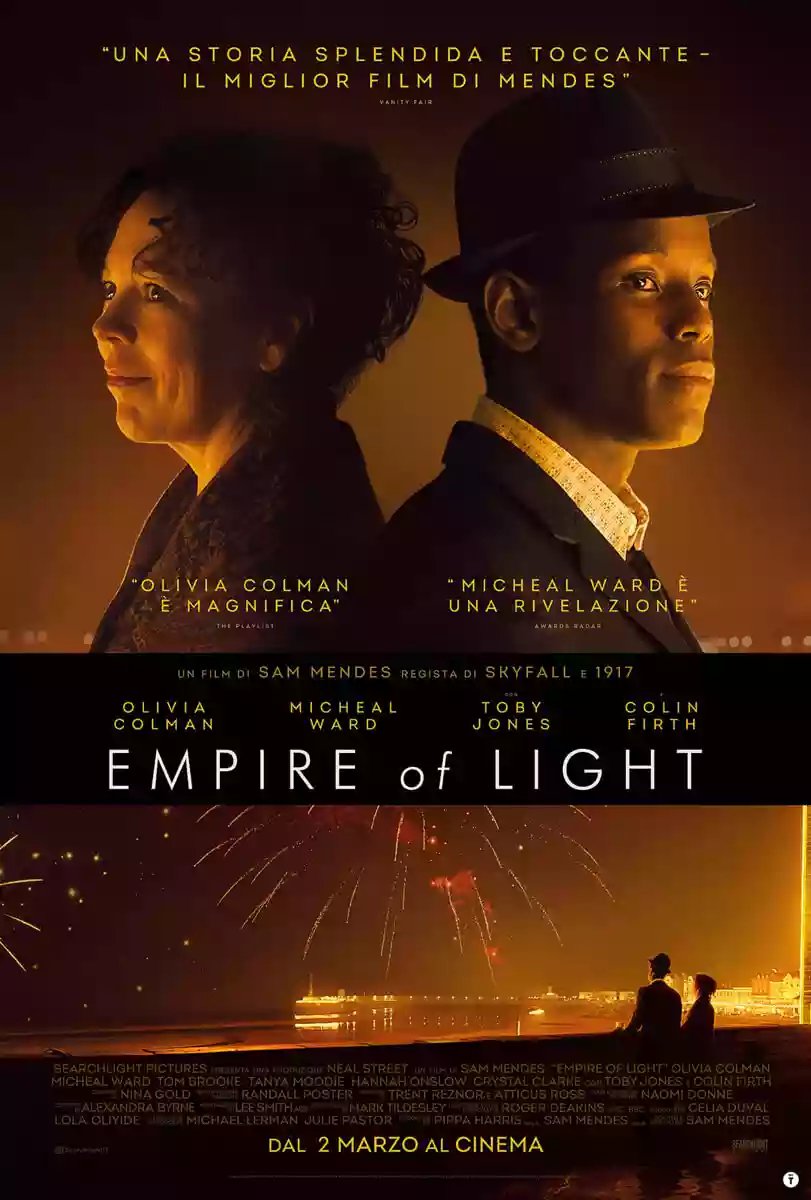
Now accustomed to "big" films, if not gigantic, bigger than life (regarding duration primarily, but also in budget and immeasurable ambitions), or works of enormous and unsustainable emotional scope, watching Empire of Light almost gives you the sensation of a film as light as air. A film of grace. Although its themes are actually very dramatic and complex, like depression, racism, and feelings. Yet Mendes' skill as a storyteller makes this work surprisingly and positively airy, ultimately absolutely positive despite the various travails of the two main protagonists. An emotional and sincere film, even poetic, which tells nothing new but does not fall into the derivative, not even in its homage to cinema, in a period where homages to cinema pop out of the damn walls.
Cinema for Mendes is escape and refuge, through light; the projection, the illusion of movement that is the illusion of life itself. An alternative life. Something that can be consoling but always of immense help. Refuge from loneliness - as well as from amorous disappointments - as in Allen and Chazelle, or a safe haven, in any case, compared to the ugliness of the external world, of society, and existence.
Life is a state of mind, Hal Ashby told us in his masterpiece Being There. And Mendes reiterates it to us, through a wonderful direct quote from the same film with Peter Sellers, who at the end walked on water, he who lived as if in a dimension suspended from his surrounding world. In an ensemble of naivety and unawareness, which was mistaken for wisdom making him fascinating and attractive to the female eye. In reality, Chance the gardener was endowed with the purity of someone who does not grasp every aspect of his reality, and therefore lives lightly, on the waters, indeed. And it's as if this same new film by Mendes walked on the waters, leaving finally a great sweetness and tenderness and a thread of emotion, like a movement of trust in humanity and life despite everything.
Empire of Light is a small bittersweet film about love between two outcasts and about rebirth, a film that in a certain sense embraces the lesson on the circularity of nature. In which everything dies to be reborn, yet not giving up the signs of such a process.
Even if, perhaps, and unfortunately, certain ugliness, hypocrisies, and difficulties will always be part of the various complexities of the world, there will always be something to finally smile about. Cinema, with the emotion and magic of the big screen it brings with it, is one of these things. And it will be forever, at least as long as this magic remains preserved within that Temple which is the Theater. With the lights off and the real world - but ultimately, and we always return to Morpheus's key question, what is "real?" - which for a while disappears.
Needless to say, Olivia Colman is extraordinary as always. And seeing a work filmed, brushed, painted by that immense artist Roger Deakins is every time a joy for the eyes. After Revolutionary Road - unattainable -, Empire of Light is the Mendes film I loved the most. Thanks to Mendes's great narrative skill, which perhaps may not make him an "author," but without a doubt, he knows what cinema is.
Loading comments slowly
Summary by Bot
Empire of Light by Sam Mendes is a subtle yet deeply emotional film addressing heavy themes like depression and racism while remaining hopeful. The storytelling feels light and poetic, celebrating cinema as a refuge. Olivia Colman's outstanding performance and Roger Deakins' cinematography enhance the film's beauty. The movie explores love, rebirth, and the enduring magic of the big screen.
Sam Mendes
Sam Mendes is a British film and theatre director whose feature debut American Beauty (1999) launched a major film career spanning dramas and large-scale productions, including Bond films Skyfall and Spectre and the World War I film 1917.11 Reviews
