
 •
Rating:
•
Rating:
THE REVIEW
Sam Cooke dies on December 11, 1964.
That night, Sam is in a seedy motel, with him is a young woman met who knows where; Sam rents a room by the hour, and the two retreat there.
In the middle of the night, the motel manager hears a young woman screaming, cries for help; she is convinced it is the one accompanying the handsome young man who entered a few moments before; and she does not hesitate to call the police to intervene.
Sam senses this and rushes out of the room; he attacks the woman on the phone and hits her repeatedly; she staggers, is in a panic, and almost unconsciously, grabs the gun under the counter and fires; two, three, four shots hit the mark.
Thus Sam Cooke dies, in a December 1964 night, in a seedy motel, where he rented a room by the hour for an occasional sexual encounter, which degenerated into an attempted rape against a young woman met who knows where.
This is the official reconstruction.
Few believe it, because a rapist and a murderer cannot hide behind that voice and that smile.
The greatest singer in the world cannot die that way, as Cassius Clay defined him a few days earlier during the press conference following the match with Sonny Liston; the greatest singer in the world cannot die that way, at whose funeral an anguished Ray Charles sings “Angels Keep Watching Over Me.”
Few believe the official reconstruction, and inevitably, the conspiracy theory takes shape: Sam Cooke was killed by the CIA and the FBI.
Sam Cooke frequents boxer Cassius Clay; Cassius is converted to Islam and calls himself Muhammad Ali, he is a draft resister and refuses to go fight in Vietnam, to sacrifice himself to preserve the Land of the Free and the Home of the Brave.
Sam Cooke is close to Reverend Martin Luther King and radical militant Malcolm X; the struggle for black rights, Selma, the assassination of King and that of Malcolm X.
“That son of a bitch is brave and getting braver”: that son of a bitch is getting bolder.
Sam moves from a small record company to RCA and then founds his own record company. He wants to move beyond “Everybody Loves To Cha Cha Cha” and “(What A) Wonderful World” and composes “A Change Is Gonna Come.” Times are changing, Bob Dylan is aware of it, but the echo of Bob’s voice and guitar doesn’t reach Harlem; only a brother can speak to other brothers.
The brothers see in Sam an intuition of awareness, and the possibility of redemption and affirmation unfolds before their eyes: those sons of bitches are getting bolder.
The single “Shake b/w A Change Is Gonna Come” is released posthumously, because Sam Cooke dies shot on a December 1964 night.
I don’t believe the story went the way Bertha Franklin, the manager of a motel where rooms are rented by the hour for occasional sexual encounters and away from prying eyes, recounts.
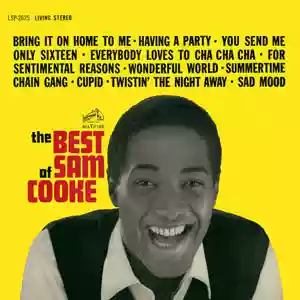
I don’t believe it because many years ago — long before I became aware of the story of Sam Cooke’s death — I bought this anthology and I know for sure that a voice like Sam’s and a smile like his do not hide a rapist or a murderer.
Does a best of dedicated to Sam Cooke make sense comprising only twelve songs, and among these twelve “A Change Is Gonna Come” is not featured? Does it make sense to encapsulate Sam Cooke’s artistic story in not even thirty minutes?
For me, who know Sam Cooke through the Animals and Van Morrison who interpret “Bring It On Home To Me,” the sense is the wonder.
The wonder is that of “You Send Me,” “Only Sixteen,” “Everybody Loves To Cha Cha Cha,” “(What A) Wonderful World,” “Chain Gang,” “Cupid,” “Twistin’ The Night Away,” “Sad Mood,” “Having A Party,” and “Bring It On Home To Me.”
But also that of reading under each single title, in parentheses, always the same surname of the author (Cooke): these songs lay the foundation of pop, more than the Beatles have done, and it’s all from his sack.
And finally, the wonder of having bought one of the best records I have ever listened to many years ago.
Sam Cooke dies on a December 1964 night.
I don’t know if he died from a temporary loss of sanity, his or whoever pulled the trigger, or from a conspiracy. I do know, however, that if it ever dies, music dies the day Sam Cooke dies.
Loading comments slowly
Summary by Bot
This review reflects on the tragic death of Sam Cooke and the lasting impact of his music. It questions the official account of his demise, highlighting his role in civil rights activism and his pioneering contributions to soul and pop music. The review also critiques the brevity of the compilation album but celebrates the enduring power of Cooke's voice and songs.Tracklist Lyrics
Sam Cooke
Sam Cooke (1931–1964) was an American singer, songwriter, and entrepreneur hailed as the King of Soul. He began with the gospel group the Soul Stirrers before crossing into pop and R&B, scoring hits such as You Send Me, Chain Gang, Cupid, Wonderful World, Bring It On Home to Me, and Twistin’ the Night Away. He co‑founded SAR Records and wrote A Change Is Gonna Come, an enduring civil‑rights anthem.04 Reviews
