
 •
Rating:
•
Rating:
THE REVIEW
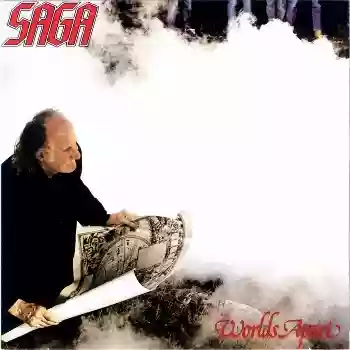
With their fourth album, Saga gives a strong jolt to their career, helped by their record label that sends them to record in England, putting them in the hands of an up-and-coming producer full of ideas: Rupert Hine. He, a musician even before being a sound engineer, identifies the weak points of the Canadian quintet’s charming musical proposal, first and foremost the singing of Michael Sadler, rudely invited by the producer to "grow a pair" and to "stop singing like a backup singer," while arrangements are made to relieve him of as many keyboard duties as possible... "you are not an instrumentalist who also sings, you are the frontman!" Sadler will forever treasure Hine’s urging.
The producer gives the band more freedom than ever to indulge in those remarkable interplays between guitar and keyboards, constituting both the basic riffs and the acrobatic instrumental breaks of the pieces, recognizing them as a distinctive element and an absolute strength of their offer. However, he almost vetoes synthesizer solos, so markedly progressive, so segregating towards a noble but niche musical taste.
The highly talented guitar player Ian Chricton is advised to permanently set aside the warm, woody, and muffled sounds of the Gibson Les Paul, of absolute historical pedigree, but not very suitable for the fiery and intricate style of the musician, to turn instead to the more metallic, defined, and analytical sounds of six strings like the Fender Stratocaster. Chricton reveals superior adaptability on these, furthermore, the fretboard allows more ease toward favored high notes while the vibrato arm, a missing accessory on the Les Paul, proves to be an indispensable expressive enrichment, true enhancement to the unpredictability and showmanship so instinctively under the little musician’s fingers.
Bass and synthetic drums finally (the infamous Simmons, a true must of those eighties) accompany the traditional instruments, inevitably adding a breath and pop accessibility to the ensemble. From all this emerges the same old Saga, but more sparkling, more powerful, more gritty, more alluring. The songwriting and instrumental ideas were already remarkable from the start, but now they manage to find an optimal, incisive, well-produced form. The result is that for a good portion of Saga fans, we are in the presence of a masterpiece in their career, unsurpassed and unsurpassable in nearly thirty record releases.
It opens with an awesome track, "On the Loose": the usual fast arpeggio of keyboardist Jim Gilmour, serving as a sequence under the verses, is broader and more rhythmic and brilliant than ever. Jim Chricton's bass (Ian's brother) powerfully travels inside Steve Negus's drum, and finally, the rhythmic drive is optimal: Saga had never lacked melody, but now there’s also a “punch.” The good Sadler starts singing with an attitude never heard before, especially concerning a new, unprecedented irony and joy, where past relaxed and contemplative tones make way for emphasis, adrenaline, in a word, rock'n'roll. The instrumental break is also exhilarating, with that cat Ian Chricton managing to compete in agility with his keyboardist as they weave heart-stopping thirty-second notes, wrapping around each other’s unison plays and high school harmonizations before giving free rein to the singing again, towards the final fading.
But the most successful track at the time, once released as a single, is the third "Wind Him Up". It has a structure quite similar to "On The Loose", but the thuds of the Simmons, preferred on this occasion over traditional drums, give it a more pop and "modern" aura (especially for the times), capable of attracting a certain share of (also) club-going fringes. Sadler shines, attacking the song with all the passion he’s capable of: chronicles recount that he was even sent by the producer to sing on the roof of the country cottage hosting the recording studio to... draw joy, enthusiasm, and energy from the scenery and fresh air of the place, thus removing any remains of timidity from his performance.
The two episodes described above are interspersed in the lineup by a high-class ballad, titled "Time’s Up", featuring the synthetic strokes of the Simmons and the subdued keyboard layers opposed to the earthy showmanship of the lead guitar and the ironic, playful interpretation of the frontman: a little gem.
The other slower-tempo track instead draws on the more progressive and "European" side of the group’s inspiration, "No Regrets" can be considered therefore less commercial and more niche... but it's wonderful! Gilmour debuts on vocals and his youthful voice, bordering on naïve, heartfelt and fresh though technically not strong, is perfect for establishing a gentle and dreamy aura, like a medieval fairy tale. Furthermore, the long final coda of the piece is stunning, with the young keyboardist taking up the clarinet, one of the protagonists along with the piano of his childhood formative studies. The fairy-tale reed vibrations, subjected to a cathedral of reverbs, surrounded by the piano chimes and gradually immersed in an ocean of keyboards, are pure bliss for those who possess the enzyme of romance and melancholy: in short, sweet and classy progressive 100%, inlaid in an album that tries to detach from it as much as possible, but cannot episodically not follow such happy inspiration to the end.
The rest of the album offers effective moments (except for the instrumental "Conversations", which is truly a filler) even if not so thrilling. Special mention for "Framed", which starts without infamy or praise by Saga standards, but shifts to the next level as a long, superb, engaging guitar solo imposes itself, becoming ever more sinuous and dramatic and making one wish it would never end.
"Worlds Apart" brings Saga out of the corner and positions them as a great international promise in the rock field, as they are the creators of a peculiar style that keeps a foot in several doors and can thus be approached by listeners with very different tastes: one can come to them loving progressive, or pop, or instrumental virtuosity, or rather tough yet melodic rock... They will indeed manage to do (in my opinion) even better than this handful of songs, but unfortunately (or perhaps fortunately for us?) they will never break on a large scale: indeed, this album remains the most well-known and sold in their noble catalog.
Loading comments slowly
Summary by Bot
Saga's fourth album, Worlds Apart, marks a pivotal moment with producer Rupert Hine's influence sharpening their sound, emphasizing frontman Michael Sadler's vocals and instrument interplay. The album balances progressive rock complexity with accessible pop elements, highlighted by standout tracks like 'On the Loose' and 'Wind Him Up.' It is considered a masterpiece by many fans and solidified Saga's international presence in rock.Tracklist Lyrics Videos
Saga
Saga are a Canadian rock band known (in these reviews) for a keyboard-driven sound balancing progressive flair with melodic AOR/hard rock, plus a long discography and a reputation as a cult/underrated act outside their strongest markets.22 Reviews
