
 •
Rating:
•
Rating:
THE REVIEW
...Amarcord: in 1981 the Rush cyclone really invaded the world. The fascinating heavy-progressive architectures of the devilish Canadians had been revealed in a stunning succession of albums (from 2112 to Moving Pictures, let's say), in a stylistic growth that went more or less from Led Zeppelin to Yes (no less!), supported by those technical skills that made them win polls in specialized magazines around the world and by an exciting and very personal imaginary. No sign of fatigue for Rush from '74 to '81, ready to take the place of the 'dinosaurs' of hard rock and classic prog (who indeed had quite a few problems) in the hearts of music maniacs; and the proverbial difficulty for vinyl dealers in classifying the band, well, I've always understood it as a great acknowledgment of stylistic variety and compositional synthesis ability.
'Exit... Stage Left' is their second double live album and the best record ever made by the boys from Toronto, and I'm categorical about that. We will learn over the years that the 'four in the studio / one live' cadence (maintained by the power trio throughout the XIX century) is both a celebration and a closure of an artistic period awaiting a new mutation, so 'Stage Left' celebrates and closes the most properly hard/prog/AOR period, the one of greatest success (three excellent singles in the charts, incidentally) and millions of copies sold of four genius albums suitable for airplay but absolutely not commercial. Marrying the majestic constructions of 'Xanadu' (Coleridge, no less) with the deceptive immediacy of 'Spirit Of Radio' is not for everyone, also because the interplay of odd times and explosive breaks of this latter track is truly astonishing, especially for a track that went to number one in the charts. It took exceptional compositional skills and instrumental techniques, capable of lightening stuff worthy of 'Heart Of The Sunrise' for use and enjoyment of rockers around the world, and the fruits are exactly in this superb live album.
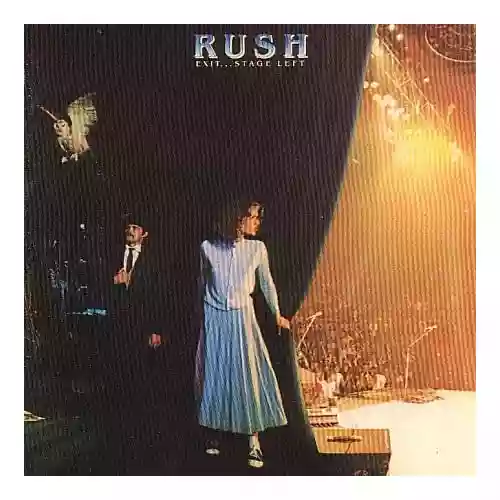
Recorded mainly in Glasgow and Montreal, the album is wrapped in the usual fanciful cover, full of misleading symbols and messages for the initiates. The tracklist is absolutely breathless, starting right from the hit 'Spirit Of Radio' and continuing through electrifying versions of the best tracks from the 1977-81 repertoire (and a dive back to 1975). The three are perpetually soloing, or almost: Lifeson's guitar is captivating (at the time he used a semi-acoustic live for greater resonance, and it's worth studying his bizarre and intricate fingerings), while Peart's drums are confirmed at the highest peaks in the rock field, full of rototoms and offbeats with the addition of a glockenspiel, stuff comparable only to Carl Palmer. Geddy Lee is the one who should enjoy himself the least: singing at those unattainable levels (in fact, he won't reach them again) while simultaneously playing a thundering and omnipresent bass, keyboards and pedals in turn, and in one track even the electric guitar, brings him closer than anyone else to a sort of Otto and Barnelli of rock, and being a rock star with that nose and still being likable... period. In 1981 Rush was the university of hard rock, listen, take notes, and do lots of homework, otherwise, nisba.
The peaks of a stunning set are the instrumental 'YYZ' (which would later become the code for Toronto's Pearson Airport), enriched by a famous and unsurpassable drum solo; the epic 'Xanadu'; the biblical 'Jacob's Ladder', and above all the mysterious and dreamlike final 'Villa Strangiato', which Rush described as 'an exercise in self-indulgence' and encapsulates in nine pressing minutes, rendered on stage in a better and more compelling way than in the studio, really all the technique and imagination possible. (A track that in '78 the trio tried more than 40 times, before mastering its execution for recording purposes, and which they play here with perfect nonchalance, indeed having fun and shouting imperceptible pleasantries from one side of the stage to the other). The audience obviously also enjoys the hits, and the beautiful 'Tom Sawyer' and the very popular 'Closer To The Heart' (ah, Ayn Rand's writings!) cannot be missing in a set in which the guitarist also offers a beautiful classic acoustic unreleased in the opening of the classic 'The Trees'.
Left out of the album (a gold record within a few months) were a remarkable version of '2112 Overture', in the medley version with 'By-Tor And The Snow Dog', as well as 'Camera Eye' and the opening 'Limelight', but you can't have everything in life, I guess. (Why not? I advocate for a reissue with bonus tracks).
None of us really makes the text, of course, but in a genre discotheque 'Exit... Stage Left' should not be missing for any reason. Sure, if you're annoyed by those who compose amazing stuff and sing and play awesomely, you can abstain, naturally. The alternative to total knowledge and subsequent veneration of this ten-and-praise album is the complete discography of Leone di Lernia, I guess. Your call.
Loading comments slowly
Summary by Bot
This review praises Rush's 1981 live double album "Exit... Stage Left" as their finest work, capturing the peak of their hard/prog/AOR style. It highlights the band's technical mastery, iconic tracks like "Spirit of Radio" and "YYZ," and the superb live energy. The album is seen as both a celebration and closing of an artistic era. Detailed attention is given to the musicians' skills and the album's lasting influence on rock enthusiasts.Tracklist Lyrics Videos
Rush
Canadian trio formed in 1968, best known for blending progressive rock and hard rock across a multi-decade career; core lineup credited in reviews: Geddy Lee, Alex Lifeson, Neil Peart.46 Reviews
Other reviews
By Ambassador
In this performance of "YYZ", lies all the greatness of Rush: the ability to engage the audience by perfectly blending different styles.
Lifeson’s solo halfway through La Villa Strangiato is indescribable in words: an incredibly emotional crescendo, to be listened to with closed eyes, freeing the mind.
