
 •
Rating:
•
Rating:
THE REVIEW
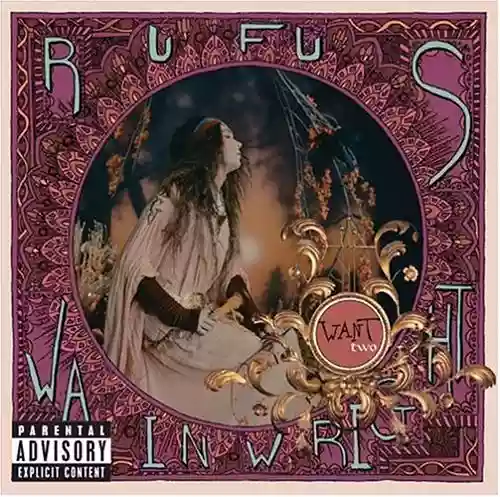
In November 2004, after three perfect albums, the talented Canadian singer-songwriter Rufus Wainwright releases "Want Two," a sort of "second act" to the previous work "Want One".
It may seem less cohesive and with fewer sparks of genius than the previous work, but the album undoubtedly presents itself as yet another series of great songs masterfully arranged.
In the devastated world of pop, where the most talented either dive into electronics or old blues and folk canons, it's nice to have a songwriter who cannot be categorized, with a timeless melodic vein, capable of mixing styles from every era, constructing arrangements so perfect and rich while remaining airy and original.
Let's get to the album.
"Agnus Dei" appears as a strange Overture, a hybrid where Eastern and Western sounds are mixed, as if it were a Gregorian chant sung in a mosque (an almost blasphemous impression), following an intriguing melodic line that then veers into operatic grandeur.
After the dreamlike enchantment of "Agnus Dei" one wakes up to the melodic mastery of "The One You Love", a highly effective pop, a rhythmically and charmingly catchy easy listening in a minor key arranged with meticulous precision, followed by "Peaches Trees", a melancholic and delicate bossa nova, and "Little Sister", a tune complete with 18th-century orchestration worthy of a Rossini of the 2000s.
A misstep compared to "Want One" could be the live pairing "The Art Teacher" - "Hometown Waltz" (an elongated melody the first, and an elegant waltz the second). Even if I don't understand this need to include live novelties, the result is good, and they probably deserved a studio recording.
After the brief live parenthesis, here comes "This Love Affair", a spectacular Lieder incredibly intense, among the highest points of the album.
I am aware that the review becomes cloying in describing each track, but I cannot fail to mention the other great pieces on the record, from "Gay Messiah" an acoustic ballad focused on personal themes, "Memphis Skyline", a passionate song of yesteryear for piano and orchestra, "Waiting For a Dream", a dreamlike track with more modern sounds, and "Crumb by Crumb", a more playful chamber pop.
The album closes with "Old Whore's Diet", the most interesting track. An intriguing melody is obsessively repeated for 9 minutes as if it were a mantra; the introduction is bare, but soon it is enveloped by an Arabic rhythm resulting from a special alchemy where a string quartet, powerful dreamlike choruses (highlighting sister Martha), and the voice of Antony Hegarty (you know Antony and the Johnsons?), whose timbre seems to come from another astral plane, all find their place. This pop rhapsody is fittingly concluded by a choral phantasmagoria to the rhythm of a march.
"Old Whore's Diet" is the emblem of modern apathetic decadence, where depression or loneliness leads the individual to eat at indecent hours, perhaps with leftover Chinese food from two days before; the "old whore's diet" becomes the emblem of this state of mind.
The entire album is dominated by the monotonous yet intense and powerful voice of Rufus Wainwright, who outlines these wide-breath melodies in superb arrangements. Each track is a small work of art, and in melodic pop, it's like dealing with rare tropical flowers on the brink of extinction.
Just like Rufus's first three albums, this record is unmissable.
Rating 8.5/10
Loading comments slowly
Summary by Bot
Rufus Wainwright's Want Two is a sophisticated follow-up to Want One, featuring rich arrangements and a timeless blend of genres. Despite some less cohesive moments, it offers emotional and melodic depth. Notable tracks like "This Love Affair" and "Old Whore's Diet" showcase his originality and vocal intensity. The album solidifies Wainwright's standing as a unique pop artist with rare musical craftsmanship.Tracklist Lyrics Videos
Rufus Wainwright
Rufus Wainwright is a Canadian-American singer-songwriter and composer known for ornate, baroque-pop songwriting and a distinctive tenor. Acclaimed for albums like Poses, Want One and Want Two, he has also composed operas, including Prima Donna and Hadrian.06 Reviews
