 •
Rating:
•
Rating:
THE REVIEW
"... In Dreams I Talk To You ..." (In Dreams - 1963)
Last night I dreamed of Roy Orbison.
We were alone in a room, and he was standing still, silently.
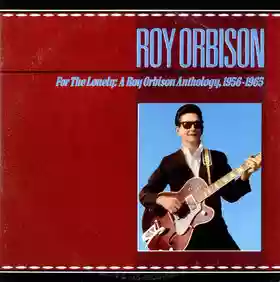
He was wearing a black suit and his trademark sunglasses.
I stared at him incredulously, without the courage to speak.
"White " he said to me suddenly, breaking the silence.
"Roy ...... How are you?"
"Fine, thank you. Listen, I wanted to ask you a favor"
"A favor? Certainly, if I can..."
"In your area, on Earth, there's a place where reviews are published.
I think it's called Database or something like that..."
"Ah yes, DeBaser..."
"Yes, I think that's the name.
Well, on that site, I accidentally read a review about me that I didn't like at all. I don't relate to it. Could you write one to set things right?"
"Certainly, but I'm not sure if I'm up to the task. If you could help me out..."
"A hand?"
"Yes. Maybe by telling me something. For example, do you want me to talk about the golden period of the '50s/'60s, the comeback towards the end of the '80s with Mystery Girl or the Traveling Wilburys?"
"I'd prefer you talk about the early period, let's say up to the mid-sixties. Take a compilation, for example, the one from Rhino Records seems perfect..."
"Alright"
"Shall we begin?"
"Well, what did you play at the start and how did you get to Phillips' Sun?"
"Well, in Texas, where I was born, I played Country, and, imagine, in 1954 I gave a composition of mine to my friend Buddy Holly, a fellow Texan.
That's how the next year, with my group, the Teen Kings, I went to Petty's studio, Buddy's producer, to record a track I had just composed, Ooby Dooby. Unfortunately, however, the record didn't achieve any success."
"That's when Sam Phillips noticed you"
"Of course. It was the spring of 1956, and Elvis had signed with RCA, so Phillips was on the hunt for new talents to launch. In reality, I wanted to sing ballads.
You know, Rockabilly wasn't my forte, but I accepted Sam's guidance because he seemed to have a clear vision. Actually, he definitely had it.
He was a dynamic guy, wanted everything to be fast, energetic, but I wasn't Presley. So I tried to go along with him, follow his directions. But sometimes I got discouraged and would say to him < Mr. Sam, I want to sing ballads> but he would smile and keep going his own way. Initially, events seemed to prove him right. Ooby Dooby in 1957 was a moderate success and... how? Ah yes, it's Tom Fogerty reminding me of the Creedence cover..."
"Certainly, that one from Cosmo's Factory"
"I was talking about the success with Sun.
However, apart from Ooby Dooby, the other singles like Rockhouse failed to break through, maybe because I wasn't giving the right interpretation to the songs, but, as I've said before, Rockabilly wasn't really my genre."
"When did you leave Sun?"
"In 1958 after writing Claudette, a song made famous by the Everly Brothers.
I moved to Nashville to record my long-desired ballads.
Initially, I wasn't lucky, but then finally, in 1960, I climbed the charts with Only The Lonely. That was the true start of my career. Blue Angel, Crying, Running Scared, In Dreams, Dream Baby were all Top Ten hits between 1960 and 1963 both in America and England."
"What do you think was the reason for your success?"
"Well, maybe the atmosphere of the songs.
For example, Only The Lonely begins with a Doo Woop chorus almost whispered, which is then broken by my powerful, almost operatic voice, creating a significant emotional impact.
My arrangements were rich in sound, while other songs, in comparison, seemed really bare.
In essence, I think my style was original, and the often sad and melancholic texts suited the melodic progressions perfectly.
You know, even my concerts were unusual.
I would stand still on stage, with sunglasses on. A slender figure, dressed in black that would suddenly erupt in a dramatic and intense voice.
So everyone would be left speechless..."
"You also met the Beatles during that period"
"Of course it was during the England Tour of 1963. They looked at me as if I were an alien. I came on first, and they stood behind the curtain listening to me, full of fear They would say..."
"Yes, then the story of Please, Please Me ..."
"Yes, I heard about it. They were inspired by my progressions. You know: Come On, Come On ... Please, Please Me Oh Yeah ... Right guys?
John and George are here next to me, nodding and smiling...
Years later, even Springsteen would show his admiration and mention me in Thunder Road "
"And then the classic Oh Pretty Woman"
"Yes, from 1964. A great hit that was later used many years later in that film ..."
"The one with Richard Gere and Julia Roberts from 1990"
"Yes, that one...
I'm really proud of Oh Pretty Woman, I believe it's a true classic.
Well, I think that's enough since I have to leave you.
Remember, the review"
"Don't worry, Roy, it will be done"
"Thank you, goodbye"
"Goodbye Roy. R.I.P."
Loading comments slowly
Summary by Bot
This imaginative review presents a dreamlike conversation with Roy Orbison, focusing on his early career from 1956 to 1965. It emphasizes his unique ballad style, his initial challenges with rockabilly, and his breakthrough with hits like ‘Only The Lonely’ and ‘Oh Pretty Woman.’ The review captures Orbison’s lasting impact and the emotional depth of his music.Tracklist Lyrics
Roy Orbison
American singer-songwriter from Texas known for an operatic voice, dramatic ballads, and a black-clad, sunglasses-on stage persona. Rose from Sun Records to early-’60s hits like Only the Lonely, Crying, In Dreams, and Oh, Pretty Woman; revived his career in the late ’80s with the Traveling Wilburys and Mystery Girl. Died in 1988.03 Reviews
