
 •
Rating:
•
Rating:
THE REVIEW
I compensate for the shameful lack of reviews on the great Roxy Music with this one of mine on "Country Life" from '74.
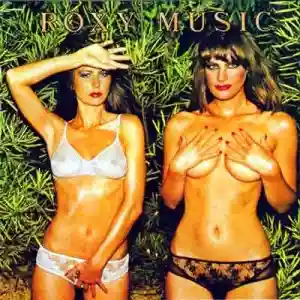
First of all, the cover, considered one of the most obscene in rock and variously censored, which continues the glorious series of pin-ups: after the vintage erotica of "Roxy Music", the animal-fetish of "For your Pleasure", the exotic-Latin of "Stranded", the idea here is a shabby and sexually ambiguous version (but is the model on the right really a woman?) of the glossy covers (depicting scenes of country life of the British upper class) of the exclusive magazine "Country Life" of which Ferry was an avid reader.
But, not by coincidence, the most "explicit" cover also reflects a dirtier and harder sound compared to the romantic excellence of "Stranded" and marks a passage for the Roxy that has always reminded me a bit of the Stones' transition from "Let it Bleed" to "Sticky Fingers", another scandalous cover (and incidentally, here there is also a peculiar blues, complete with harmonica played by Ferry: "If It Takes All Night").
The manifesto here is "The Thrill Of It All", the group's new call to arms: "The time has come. It's getting late, It's now or never, Don't hesitate or stall, When I call, Don't spoil, The thrill of it all". The pounding rhythm of "hitter" Thompson, the dense guitar texture of Manzanera, the violin of Jobson and the bass of Gustafson (along with MacKay's baritone), saturating the high and low registers, make it one of the group's classics.
"All I Want Is You", "Casanova" and "Out Of the Blue" are the other uptempo tracks: the latter is my favorite with a slowly dissolving intro from anthology and a remarkable electric violin solo by Jobson, finally in the spotlight as he was in Curved Air. The contrast between the initial gloomy atmosphere and the optimistic refrain ("Then: out of the blue, Love came rushing in, Out of the sky, Came the sun, Out of left field, Came a lucky day, Out of the blue, No more pain") preceded by an excellent bass run is exciting. Another classic even in live performances.
Elsewhere reemerges the romantic vein of Stranded: the nostalgic "Three And Nine" is, for example, the new "Just Like You", while "Bitter-sweet" is the new "Song For Europe": instead of French Chanson, Ferry and MacKay revive the German cabaret; instead of the romance gramelot, we find here German passages, courtesy of the translation done for Ferry by the two German models on the cover (one of whom, incidentally, is the sister of Michael Karoli from Can). And the love for the Weimar era will find complete realization in the Hitler-Youth outfit Ferry will display during the 75-76 tour, anticipating by a year the controversies sparked by Bowie with Heroes.
Towards the end, the tracks become a bit weaker but the stylistic variety is high: the most striking contrast is felt between the spiritual "Triptich" (with oboe and harpsichord) and the cynical "Casanova" ("Now you're nothing, But second hand, In glove, With second rate now, Now you're flirting, With heroin, Or is it cocaine? Casanova, Is that your name, Or do you live there?") where, as throughout the album, Phil Manzanera's sumptuous guitar reigns supreme. In short, variety of styles and "sick" atmospheres which, in Roxy's catalog, make "Country Life" somewhat the rock counterpart to the paradisiacal Synth-Pop of "Avalon".
The concluding "Praire Rose", although not exceptional, is an important song because it heralds (along with the opening of "The Thrill Of It All") the band's imminent flirtation with Disco music. Moreover, it is an ode to the beautiful Texan Jerry Hall, Ferry's new flame, who would soon appear, like a languid siren, on the cover of the group's next album.
Loading comments slowly
Summary by Bot
This detailed review praises Roxy Music's 1974 album 'Country Life' for its audacious cover art and its shift towards a harder, bluesy rock sound. It highlights key tracks like 'The Thrill of It All' and 'Out of the Blue,' emphasizing the band's rich instrumental textures and stylistic variety. The album is noted for blending romantic and cynical themes and foreshadowing the band’s flirtation with disco. Despite some weaker late tracks, it remains a classic showing Roxy Music's evolving artistic identity.Tracklist Lyrics Videos
Roxy Music
Roxy Music are an English rock band formed in 1970, fronted by Bryan Ferry, known for blending glam-era style with art-rock experimentation and later shifting toward sleek, sophisticated pop.14 Reviews
