
 •
Rating:
•
Rating:
THE REVIEW
The Rosenstolz; I've already talked about them in general, especially about how this (at the time) lively and original duo was born, and to that end, I refer you here, to their debut dated 1992. In the meantime, I've had the chance to delve deeper and evaluate more thoroughly their entire artistic journey, discovering (with much disappointment) that after "Die Schlampen Sind Mude" in 1997, the first album released for a major label (Polydor), AnNa and Peter completely gentrified, gradually losing all the creativity and brilliance that made them unique. First, a flat and standardized synth/pop-rock, then gradually more and more saccharine, reaching the limits of unlistenability and finally their breakup, late but providential, dated 2012. But this is not what I want to talk about; rather, it's about how beautiful, engaging, and histrionic these two were in their prime period, that lustre that began in 1992 and indeed concluded in 1997.
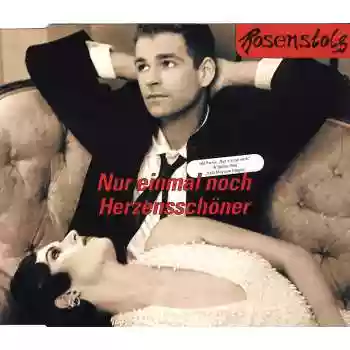
In that period, they published five albums, "Nur Einmal Noch" from '94 is the second, the best of Peter Plate and Andrea Neuenhofen alias AnNa R's entire career, and not just that, I'd say one of my favorite pop/camp albums of all time. At the time, they were truly a force of nature, a case in point? The ballads, precisely those ballads which over time became their downfall; after the fateful 1997 and especially after 2006, they produced them in droves, ad nauseam, but never even remotely at the level of "Kuss Der Diebe", "Lebend Erwacht" and "Viel Zu Kalt (Februar)", songs of great impact and theatricality, that draw heavily from the symphonic-romantic Central European tradition with a slight Queen-ish touch in the supporting electric guitars, perfectly enhancing AnNa R's powerful and charismatic vocals, another feature that would later be sacrificed on the altar of so-called mainstream. And even without this bombastic orchestration (wisely limited to just three episodes, but really well done) the other slow tracks work very well too, the poignant "Kleiner Prinz", semi-acoustic, and "Strahlende Nachte", rich in synth-cabaret suggestions.
Ah, but Rosenstolz wasn't just about ballads, on the contrary, they were a real burst of life, color, and fun, proven by "Nur Einmal Noch", their first (small) hit after their first album went almost completely unnoticed. Here we find an AnNa R half opera singer from a dubious Berlin venue and half Nina Hagen, an almost glam sound, very direct and catchy, a real show in short, of which this is only the first act. With "Es Tut Mir Leid", "Greta Hilf Mir" and "Die Dame Von Der Akademie", they dive fully into a musical-vaudeville vein, showcasing their excellent entertainer qualities and drawing inspiration (naturally in a slightly more brash and cheeky way) from the great Hildegard Knef, to whom they would soon pay tribute. Finally, "Cocktailparty" and the dazzling synth-orchestral gallop "Nymphoman" add an extra touch of spice to the mix, between unrestrained fun, bottles of champagne, and lustful visions; the Scissor Sisters of their first two albums would have gone to any lengths for a couple of such tracks, suggestive, extremely danceable, and with that extra touch of "flamboyance".
In all this multicolored flurry, the good Peter Plate manages to carve out his own space as a singer with "Die Zigarette Danach", the album's least immediate track and perhaps a bit out of context, but very suggestive and surprising: a very fluid and measured electronic base, almost bluesy guitar phrasing, and a low-register, whispering, elegant crooner-like vocal, a very subdued mood that nonetheless manages to scratch with a convincing final crescendo; very beautiful, but the definitive touch of class remains the concluding "Fur Dich Mich Dreh", in my opinion the most beautiful song ever written by Rosenstolz. A languid sax, piano, orchestrations, and AnNa R's versatile and powerful vocals, splendid chanteuse as never before; impact and theatricality but also a retro and melancholic elegance, recalling black-and-white scenarios, but with vivid passion, an absolutely evocative and perfect song, an authentic masterpiece, crowning their best album as best it could. Peter was a volcano of ideas, AnNa the perfect "medium" to implement them with maximum effectiveness, and they would remain so for a few more years, after "Nur Einmal Noch" came the intermediate "Mittwoch Ist Er Fallig", then "Objekt Der Begierde", almost at this same level, and finally the eagerly awaited arrival in the mainstream with the still appreciable "Die Schlampen Sind Mude" but what followed was only decline, and, precisely for what was expressed in these early albums, it was a real disappointment. Peter Plate pursued a solo career, also talked about this, an entirely different world, levels not at all comparable to these but he's still got it, and seems to have found his own new dimension, much better than that of the last Rosenstolz, a glorious name that deserves to remain tied to its first, beautiful years of life.
Loading comments slowly
Summary by Bot
This review praises Rosenstolz's 1994 album 'Nur Einmal Noch' as the duo's finest work, highlighting its theatrical pop style and impactful ballads. The reviewer contrasts the album's creativity and vibrancy with the later commercial decline after 1997. Emphasis is placed on the duo’s powerful vocals, strong composition, and unique blend of glam, vaudeville, and symphonic-romantic elements. The album is applauded as a classic of 90s German pop, showcasing the best of Peter Plate and AnNa's collaboration.Tracklist Lyrics
Rosenstolz
Rosenstolz was a German pop duo formed by AnNa R (Andrea Neuenhofen) and Peter Plate, noted for theatrical, synth-influenced pop and strong ballads; active from the early 1990s until their 2012 split.02 Reviews
