
 •
Rating:
•
Rating:
THE REVIEW
The Eighties represented for many popular artists of the Sixties and Seventies a true "point of no return," also and especially due to the explosion of genres, even very different from one another, such as Punk, Iron Maiden and company’s Heavy Metal, Disco Music, Pop, and New Wave, just to mention the most fashionable genres at the time.
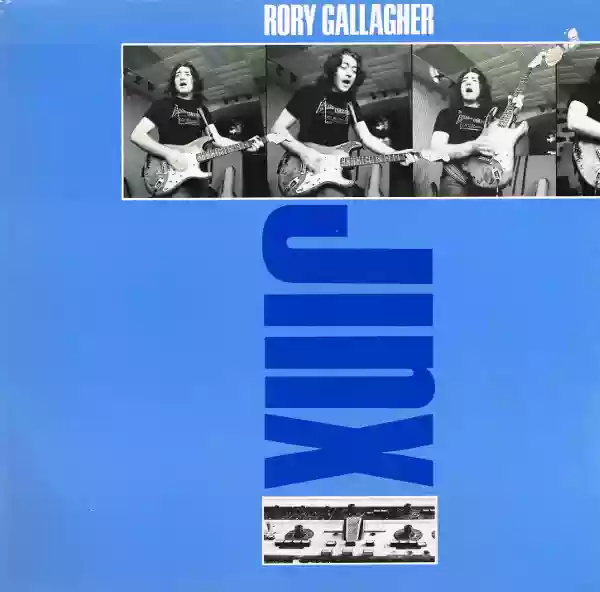
The career of Rory Gallagher is no exception: after the Hard Rock period of the second half of the Seventies, concluded with "Stage Struck" in 1980, the versatile Irishman embarked on a difficult period in which his problems with alcoholism began to emerge more and more evidently. Nevertheless, his musical production, faithful to his Rock/Blues creed, continued with another excellent album released in Germany in 1982, along with the indispensable Gerry McAvoy on bass, Brendan O'Neill stepping in for Ted McKenna on drums, and with the support of Bob Andrews on keyboards and Dick Perry (ex-Pink Floyd) on sax with Ray Beavis. This album bears the unequivocal name of Jinx.
This is an unequivocal title (translated from English as "spell" or "curse," "jinx"), because it is from here that the excellent Rory begins to question his life as an authentic anti-Star of Rock and on his personal problems which he sublimates, especially, in two masterful Rock/Blues ballads that probably form the core of the album: "Easy Come, Easy Go" and "Jinxed."
The first highlights the artist's all-too-underrated vocal and songwriting skills, as seen from some of the lyrics (translated by the excellent Fabio Rossi):
"From easy victories and easy defeats, now you are no longer so carefree. [...] / "It used to be easy to win, easy to lose, lately, you only hear sad notes. [...] / "Closed within yourself, you must come out immediately. Come on, try again, and you'll hear a different melody."
The second is another fabulous Rock/Blues composition where another sorrowful tale of Rory’s condition unfolds, perpetually searching for himself amid failed loves and various mishaps, like some sort of "evil eye" (that is, the famous Jinx), a kind of "shadow cone" from which he cannot escape.
In the same vein seems to be “Signals”, another excellent Rock/Blues performance, while the space for Hard Rock tinged with Rock 'N' Roll is dedicated to tracks like "The Devil Made Me Do It," dedicated to Buddy Holly and Eddie Cochrane, two of the Rock 'N' Roll idols loved by Rory, "Big Guns" with some sounds that, especially in the riffs, seem to wink at the melodic lines even of the "Sex Pistols," and the muscular "Bourbon," where his (often excessive) passion for good old whiskey (or in American English bourbon, indeed) emerges.
With "Double Vision," the use of the famous "slide guitar" returns forcefully, here played in the style of Muddy Waters (another undisputed idol of the Irish artist), as does in "Ride On Red, Ride On," a track actually written by bluesman Iverson Minter known as Louisiana Red with a blatantly anti-racist background.
"Loose Talk," a track in which Rory not-so-implicitly criticizes the manipulation process of artists present in a certain record label, closes in a very worthy manner another excellent album where Rory shows even more the desire to make real music and, above all, "played" music, defying the modernity of the time represented by "plastic music" or worse still by easy listening which he consistently avoided in his life like the plague.
Loading comments slowly
Summary by Bot
Rory Gallagher's 1982 album Jinx captures a difficult period in his life while delivering raw and authentic Rock/Blues music. Highlighting personal struggles and heartfelt songwriting, the album features memorable ballads like 'Easy Come, Easy Go' and 'Jinxed.' Despite shifting musical trends of the 1980s, Gallagher stayed true to his roots, blending influences from Muddy Waters and paying tribute to Rock 'N' Roll idols. Jinx is a testament to his passion for genuine, heartfelt music.Tracklist Lyrics Videos
Rory Gallagher
Rory Gallagher (also known as William Rory Gallagher) was an Irish guitarist, singer-songwriter and multi-instrumentalist associated with blues-rock and hard rock. He played in the band Taste before launching a solo career in the early 1970s and became especially celebrated for powerful live performances and a stripped-down, effects-light electric guitar approach.16 Reviews
